Table Of Content
Table Of Content
Choosing between an 8-port and a 16-port industrial Ethernet switch looks like a simple capacity decision. In practice, it is an architecture decision. The wrong choice can leave a system with no room for redundant uplinks, insufficient PoE headroom, an overloaded aggregation link, or an enclosure that is larger and hotter than necessary.
After two decades working around Pro AV connectivity and networked systems, I have learned that port count should never be treated as a shopping specification. It should be treated as part of system design. This is especially true as industrial automation and Pro AV increasingly share the same technologies: Ethernet, fiber uplinks, PoE, multicast, VLANs, remote management, and AV over IP.
So, when is an 8-port industrial switch the better engineering choice, and when does a 16-port model make more sense? The answer begins with the topology, not the number printed on the front panel.
Count Connections, Not Just Devices
A common mistake is to count only end devices: four cameras, two PLCs, one HMI, therefore seven ports. That leaves almost no architectural margin.
A realistic port plan should include endpoints, copper or fiber uplinks, redundant network paths, service or commissioning connections, and planned expansion. In a Pro AV system, endpoints may include AV over IP encoders and decoders, Dante or AES67 devices, PTZ cameras, control processors, touch panels, digital signage players, or KVM endpoints. In an industrial system, the same switch may connect PLCs, remote I/O, machine vision cameras, sensors, HMIs, and edge computers.
A useful planning rule is: Required ports = active endpoints + uplinks + redundancy + infrastructure + growth reserve. That formula often changes an apparent 8-port requirement into a 16-port requirement.
When an 8-Port Switch Is the Better Choice
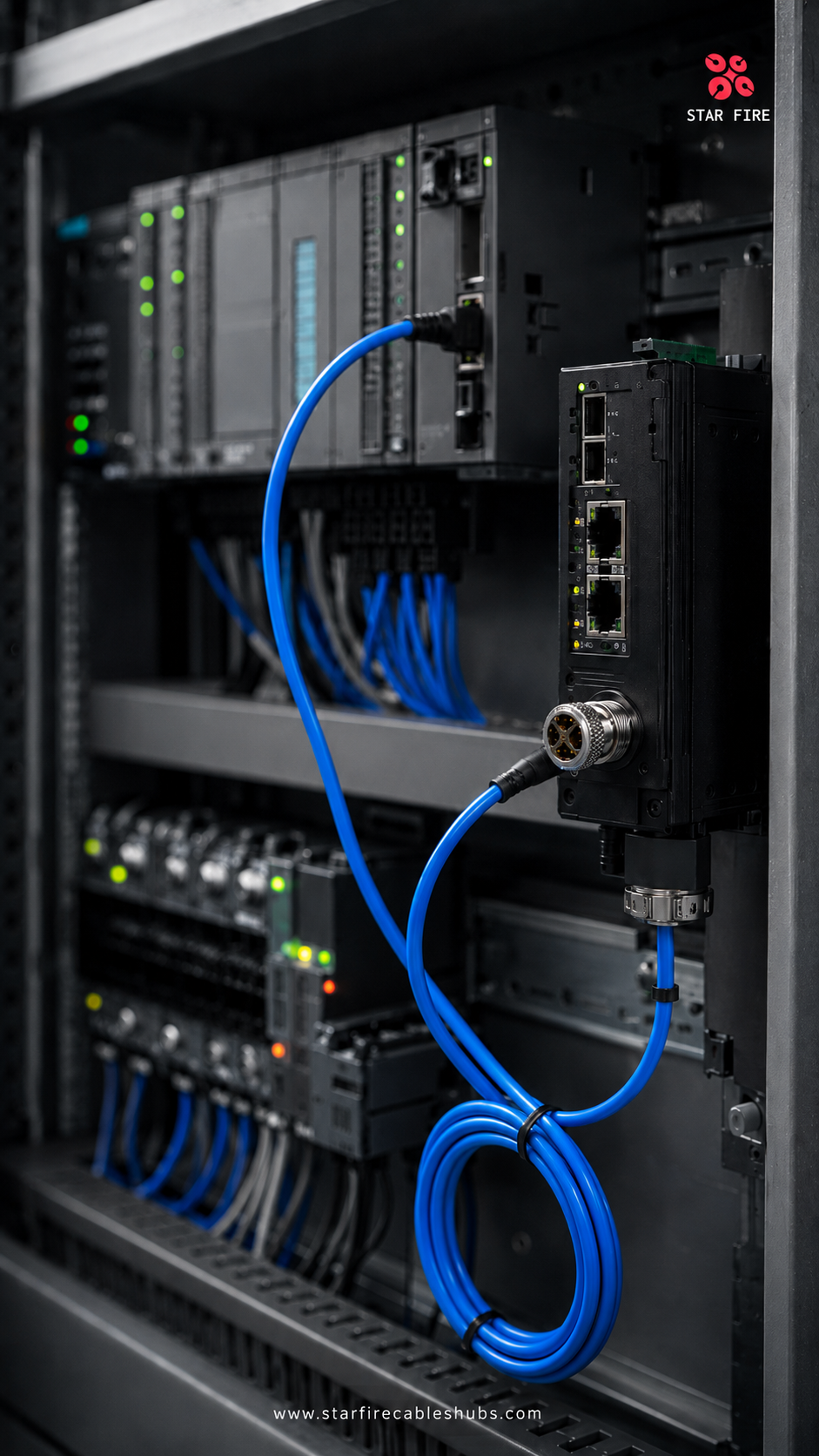
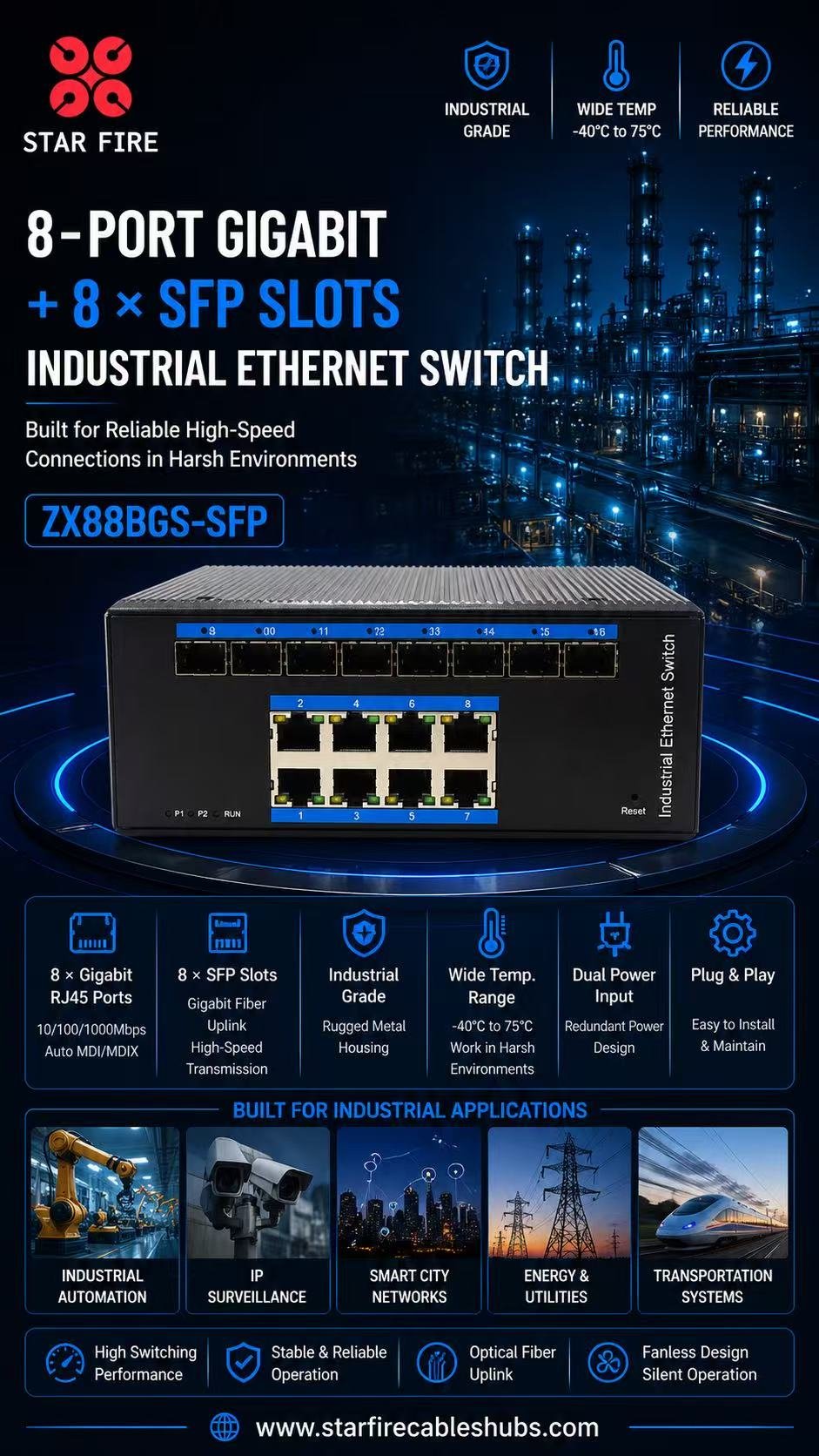
An 8-port industrial Ethernet switch is often ideal at the network edge. It fits compact control cabinets, machine cells, roadside enclosures, small AV racks, remote camera locations, and distributed automation nodes where only a limited number of devices need local connectivity.
The smaller form factor can reduce DIN-rail space, power consumption, heat generation, and installed cost. It can also encourage a more distributed topology: several small edge switches connected by fiber rather than one large copper-centered switch. That can be valuable where equipment is physically dispersed or electromagnetic interference makes long copper runs undesirable.
For Pro AV, an 8-port managed switch can be an efficient choice for a small Dante system, a meeting room, a localized AV over IP zone, a PTZ camera cluster, or a control-room edge segment – provided the switching features and uplink capacity match the traffic profile.
When 16 Ports Become the Safer Engineering Decision
A 16-port switch becomes attractive when device density is higher, when the switch acts as an aggregation point, or when future expansion is likely. The extra ports are not simply spare sockets; they are design flexibility.
Consider a production cell with eight current endpoints. Add two fiber uplinks, one redundant path, one engineering laptop connection, and 20 to 25 percent growth capacity. An 8-port switch is already undersized before the system is commissioned.
The same logic applies to Pro AV. A rack with six AV over IP endpoints may later add networked audio, control, PTZ cameras, monitoring, or secondary uplinks. Replacing a switch after commissioning is usually more disruptive than selecting modest headroom at the design stage.
Port Count Is Meaningless Without Uplink Capacity
More access ports do not automatically mean more usable network capacity. A 16-port Gigabit switch feeding all traffic through a single 1GbE uplink can create a very different system from a 16-port switch with dual 10GbE SFP+ uplinks.
This matters in AV over IP and machine vision, where several high-bandwidth streams can converge at once. Multicast management with IGMP snooping can prevent unnecessary flooding, but it does not create bandwidth that does not exist. Designers should examine endpoint data rates, traffic direction, multicast behavior, oversubscription, switching capacity, and the bandwidth between access and aggregation layers.
In many applications, I would choose an 8-port switch with the right fiber uplinks over a 16-port switch with inadequate uplink architecture. Port density and backbone capacity must be designed together.
PoE Can Change the Answer Completely
If the switch powers PTZ cameras, wireless access points, AV encoders or decoders, touch panels, intercoms, IP speakers, or industrial cameras, the PoE power budget becomes as important as the port count.
A switch may have 16 PoE-capable ports without having enough total power to run 16 maximum-load devices simultaneously. The engineer should verify the IEEE PoE class required by each powered device, the switch's total PoE budget, startup and peak consumption, ambient temperature, cable conditions, and the available DC input power in the cabinet.
This creates an important design distinction: sometimes an 8-port high-power PoE switch is technically stronger for the application than a 16-port model with a lower total power budget. Always separate 'number of PoE ports' from 'usable PoE system capacity.'
Managed Features Matter More as the Network Grows
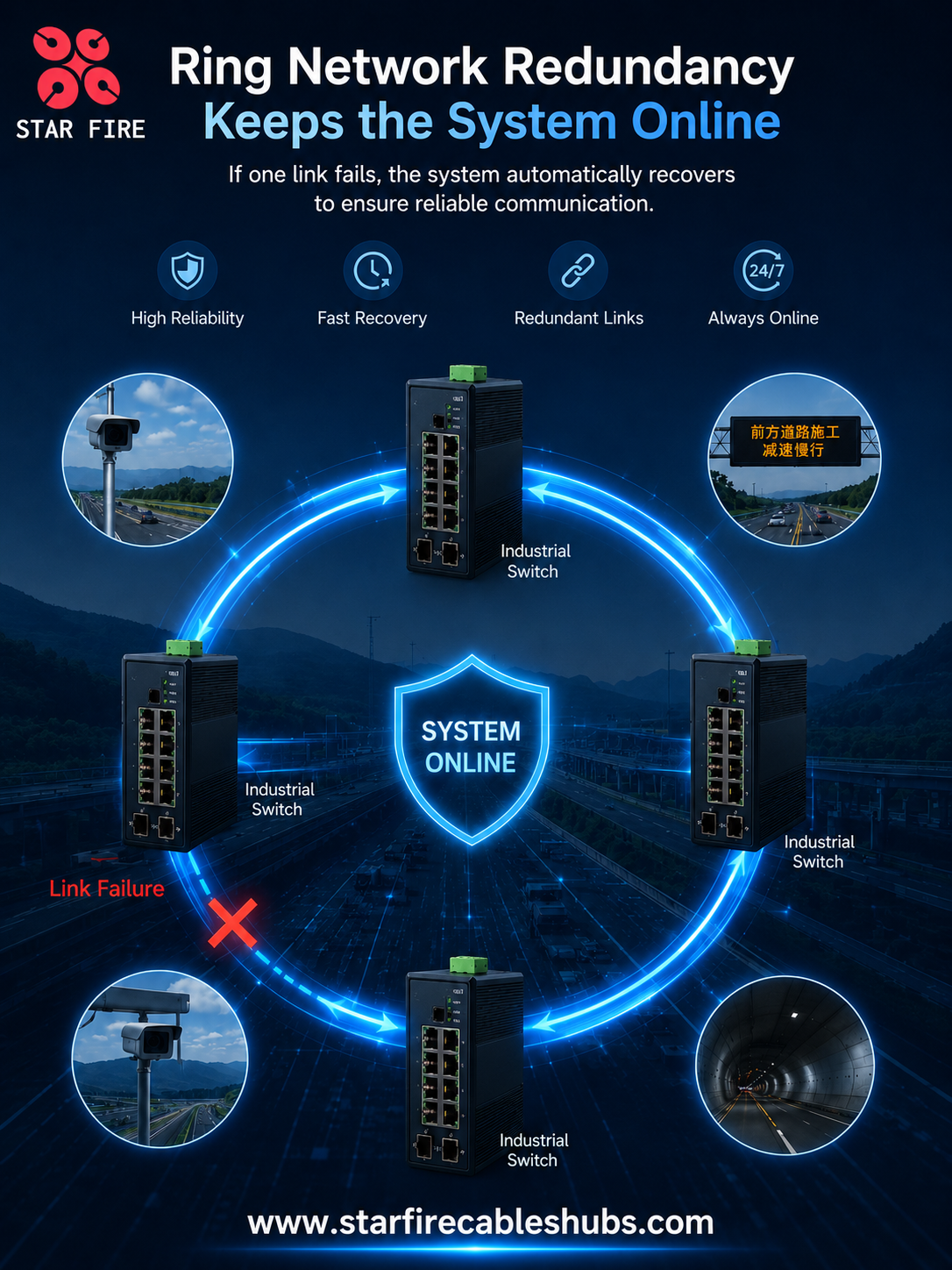
As port density and traffic diversity increase, management capability becomes more valuable. VLANs can separate control, AV, camera, and service traffic. QoS can protect time-sensitive traffic. IGMP snooping and an appropriate IGMP querier can control multicast behavior. RSTP, MRP, ERPS, or other redundancy mechanisms can reduce the impact of a link failure depending on the application and protocol ecosystem.
Remote diagnostics also matter. SNMP, port statistics, SFP diagnostics, event logs, LLDP, port mirroring, and topology visibility can reduce troubleshooting time. A 16-port switch serving as a local aggregation point usually has a stronger case for management than a simple four-device edge node.
For Pro AV integrators working with Dante, AES67, NDI, SDVoE, networked control, or other AV over IP platforms, switch selection should therefore consider traffic behavior and management functions – not only RJ45 quantity.
Industrial Design Still Matters
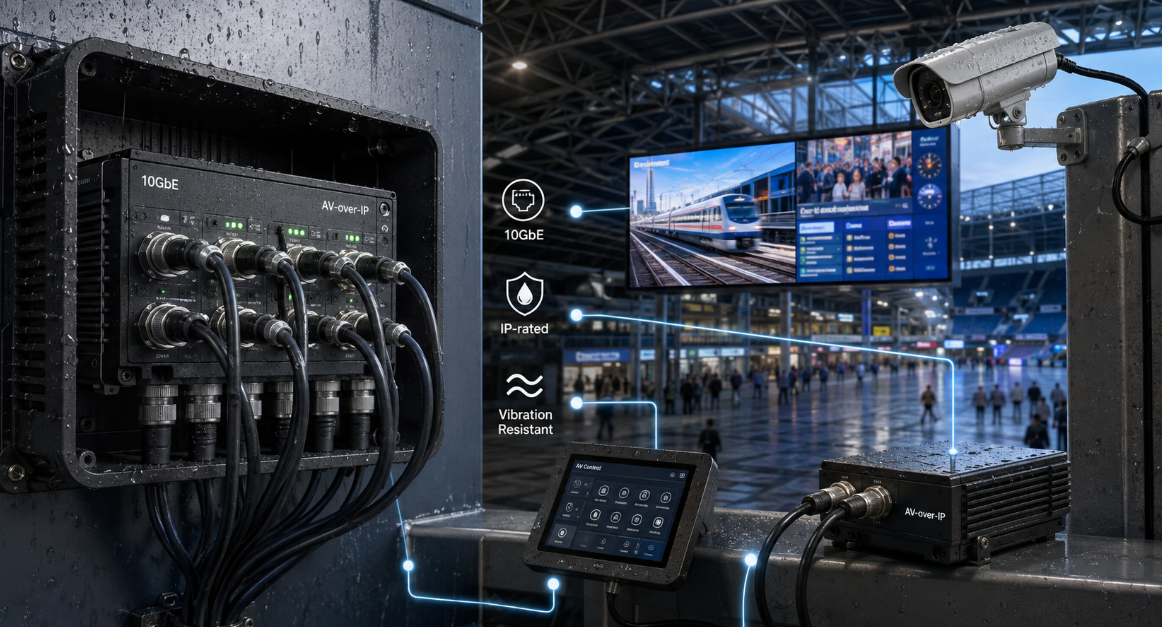
An industrial switch should be selected for the environment in which it will operate. Temperature range, fanless thermal design, vibration resistance, redundant DC inputs, surge and ESD protection, enclosure construction, grounding, DIN-rail installation, and fiber options can be more important than adding eight extra ports.
In a climate-controlled AV rack, acoustics and rack integration may dominate. In a factory cabinet, transportation system, utility installation, or outdoor enclosure, temperature and electrical resilience can dominate. The correct product is the one that fits both the network architecture and the physical environment.
A Practical 8-Port vs. 16-Port Decision Framework
Choose an 8-port industrial Ethernet switch when the node is clearly an edge location, device count is stable, cabinet space is tight, distributed fiber architecture is preferred, and enough ports remain after uplinks and reserve capacity are included.
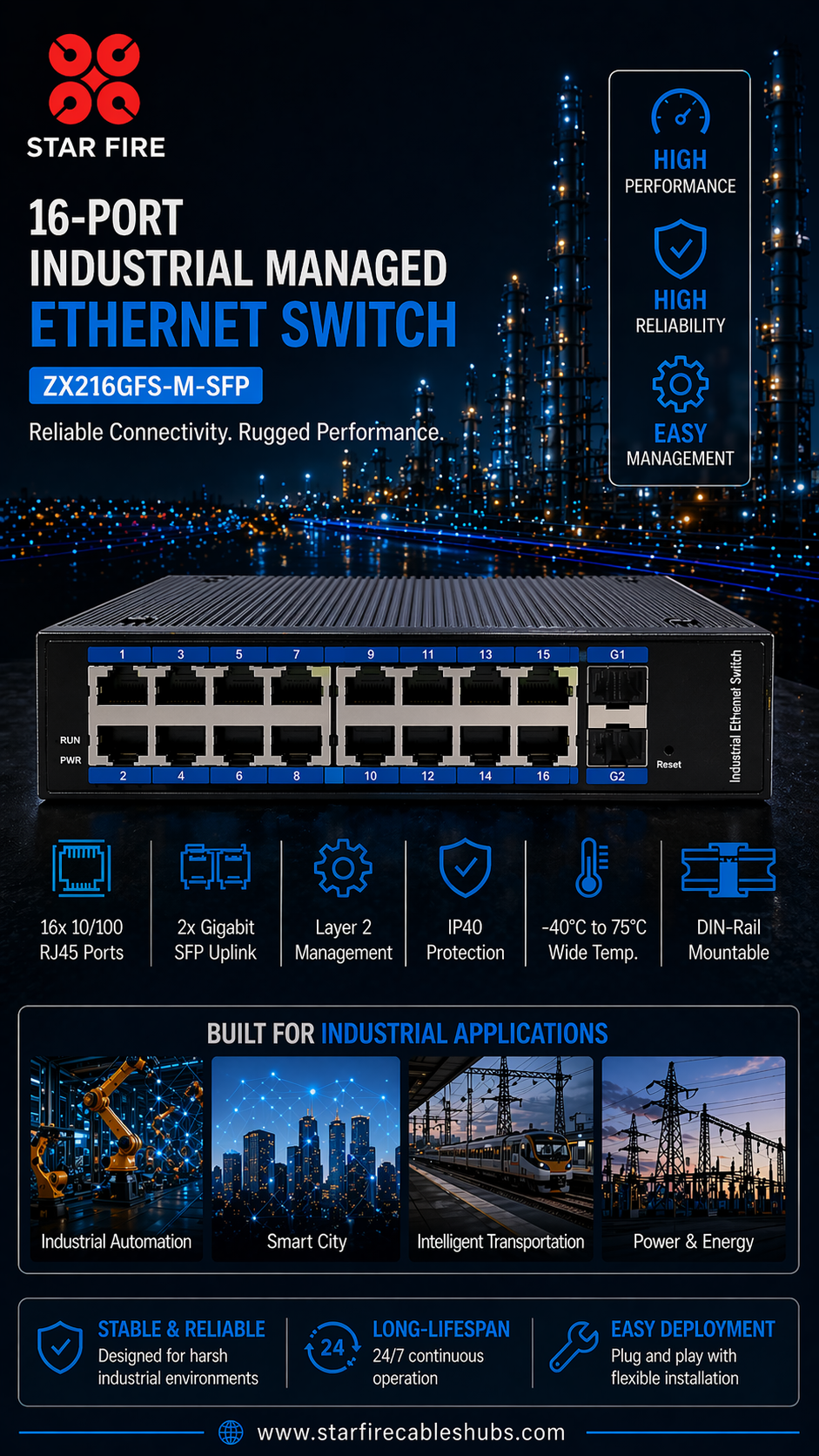
Choose a 16-port industrial Ethernet switch when the node aggregates several device groups, additional endpoints are likely, redundant uplinks are required, multiple PoE devices share the switch, or replacing the switch later would be operationally expensive.
Before final selection, ask five questions: How many ports will be occupied on day one? How many are required for uplinks and redundancy? What will the network look like in three years? Is the PoE budget sufficient at worst-case load? Can the uplinks carry the aggregate traffic without creating a bottleneck?
Conclusion: Design for the Network You Will Operate
The real question is not whether 8 ports or 16 ports are better. It is which architecture creates the most reliable, maintainable, and scalable system with the least unnecessary complexity.
An 8-port switch can be the more sophisticated choice when it supports a well-designed distributed edge architecture. A 16-port switch can be the lower-risk choice when it preserves expansion capacity and reduces future redesign. Neither should be chosen by port count alone.
At STAR FIRE TECH, our work across Pro AV connectivity, optical fiber communication, structured cabling, and industrial communication gives us a practical view of the entire signal path – from copper and fiber interconnects to managed industrial Ethernet infrastructure. For system integrators and equipment manufacturers, the goal is not to install the biggest switch. It is to build a network that remains predictable as the system grows.
That is the principle worth remembering: buy ports for the architecture, not for today's device count.