Table Of Content
Table Of Content
In professional AV, HDMI cable selection becomes more difficult as distance increases. A cable that works perfectly between a laptop and a nearby display may behave very differently when the same signal must travel 10, 20, 50, or 100 meters through a ceiling, rack, control room, digital signage system, or medical imaging environment.
The first mistake is to treat distance as the only variable. The better question is: what signal must be transported, at what bandwidth, under what installation conditions, and with what reliability margin? HDMI does not define one universal maximum cable length. Performance depends on bandwidth, construction, active electronics, source and display behavior, EMI, and installation quality.
Start with bandwidth, not the 4K or 8K label
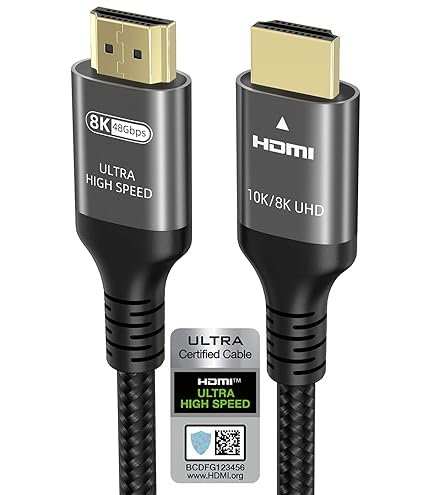
A “4K” or “8K” label is not enough to engineer a reliable link. 4K60, 4K120, HDR, color depth, chroma sampling, eARC, and HDCP can place very different demands on the connection. Ultra High Speed HDMI Cable supports system configurations up to 48 Gbps, while HDMI 2.2 introduces the Ultra96 HDMI Cable for systems requiring up to 96 Gbps.
For a Pro AV project, define the real operating mode first. The closer the application runs to the link's bandwidth limit, the smaller the signal margin becomes and the more important cable design and validation become.
Around 10 meters: copper can work, but verify it
Ten meters is a transition zone. For moderate-bandwidth HDMI, a well-designed passive copper cable can still be practical. For demanding 4K HDR, 4K120, 8K, or full-bandwidth 48 Gbps operation, however, 10 meters should not automatically be treated as an easy copper run.
Long copper cables often require larger conductors and stronger shielding, which increases diameter, weight, bend resistance, and pulling difficulty. Active copper or HDMI AOC may be the better choice when routing space is limited or signal margin is tight. If passive copper is selected, validate the exact length with the actual source, display, switching equipment, and target format.
Around 20 meters: active transmission is usually safer
At 20 meters, the balance normally shifts toward active copper or hybrid HDMI AOC for high-bandwidth professional systems. Hybrid AOC converts high-speed HDMI data to optical transmission while retaining copper conductors for functions that still require electrical connectivity. It is typically thinner, lighter, and more resistant to electromagnetic interference than a long heavy copper cable.
Most active HDMI cables are directional. The source end must connect to the transmitter and the display end to the sink, so installers should confirm direction before pulling the cable through walls, conduit, or ceiling spaces.
Around 50 meters: treat HDMI as an optical-link project
At 50 meters, I would normally approach the design as an optical transmission problem rather than a long copper problem. Hybrid HDMI AOC is often the straightforward point-to-point choice for conference centers, control rooms, auditoriums, digital signage, medical imaging, and other professional display applications.
Now the selection criteria extend beyond bandwidth. Check minimum bend radius, pulling strength, connector dimensions, jacket rating, temperature range, EMI behavior, power design, and conduit requirements. Test the complete system at the actual target format: a successful 1080p test does not prove the same link is ready for 4K120 or 8K60.
Around 100 meters: design for reliability and serviceability
A 100-meter HDMI run is part of the system architecture, not simply a cable purchase. Purpose-built hybrid AOC can support very long point-to-point links – STAR FIRE TECH, for example, offers HDMI 2.1 hybrid AOC solutions in lengths up to 100 meters – but the design should also consider what happens after installation.
Can the cable be replaced if a connector is damaged? Is there accessible conduit? Would a detachable-head, armored, locking, low-smoke, plenum, or high-temperature design be more appropriate? In mission-critical systems, is a backup signal path required? At this distance, the cost of reopening ceilings or delaying commissioning can far exceed the cable price itself.
Copper vs. Hybrid AOC: match the architecture to the job
Copper remains an excellent solution when distance, bandwidth, flexibility, and environment are appropriate. But as distance and bandwidth rise, copper increasingly trades signal margin for larger conductors and heavier construction.
Hybrid AOC becomes attractive when Pro AV projects need long-distance 4K or 8K transmission, lighter cabling, improved EMI immunity, easier routing, or lower attenuation. It is especially useful in control rooms, broadcast facilities, corporate AV, healthcare imaging, simulation, education, and large-format digital signage. The mistake is not choosing copper or fiber; it is using one cable architecture for every distance.
A practical selection framework
Around 10 m: high-quality passive copper can be considered for moderate bandwidth; active copper or AOC deserves serious consideration for demanding 4K/8K formats.
Around 20 m: active copper or hybrid AOC is usually the safer professional choice for high-bandwidth systems.
Around 50 m: hybrid HDMI AOC should normally be on the shortlist. Validate bend radius, jacket, power behavior, directionality, and full-system compatibility.
Around 100 m: use a purpose-built long-distance optical solution and design for installation, mechanical protection, serviceability, and redundancy where required.
These are engineering guidelines, not HDMI specification limits. HDMI defines performance requirements rather than a fixed maximum length, so every professional installation should be qualified for the actual signal format and equipment combination.
What experienced Pro AV buyers should ask suppliers
Before approving a long HDMI cable, ask more than “Does it support 8K?” Ask whether the exact length has been validated at the required bandwidth; whether the construction is passive copper, active copper, or hybrid AOC; whether it is directional; how it is powered; what the minimum bend radius is; what jacket options are available; and what production testing is performed.
For certified Ultra High Speed HDMI products, verify the official certification label and the exact model and length. Certification matters because every certified length is tested rather than assuming that performance at one length automatically applies to another.
The broader lesson: distance is a system-design decision
After two decades in professional connectivity, I have learned that long-distance HDMI problems rarely come from one specification alone. They appear when bandwidth, distance, cable construction, source behavior, display equalization, installation stress, EMI, and future requirements are considered separately instead of as one system.
The best HDMI cable is not the cable with the highest number printed on the package. It is the one that preserves enough signal margin for the application throughout installation and operation.
At STAR FIRE TECH, our experience across Professional AV, optical fiber communication, structured cabling, and industrial connectivity reinforces the same principle: reliable connectivity begins with choosing the correct physical-layer architecture for the real application. For long HDMI runs, that means knowing when copper remains practical and when Hybrid AOC becomes the lower-risk solution.
Expert takeaway: Do not choose HDMI by distance alone. Choose the transmission architecture that preserves signal margin at the required bandwidth, then validate the exact system before installation.