

Table Of Content
Table Of Content
Why B2ca, Cca, Dca, and Eca are design decisions—not just procurement labels
A high-performance AV system can deliver flawless 8K video and still be poorly specified for the building around it. In permanent installations, the cable's behavior in a fire deserves the same engineering discipline as signal integrity, bandwidth, and connector reliability.
The practical answer: European CPR cable classes describe reaction to fire , not whether a cable keeps transmitting during a fire. B2ca, Cca, Dca, and Eca represent different levels of tested fire behavior; the right selection depends on the applicable local building rules, installation location, and documented product classification.
1. Why does cable fire performance matter in Pro AV?
A modern Pro AV installation may include hundreds of meters of HDMI, USB-C, DisplayPort, fiber-optic, Ethernet, and control cable routed through ceilings, risers, wall cavities, equipment rooms, or shared pathways. Cabling that appears insignificant on a bill of materials may constitute a distributed combustible load across an occupied building.
In conference centers, airports, universities, hotels, stadiums, digital signage networks, and corporate AV-over-IP installations, a cable is not only a signal path. Where the installed product falls within the applicable CPR scope, it is also a construction product whose reaction-to-fire performance must be addressed. A technical specification that states only “4K/8K compatible,” “LSZH,” or “flame retardant” is incomplete when a defined CPR class is required.
The key engineering question is therefore not “Which class is best?” It is “Which declared class, including supplementary ratings, is required for this particular building, pathway, and jurisdiction?” There is no universal rule that every Pro AV cable must be B2ca.

2. What do B2ca, Cca, Dca, and Eca actually measure?
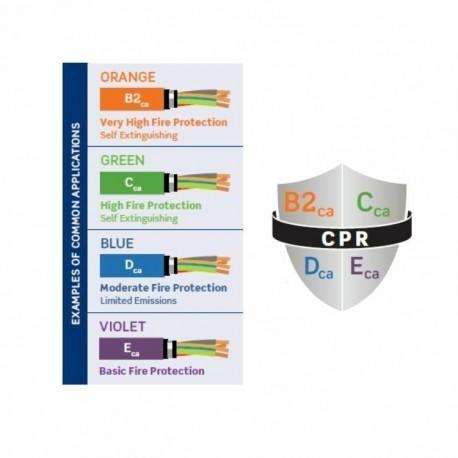
The CPR Euroclass system evaluates cable reaction to fire using standardized tests. The wider classification family includes Aca, B1ca, B2ca, Cca, Dca, Eca, and Fca. The four classes below are commonly discussed in commercial cable selection, listed here from stronger to less demanding measured reaction-to-fire performance:
B2ca — high reaction-to-fire performance. Testing addresses limited flame spread, total heat release, peak heat release rate, and fire growth. It may be specified in demanding projects, but only a project’s governing requirements determine whether it is necessary.
Cca — substantial reaction-to-fire performance. Also assessed for bunched-cable flame propagation, heat release, and fire growth, with less stringent thresholds than B2ca. Cca can be an important option in commercial building designs where accepted by local rules.
Dca — defined intermediate reaction-to-fire performance. Dca remains subject to bunched-cable heat-release and fire-growth criteria, but allows higher values than Cca. It should not be casually described as “basic flame resistance” without reference to those measured properties.
Eca — single-cable vertical flame-spread criterion. Eca is assessed using the vertical flame-spread test for a single cable. It does not provide the same bunched-cable heat-release characterization as B2ca, Cca, or Dca, nor does Eca carry the corresponding s/d/a supplementary classification.
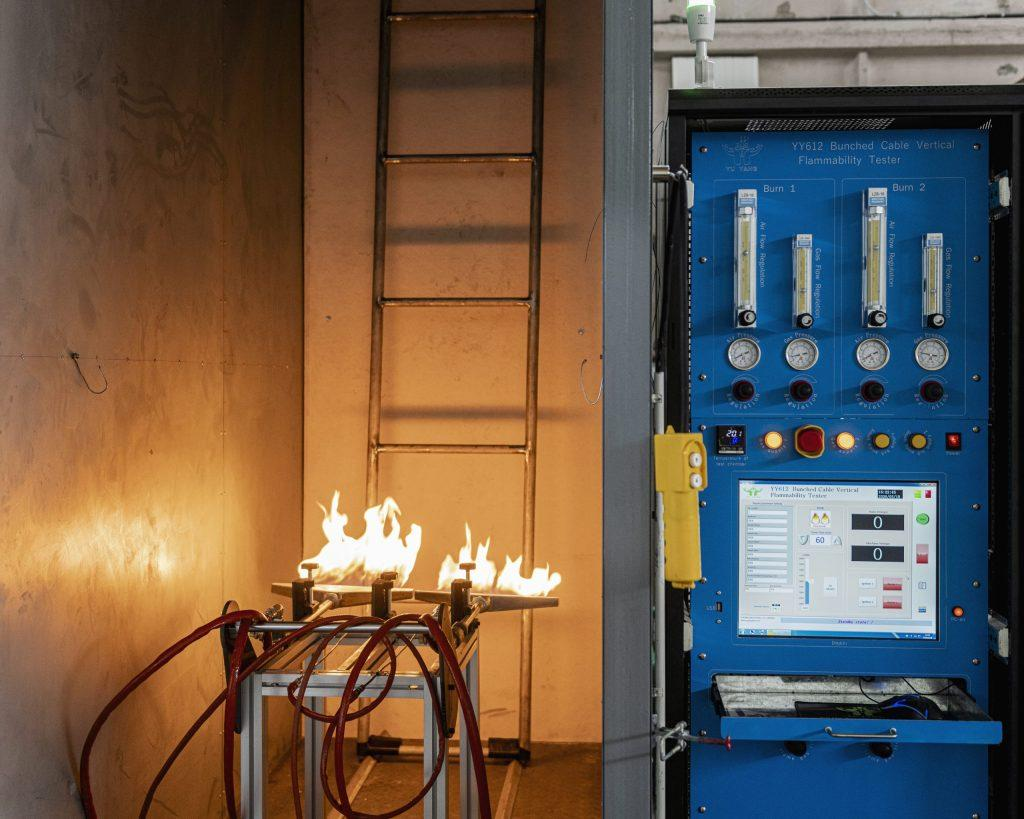
A useful technical comparison is the total heat release over 1,200 seconds (THR1200s) : B2ca ≤15 MJ, Cca ≤30 MJ, and Dca ≤70 MJ. The corresponding peak heat release rate limits are ≤30 kW, ≤60 kW, and ≤400 kW; the fire growth rate index (FIGRA) limits are ≤150, ≤300, and ≤1,300 W/s. These are laboratory classification limits, not promises about real-building fire outcomes. B2ca and Cca also have defined bunched-cable flame-spread limits; Eca instead relies on the single-cable test criterion.
These thresholds explain why the class ladder is meaningful: fire development is more informative than a simple pass/fail statement about a flame touching a jacket.
3. What do s1, d0, and a1 add to a CPR rating?
An example such as B2ca-s1a,d0,a1 communicates significantly more than B2ca alone. For applicable B1ca through Dca ratings, supplementary indicators describe three separate concerns:
Smoke (s): s1, s2, and s3 classify smoke production, with s1 indicating the stricter measured category. Where applicable, s1a and s1b add smoke-transmittance criteria. Lower smoke production can matter for visibility and evacuation; the specific specification should follow the fire strategy, not a marketing adjective.
Flaming droplets (d): d0 means no flaming droplets or particles during the specified test interval; d1 limits how long such droplets may persist; d2 does not meet d0 or d1. This matters because burning particles can spread ignition to nearby materials.
Acidity (a): a1, a2, and a3 classify the acidity/conductivity characteristics of gases generated under the specified test method. This can be relevant where corrosive combustion products could affect sensitive systems, although the rating is not a direct guarantee of equipment survival.
The entire string matters. Cca-s1,d1,a1 and Cca-s3,d2,a3 are not equivalent engineering declarations. Do not claim that “B2ca automatically means low smoke” without checking the supplementary values on the Declaration of Performance (DoP).
4. Why isn't LSZH the same as CPR classification?
“LSZH” (low-smoke zero-halogen) is commonly used to describe cable material or expected smoke/halogen behavior. It is not a substitute for a declared CPR Euroclass. Likewise, labels such as “flame retardant,” “IEC 60332 tested,” or “fire rated” may be useful but do not establish B2ca, Cca, Dca, or Eca classification by themselves.
A cable can be marketed as LSZH without proof that the exact product construction achieved the CPR class a project requires. Conversely, a documented CPR rating must be read from the correct product-level evidence—not inferred from jacket resin alone. Jacket composition, cable diameter, shielding, fiber versus copper construction, and the assembled cable design can affect the applicable classification and test outcome.
Another critical distinction: reaction to fire is not fire resistance. CPR reaction-to-fire ratings describe how a cable contributes to fire development under defined testing. A life-safety circuit required to maintain functionality during a fire calls for a different set of requirements and evidence. An ordinary B2ca cable should never be presented as circuit-integrity or fire-survival cable without specific certification.
5. How should system integrators specify CPR cables for real projects?
Consider three typical Pro AV contexts, without assuming that any suggested class is legally mandated:
A corporate meeting room: HDMI or USB-C signal cables may run through furniture, walls, or ceiling plenums. First establish whether the product is permanently incorporated into construction works and which national rules apply. Then identify the route, fire compartment, occupancy, and authority-approved specification. A short detachable patch lead and a permanently installed in-wall run may require different compliance reviews.
An airport or transportation hub: A distributed AV-over-IP system may connect media servers, switches, displays, and digital signage across long cable routes. Pathways may traverse busy public areas, risers, escape routes, and multiple fire compartments. Here, fire engineering, smoke behavior, and documented installation-zone requirements can outweigh a small material-cost difference.
A university auditorium or stadium: Fiber backbones and copper endpoints may share trays and risers. Repeatedly specifying a generic “LSZH cable” is insufficient if the project documentation calls for Cca-s1,d1,a1 or another exact class. Route-by-route review is more reliable than treating the venue as one homogeneous fire-risk zone.
Decision rule: Do not work backward from a supplier’s available stock. Work forward from the governing building/fire code, the engineer-of-record's specification, and the actual cable installation. Requirements vary by country and use case; verify with the authority having jurisdiction and applicable project documents.
6. What evidence should buyers request before approving a cable?
For European building installations subject to CPR, ask for the actual Declaration of Performance (DoP) and the relevant CE marking information , tied to the exact cable type. Check the manufacturer, unique product-type identification, declared Euroclass, intended use, and notified-body details where required. For higher classes such as B2ca and Cca, the applicable assessment and verification route is more stringent than for Dca or Eca.
A robust prequalification review should answer six questions:
- Is the particular cable within the CPR scope for its intended permanent installation?
- Does the DoP identify the exact construction or product family being supplied?
- Does the declared class include every supplementary s/d/a requirement specified by the project?
- Are the supporting assessment/certification documents appropriate for the class, and are the document identifiers traceable?
- Do the labels, order description, datasheet, and delivered reels or packages consistently identify the correct product?
- Has the supplier controlled material, jacket, and construction changes that could affect performance or the validity of the declaration?
It is dangerous to “upgrade” a product's fire class in a quote because its jacket sounds similar to that of a tested cable. An engineering-grade supplier should be willing to say when a requested construction has not been qualified.
7. Can better fire performance create AV signal-integrity tradeoffs?
Potentially. Fire-performance formulations and physical cable construction interact with mechanical, electrical, and optical requirements. For high-speed copper links, changes in insulation and jacket design can influence geometry, flexibility, dielectric environment, attenuation, impedance control, and routing. In hybrid optical active cables, the overall assembly involves fibers, copper conductors, power handling, connectors, and active electronics, each with distinct verification needs.
That does not mean a higher CPR class necessarily degrades signal performance. It means the two claims must be validated independently and together for the final product configuration. CPR evidence does not replace HDMI/USB/DisplayPort link validation; a successful 8K signal test does not replace a CPR DoP.
For a demanding Pro AV project, I would establish a dual acceptance plan: (1) the exact fire-class declaration required for the installation, and (2) the applicable link-level performance and interoperability tests at the required length, resolution, refresh rate, bandwidth, and environmental conditions. Add bend-radius, pulling-force, and installation-method checks so the design that passed in the lab remains practical on site.
8. What is the bigger lesson for Pro AV procurement?
The most mature specifications treat cabling as part of the building system, rather than an inexpensive accessory attached to expensive equipment. Professional buyers should avoid three shortcuts: equating LSZH with a Euroclass; assuming all cables used in a “public building” need the same rating; and accepting generic certificates that cannot be traced to the delivered product.
For OEM brands, distributors, consultants, and AV system integrators, supplier capability should be assessed across compliance traceability, signal integrity, production consistency, and change control . This reduces late-stage substitutions, installation disputes, and avoidable project risk.
At STAR FIRE TECH , our experience in Pro AV connectivity, high-speed cables, active optical cables, and OEM/ODM manufacturing shapes how we approach those conversations: the right cable is not merely one that transmits the signal; it is one whose full set of declared properties fits the intended installation. We welcome technical discussions about product configurations, validation plans, and project-specific compliance documentation. Any CPR class for a particular STAR FIRE TECH product should be confirmed against that product's actual DoP and supporting evidence—not assumed from this article.
My closing question to fellow AV engineers: When you review a cable submittal, are you verifying only bandwidth and connector type—or also the exact fire-performance declaration that belongs to the installed cable?
Learn more: https://www.starfirecableshubs.com
Technical references
- European Commission Delegated Regulation (EU) 2026/331, consolidated text, cable reaction-to-fire class criteria: https://eur-lex.europa.eu/legal-content/EN/TXT/?uri=CELEX:02026R0331-20260421
- Commission Delegated Regulation (EU) 2016/364, cable classification criteria and supplementary ratings: https://www.legislation.gov.uk/eur/2016/364/annexes/2015-07-01?view=plain
- Europacable, Understanding CPR Cable Classification and Certification : https://cpr.europacable.eu/ie/cpr/understanding-cpr-cable-classification-and-certification
- LinkedIn Help, Tips for writing articles on LinkedIn : https://www.linkedin.com/help/linkedin/answer/a516913?lang=en
#ProAV #AVIntegration #AVoverIP #CableFireSafety #CPRCables #B2ca #Cca #Dca #Eca #EN50575 #CableCompliance #FireSafetyEngineering #SignalIntegrity #HDMICables #FiberOpticCables #SystemIntegrators #CommercialAV #DigitalSignage #STARFIRETECH
