Table Of Content
Table Of Content
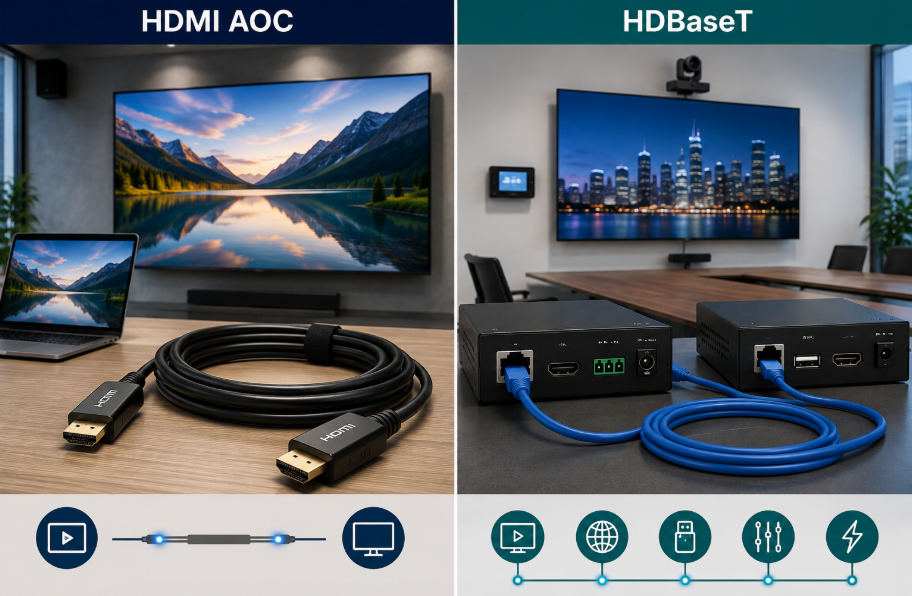
Long-distance HDMI design is often reduced to one question: fiber or Category cable? In professional AV, that question is too simple. HDMI active optical cable (AOC) and HDBaseT solve different system problems, and the better choice depends on what the link must carry, how the system will be installed, and how it will be maintained years after commissioning.
After two decades working with professional AV connectivity, I have found that reliable designs begin by separating signal transport from system architecture. HDMI AOC is primarily a high-bandwidth point-to-point path; HDBaseT is an extension platform that can combine AV, control, Ethernet, USB and power over Category cable. Neither is universally better. The question is which architecture creates the most margin with the least operational risk.
Start with the video requirement, not the cable
Bandwidth is the first dividing line. Certified Ultra High Speed HDMI cables support up to 48 Gbps, including 4K120 and 8K60. Active and optical assemblies are supported within the HDMI cable ecosystem, so a properly engineered HDMI AOC can carry native HDMI across distances that are impractical for passive copper.
HDBaseT 3.0 takes a different approach. It supports fully uncompressed 4K60 4:4:4 up to 100 m over Category cable, while also transporting Gigabit Ethernet, USB 2.0, control and power. That is an excellent fit for a large part of installed Pro AV, but it is not the same bandwidth envelope as a native 48 Gbps HDMI 2.1 link. If the project requires 4K120, 8K60 or another high-FRL-bandwidth HDMI mode, verify the complete extender chain rather than assuming that '4K' or '8K' on a product page means full native HDMI bandwidth.
HDMI AOC is strongest when the job is direct high-bandwidth transport
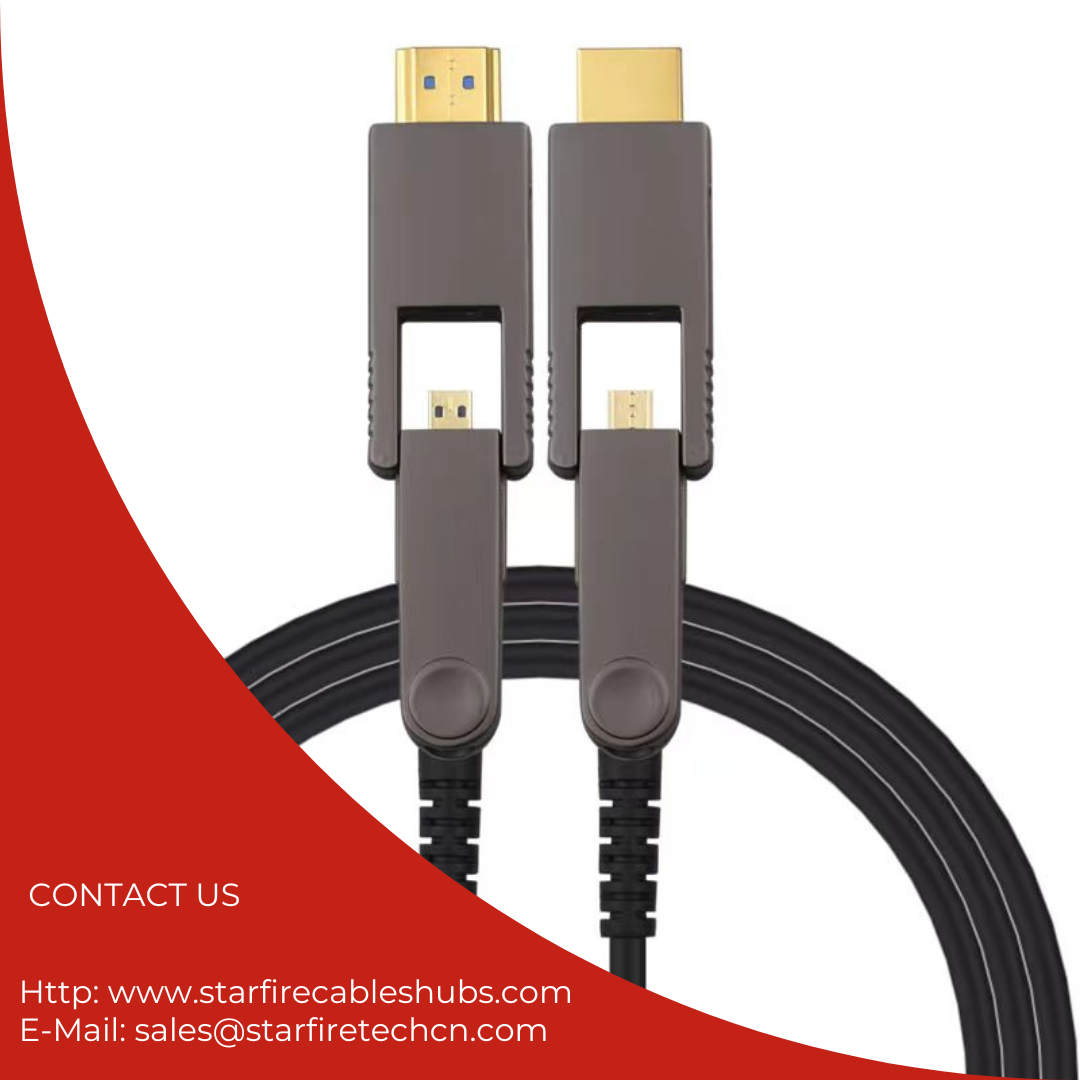
For a source-to-display connection, HDMI AOC is often the cleanest architecture. The conversion electronics are integrated into the cable ends, so there is no separate transmitter, receiver or extender power supply to mount and manage. Hybrid AOC also moves the high-speed video channels into optical fiber, which reduces susceptibility to electromagnetic interference and avoids the attenuation problems that make long passive copper HDMI links difficult.
That makes HDMI AOC attractive for LED walls, control rooms, broadcast displays, medical imaging, digital signage and conference spaces where signal integrity and HDMI bandwidth matter more than carrying multiple auxiliary services on the same cable.
The tradeoff is serviceability. Most AOCs are directional, their connector heads must be protected during pulling, and a factory-terminated cable must be replaced as an assembly if it is damaged. Conduit fill, bend radius, pulling force and connector access therefore belong in the design review—not just the video resolution.
HDBaseT is strongest when the link is part of an infrastructure
HDBaseT becomes especially compelling when the cable must do more than carry HDMI. Its 5Play concept can combine uncompressed AV, Ethernet, USB, control and power over one Category cable. For classrooms, meeting rooms, wall plates and standardized enterprise AV rooms, that convergence can reduce cable count and simplify deployment.
Category cabling also brings an operational advantage: it is familiar, field-terminable and easy to test or replace. A damaged run can often be reterminated rather than replacing a long preterminated assembly. HDBaseT also has a broad interoperable ecosystem, useful when systems must be supported by different integrators over a long service life.
The comparison that matters in real Pro AV projects
| Engineering factor | HDMI AOC | HDBaseT |
|---|---|---|
| Primary strength | Native point-to-point HDMI transport | Multi-service AV extension infrastructure |
| Typical high-end video | Can support 48 Gbps HDMI systems when designed/certified for it | HDBaseT 3.0: uncompressed 4K60 4:4:4 up to 100 m |
| Auxiliary services | Usually HDMI-side functions; design dependent | Ethernet, USB, IR/RS-232/control and power can share the link |
| EMI resilience | Very strong for high-speed channels because they are optical | Robust, but Category cable and installation practice remain important |
| Field termination | Generally no; factory terminated | Yes, using qualified Category cabling and connectors |
| Active hardware | Electronics integrated into cable ends | Usually separate transmitter and receiver |
| Best fit | High-bandwidth direct runs, EMI-sensitive paths, simple source-to-display links | Standardized rooms, wall plates, control-rich endpoints and maintainable infrastructure |
Distance alone should never make the decision
Both technologies can operate around the 100 m class, but equal distance does not mean equal architecture. A 70 m signage run carrying high-bandwidth HDMI may favor AOC; a 70 m classroom run needing RS-232, USB, Ethernet and remote power may favor HDBaseT.
Do not specify 'HDMI over 100 m' as a standalone requirement. Define resolution, refresh rate, chroma, HDR, HDCP, control, USB, power, pathway conditions and service strategy. Then the transport choice becomes much clearer.
EMI, grounding and installation environment
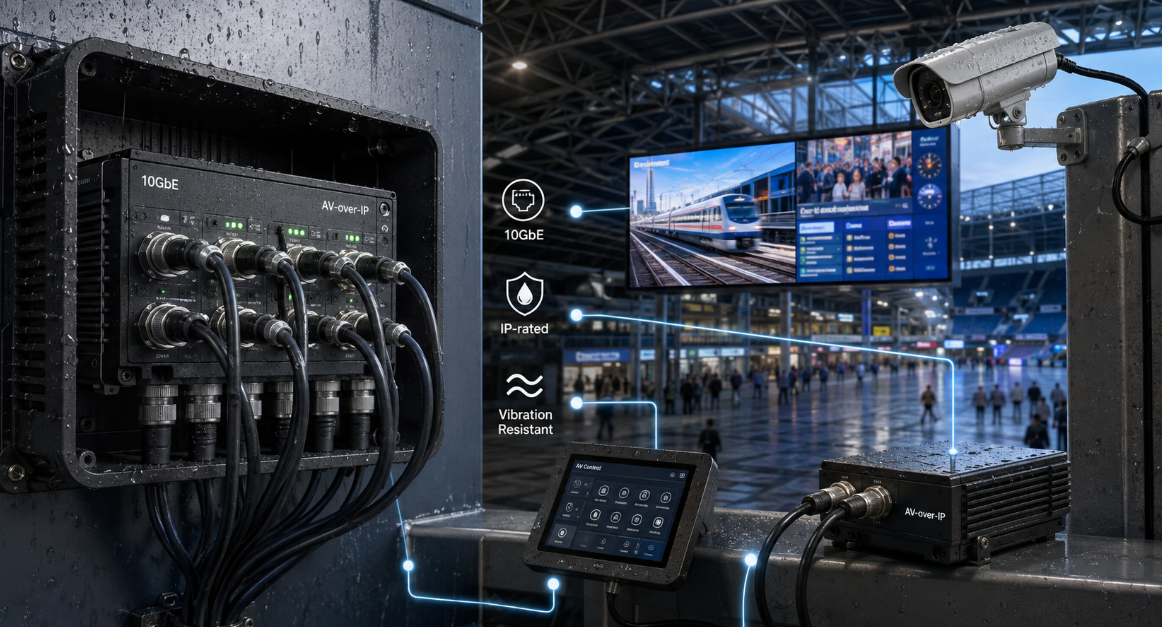
In electrically noisy environments, fiber-based HDMI AOC has a natural advantage because the high-speed payload travels optically. That can be valuable near variable-frequency drives, motors, large LED power systems, medical equipment and other sources of electromagnetic noise.
Think about failure recovery before commissioning
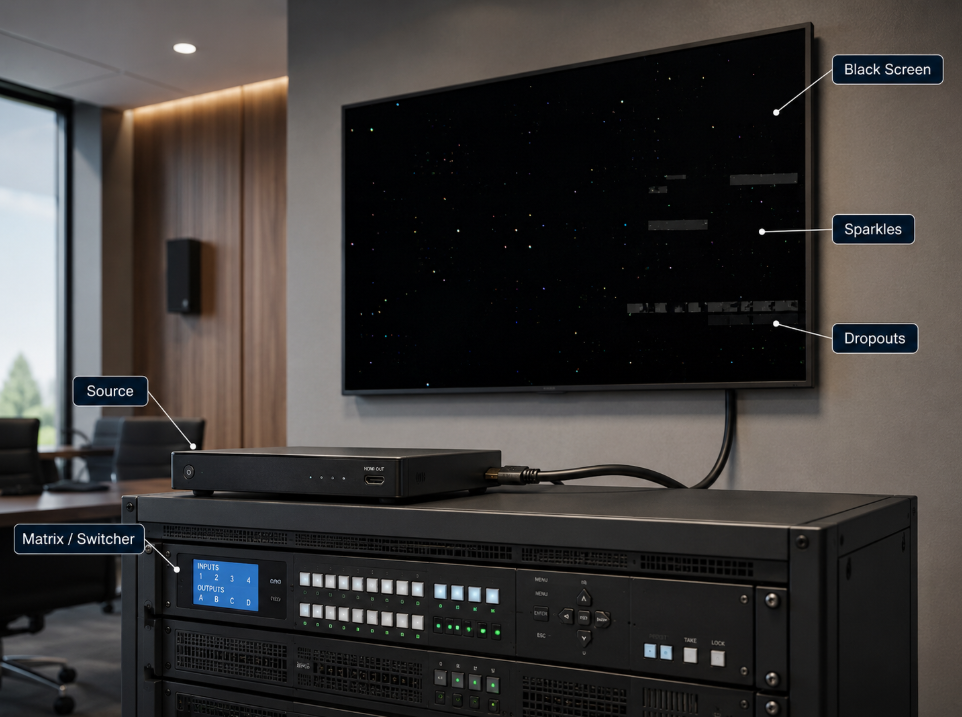
The best transport method is not only the one that passes signal on installation day; it is the one the operations team can recover quickly when something fails. Validate the actual source, sink, resolution, HDCP behavior and installed length before deployment, and document the components that operations teams may need to replace.
A practical selection rule
Choose HDMI AOC when the priority is a direct, low-complexity, high-bandwidth HDMI path; when EMI immunity is important; or when 4K120/8K60-class HDMI performance is required and the selected assembly is verified for that bandwidth.
Choose HDBaseT when the priority is standardized Category infrastructure; when AV, control, Ethernet, USB and power need to converge; when field termination and long-term serviceability matter; or when 4K60 4:4:4 over distances up to 100 m matches the application.
And in larger Pro AV systems, do not be afraid to use both. A control room may use HDMI AOC for high-bandwidth display trunks while using HDBaseT for wall plates, room endpoints and integrated control. Good engineering is not about choosing one technology as a winner. It is about placing each technology where its architecture is strongest.
The broader lesson for Pro AV
As Pro AV becomes more networked and operationally critical, connectivity decisions influence the whole system lifecycle. The most expensive cable is rarely the one with the highest unit price; it is the one that forces redesign, creates intermittent failures or is difficult to replace later.
At STAR FIRE TECH, our work across professional AV, HDMI and hybrid AOC, optical fiber communication, structured cabling and industrial connectivity reinforces one principle: transmission should be engineered as part of the system, not selected as an accessory at the end of the BOM.
Final checklist
Before selecting HDMI AOC or HDBaseT, confirm: required HDMI bandwidth and video format; maximum installed distance; HDR and HDCP requirements; USB, Ethernet, IR or RS-232 needs; remote power requirements; EMI environment; conduit and bend-radius limits; field-termination requirements; access for service and replacement; and whether the exact source-display combination has been tested at full operating mode.