Table Of Content
Table Of Content
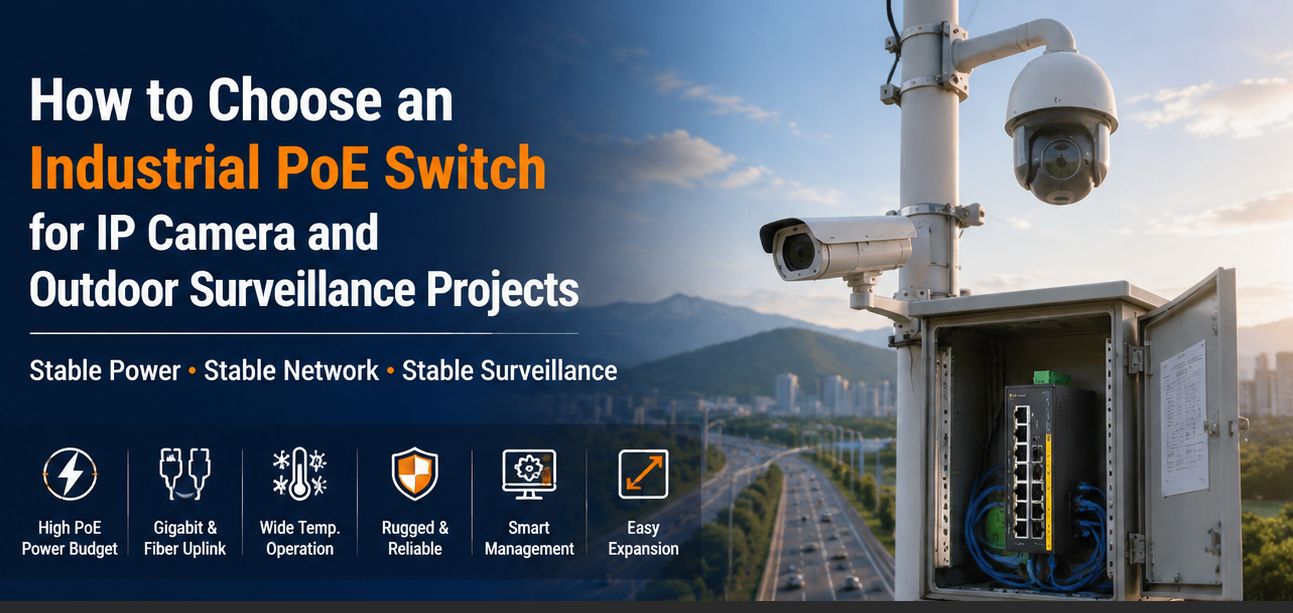
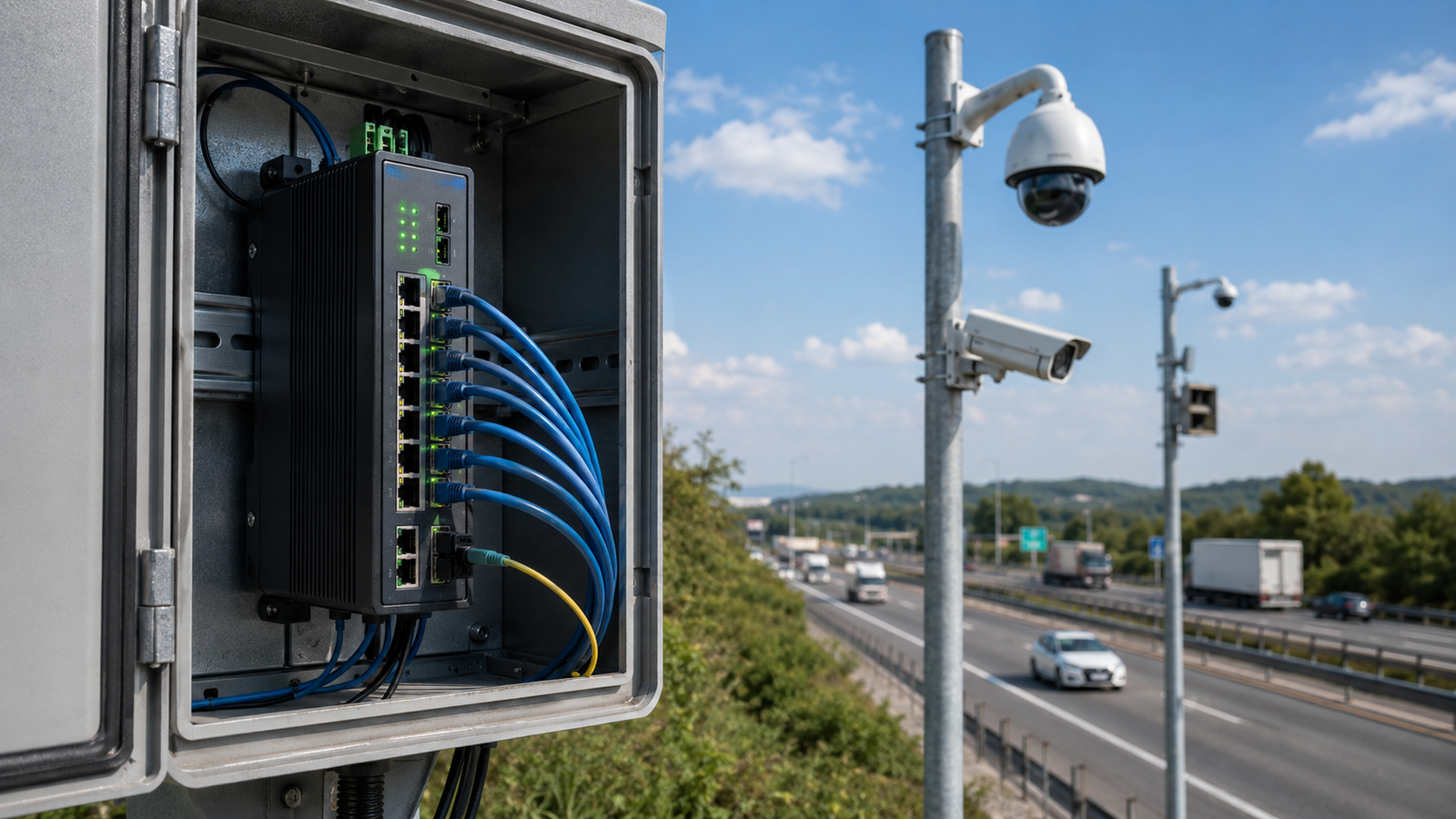
 A highway surveillance cabinet, IP cameras, or an industrial PoE switch installed in a control box.
In surveillance projects, network stability is not a small detail.
When an IP camera goes offline, the problem is not just a missing video feed. It may affect traffic monitoring, factory security, public safety, or real-time operation control. For system integrators and project contractors, every unstable connection can mean extra site visits, higher maintenance costs, and more pressure from the end user.
That is why the switch used in a surveillance network should not be selected only by port count or price.
It should be selected by application environment, power stability, network structure, and long-term reliability.
The Project Challenge
A typical outdoor surveillance project may include multiple IP cameras installed along roads, industrial parks, parking areas, tunnels, or factory perimeters.
At first, the network design may look simple:
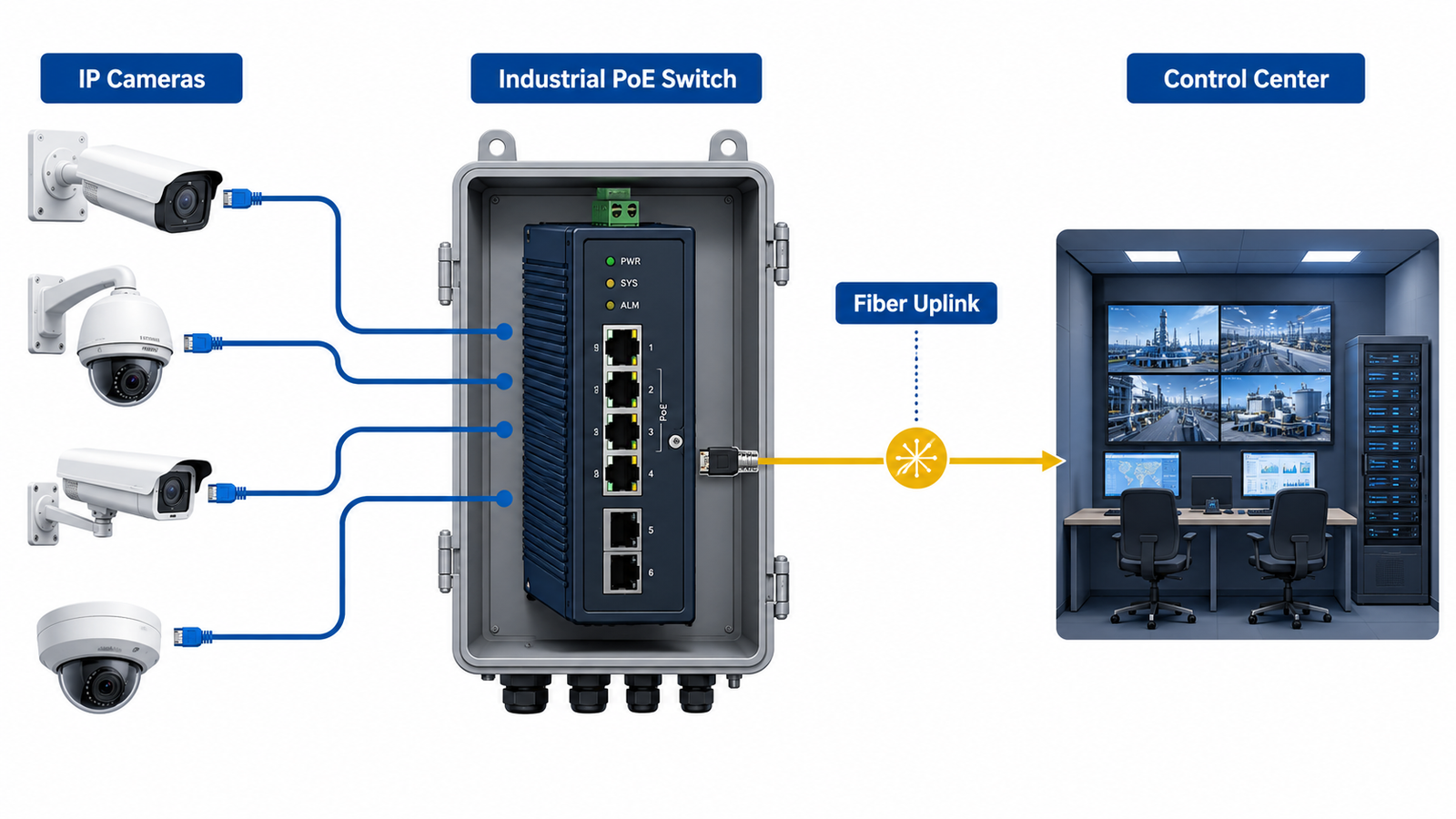
IP cameras connect to a PoE switch. The switch connects to the control center through fiber uplink. Power and data are transmitted through one Ethernet cable.
But in real installation, the environment is much more demanding.
The project may face:
- High temperature inside outdoor cabinets
- Dust, vibration, and unstable site power
- Long-distance transmission between equipment points
- Electromagnetic interference from nearby electrical systems
- Multiple cameras requiring stable PoE power at the same time
- Difficult maintenance after installation
In this kind of application, a regular commercial switch may work during testing, but it may become unstable after long-term operation.
The most common problems include camera disconnection, unstable video transmission, PoE power drop, switch overheating, and difficulty identifying faults remotely.
The Solution: Industrial PoE Switch with Fiber Uplink
For this type of project, an industrial PoE switch is usually a better choice.
A well-designed industrial PoE switch can provide both network connection and stable power supply for IP cameras. More importantly, it is designed for harsh environments where commercial switches are not reliable enough.
A practical solution may include:
Industrial PoE ports for IP cameras Gigabit SFP uplink ports for long-distance fiber transmission Wide temperature operation for outdoor or cabinet installation DIN-rail mounting for control boxes and industrial panels Metal housing for better protection and heat dissipation Redundant power input to improve system reliability Managed functions such as VLAN, QoS, IGMP Snooping, and fault alarm
For surveillance networks, fiber uplink is especially important.
Copper Ethernet cable is usually limited to around 100 meters. But fiber transmission can support much longer distance and better resistance to interference. This makes fiber uplink a strong choice for highways, tunnels, industrial parks, smart city projects, and large outdoor monitoring systems.
How This Helps the Customer
The value of an industrial switch is not only in the hardware itself.
The real value is that it helps the customer reduce operational risks.
1. Fewer Camera Disconnections
Stable PoE output and industrial-grade design help reduce random camera offline issues. This is especially important when multiple cameras are working at the same time.
For the customer, this means fewer complaints from the end user and fewer emergency maintenance visits.
2. Better Long-Distance Transmission
With SFP fiber uplink, the system can transmit data over longer distances with stronger anti-interference performance.
For large-scale projects, this helps simplify network planning and improve transmission stability.
3. Lower Maintenance Pressure
Managed industrial switches can support remote monitoring, VLAN, QoS, redundancy protocols, and fault alarms depending on the model.
This helps engineers identify network problems faster instead of visiting the site every time a device goes offline.
4. More Reliable Outdoor Operation
Industrial environments are not always clean and stable.
Outdoor cabinets can become hot. Factories may have vibration and electromagnetic interference. Roadside boxes may face dust and unstable power.
An industrial switch is designed for these conditions, helping the network maintain stable operation over time.
Why This Matters for System Integrators
For system integrators, a switch failure is not just a product issue.
It becomes a project issue.
If the network is unstable, the customer may not blame the switch first. They may blame the whole solution provider.
That is why choosing the right industrial switch helps protect not only the network, but also the project reputation.
A reliable switch can help integrators:
- Reduce after-sales service costs
- Improve project delivery quality
- Lower the risk of repeat site visits
- Build stronger trust with end users
- Offer a more professional network solution
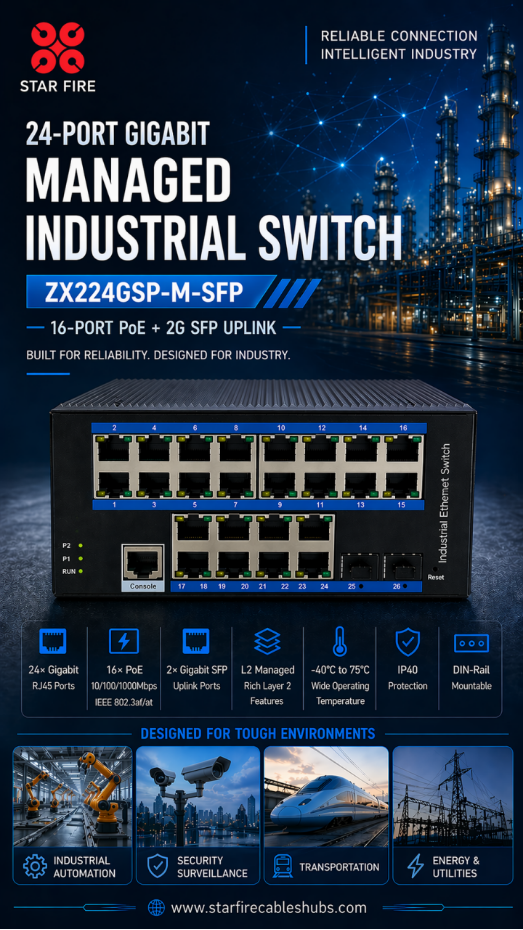
What to Check Before Choosing an Industrial PoE Switch
Before selecting an industrial PoE switch for a surveillance project, customers should check these key points:
- How many IP cameras need PoE power?
- What is the power requirement of each camera?
- Is the installation indoor, outdoor, roadside, or inside a cabinet?
- Does the project require fiber uplink?
- Is remote management required?
- Does the network need redundancy?
- What temperature range is required?
- Does the project require CE, FCC, RoHS, or REACH compliance?
- Is fast delivery or flexible MOQ important?
- Will custom branding or OEM support be needed?
Final Thought
In industrial surveillance projects, stability is more important than a low initial price.
A cheaper switch may reduce the purchasing cost at the beginning, but if it causes downtime, camera disconnection, or repeated maintenance, the total cost becomes much higher.
An industrial PoE switch is not just a connection device.
It is part of the system’s uptime strategy.
#IndustrialSwitch #IndustrialEthernet #IndustrialPoESwitch #PoESwitch #CCTVNetwork #SurveillanceSystem #SmartTransportation #IndustrialNetworking #FiberUplink #NetworkReliability #STARFIRETECH