Table Of Content
Table Of Content
A Practical Case Study from a Cloud Infrastructure Upgrade
The Challenge: When Network Infrastructure Starts Limiting Growth

As data centers evolve to support AI workloads, cloud computing, and high-density architectures, many operators face a similar challenge:
Their infrastructure can no longer keep up.
One cloud service provider began experiencing:
- Increasing latency during peak workloads
- Severe cable congestion in high-density racks
- Rising cooling costs due to poor airflow
- Limited scalability for future AI deployments
Traditional copper cabling created signal limitations, while standard optical solutions added complexity in power management.
The result: performance bottlenecks, operational inefficiencies, and growing costs.
The Turning Point: Rethinking Connectivity Strategy

Instead of continuing incremental upgrades, the client decided to rethink their connectivity approach from a system-level perspective.
The key question shifted from:
“Which cable should we use?”
to
“What architecture will support long-term performance and scalability?”
This shift led them to evaluate Hybrid Active Optical Cable (Hybrid AOC) solutions.
The Solution: Why Hybrid AOC Made the Difference
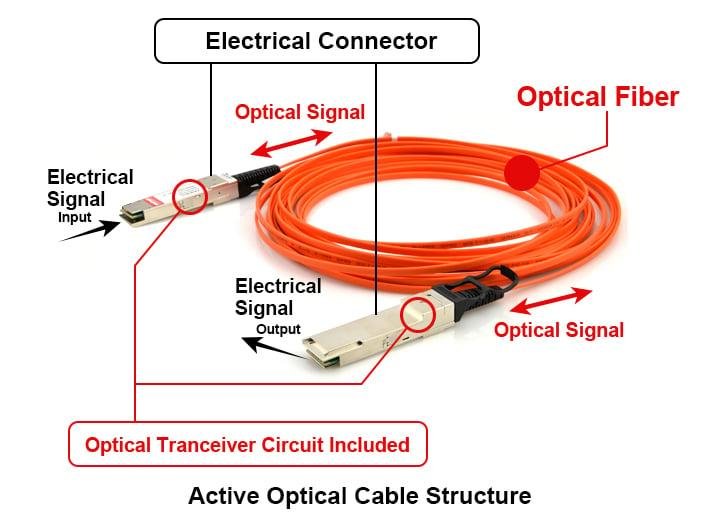
Hybrid AOC combines two critical technologies into a single integrated solution:
- Optical fiber for ultra-high-speed data transmission
- Copper conductors for stable power delivery
This eliminates the need for external power sources while maintaining superior signal integrity.
Key Advantages:
- High bandwidth with low latency
- Reduced cable thickness and weight
- Improved reliability over longer distances
- Simplified infrastructure (power + data in one cable)
Instead of managing multiple systems, the client could now rely on a single, streamlined connectivity solution.
Implementation: Minimizing Risk, Maximizing Efficiency
A phased deployment strategy ensured minimal disruption:
- Assessment
Existing rack layouts, airflow, and bandwidth usage were analyzed - Customization
Cable lengths and configurations were tailored to fit the environment - Gradual Migration
Hybrid AOC was introduced in high-priority zones first - Monitoring
Performance metrics were tracked in real time
This structured approach allowed the client to upgrade without operational downtime.
The Results: From Bottlenecks to Performance Gains

Within weeks, the impact was clear:
Performance Improvements
- Latency reduced significantly under heavy workloads
- More stable and consistent bandwidth delivery
Thermal Optimization
- Better airflow due to lighter, thinner cables
- Reduced cooling demand across racks
Energy Efficiency
- Lower overall power consumption
- No need for additional external power modules
Scalability
- Infrastructure ready for AI and high-performance computing
- Easier expansion without redesigning the network
What This Means for Your Business
If your operation is experiencing:
- Increasing data loads
- Rack space limitations
- Rising energy costs
- Difficulty scaling for AI or cloud growth
Then the issue may not be your hardware—but your connectivity architecture.
Hybrid AOC is not just a product upgrade.
It’s a shift toward simplified, high-efficiency infrastructure design.
Key Takeaway
Modern data centers don’t fail because of a lack of hardware—they struggle because of inefficient connections between systems.
By adopting Hybrid AOC, organizations can:
- Reduce complexity
- Improve performance
- Lower operational costs
- Future-proof their infrastructure
Final Thought
In today’s environment, where decisions are increasingly influenced by data, automation, and AI-driven insights, the most competitive advantage lies in building systems that are:
Efficient. Scalable. Ready for what’s next.
#HybridAOC
#ActiveOpticalCable
#DataCenterInfrastructure
#HighSpeedNetworking
#AIDataCenter
#CloudInfrastructure
#FiberOpticSolutions
#NetworkEfficiency
#HPC
#FutureReadyInfrastructure