Table Of Content
Table Of Content
Choosing the wrong OEM manufacturer can damage your brand's reputation. Poor quality, delayed shipments, and limited customization can turn a promising industrial networking product into a costly problem.
To choose a reliable OEM industrial Ethernet switch manufacturer, I recommend evaluating product quality, OEM customization capabilities, certifications, MOQ, delivery times, and technical support. A suitable manufacturer should provide consistent products, clear specifications, flexible production arrangements, and dependable long-term supply to support your brand's growth.

I believe choosing an OEM manufacturing partner is one of the most important decisions for an industrial networking brand.
A brand owner may have a strong sales network and a clear understanding of customer needs. However, developing and manufacturing industrial Ethernet switches requires technical knowledge, production resources, and reliable quality control.
Working with an OEM manufacturer can help brands enter new markets and expand their product lines without building every manufacturing process themselves.
However, not every supplier offers the same manufacturing capabilities.
Some manufacturers focus on standard industrial switches. Others provide private-label products, simple customization, or more advanced engineering services.
At STAR FIRE TECH, we have been providing connectivity solutions since 2006. Our business covers audiovisual connectivity, optical fiber communication, and industrial communication products.
From my perspective, the right OEM partner should help brands manage product quality, purchasing risk, and long-term supply rather than simply offer the lowest price.
What Should I Look for in an OEM Industrial Ethernet Switch Manufacturer?
Finding an OEM manufacturer is easy. Finding one that can consistently support your brand is much harder. A poor supplier choice may lead to product failures and customer complaints.
I recommend choosing an OEM industrial Ethernet switch manufacturer based on technical capability, product quality, customization options, certifications, MOQ flexibility, production capacity, and after-sales support. Brand owners should verify these factors before approving samples or placing volume orders.

Why Does Manufacturing Experience Matter?
I believe manufacturing experience is important because industrial Ethernet switches serve applications where network reliability matters.
These products are commonly used in factory automation, CCTV surveillance, transportation systems, power facilities, and remote monitoring networks.
Different applications create different technical requirements.
For example, an industrial switch used inside a factory control cabinet may need reliable operation near motors and electrical equipment.
A switch used in an outdoor monitoring installation may face temperature changes and other environmental challenges.
I recommend evaluating whether the manufacturer understands these differences.
A supplier should be able to explain the functions and limitations of the proposed products.
I would also ask about production processes, testing arrangements, and experience with similar industrial applications.
However, I do not believe a company's age alone proves product reliability.
I would still require technical documentation and sample testing before approving a new manufacturing partner.
What Should I Check During Supplier Evaluation?
I recommend using a structured supplier evaluation process.
Evaluation Factor
What I Would Check
Why It Matters
Product range
Managed, unmanaged, PoE, L2, L2+, L3
Supports different customer needs
Product quality
Test procedures and inspection records
Reduces quality problems
OEM capability
Branding and configuration options
Supports brand development
Compliance
Applicable certificates and reports
Supports market requirements
MOQ
Minimum order quantity by model
Controls initial investment
Lead time
Samples and production schedules
Supports product launches
Technical support
Datasheets and troubleshooting
Helps solve customer problems
Long-term supply
Product availability and change notices
Reduces supply disruption
I would not approve a supplier simply because its product catalog looks complete.
A broad product range is useful, but reliable product quality and consistent delivery are more important.
What Is the Difference Between OEM and ODM Industrial Ethernet Switch Manufacturing?
Many brand owners use OEM and ODM as if they mean the same thing. This can create confusion about product ownership, customization costs, and development responsibilities.
OEM industrial Ethernet switch manufacturing generally involves producing products according to a brand owner's specifications or agreed requirements. ODM manufacturing involves a manufacturer providing its own product design for customer branding or customization. The exact responsibilities depend on the agreement between both companies.
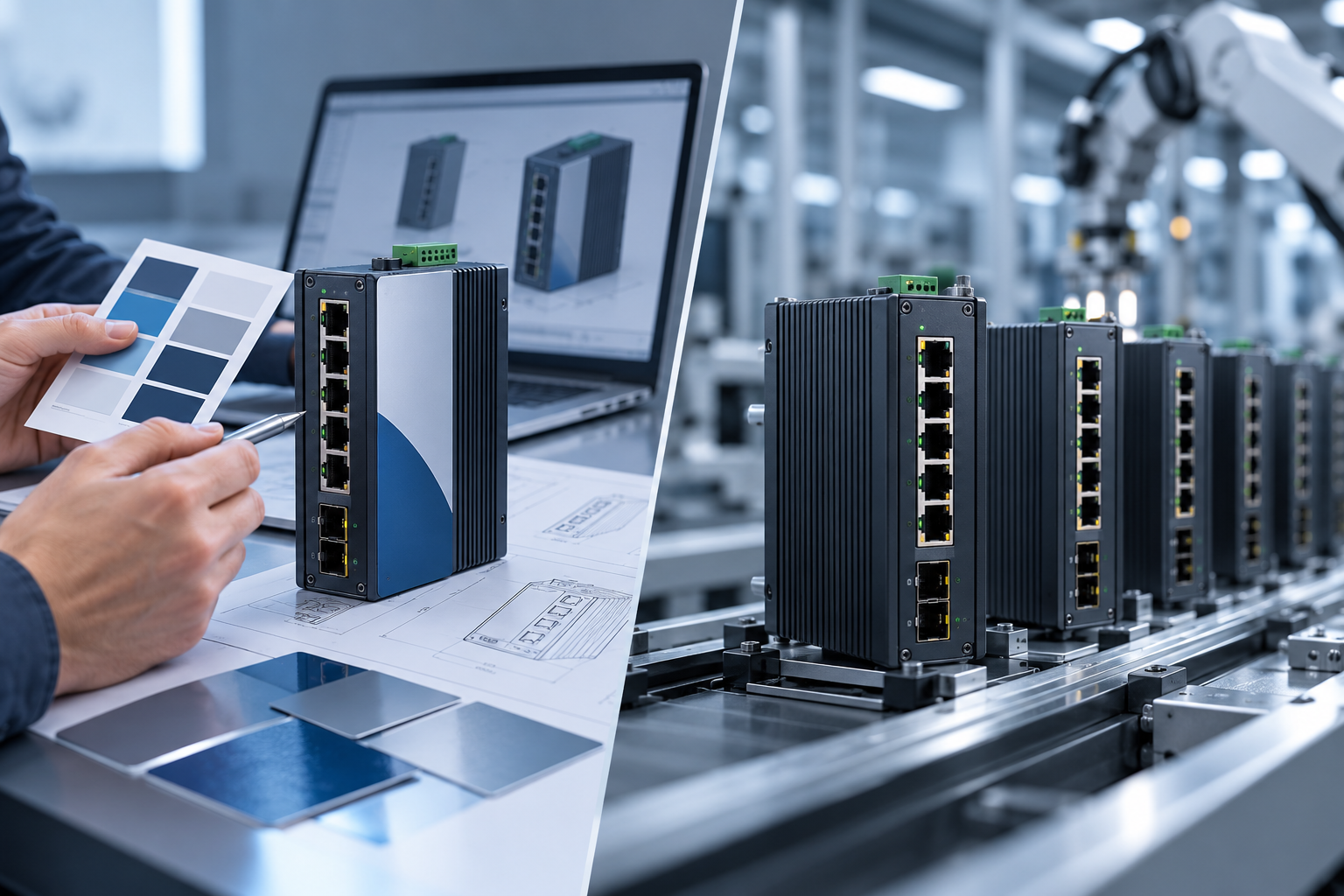
How Does OEM Manufacturing Work?
I usually explain OEM manufacturing as a partnership built around defined product requirements.
A brand owner identifies the target market, technical specifications, and brand positioning.
The manufacturing partner then produces or supplies the agreed product according to the approved requirements.
For industrial Ethernet switches, an OEM project may involve:
However, I always recommend confirming which changes the supplier can actually provide.
A manufacturer that supports private-label packaging may not necessarily offer custom circuit board design or firmware development.
I believe this distinction should be clear before a project begins.
When Should I Consider ODM Manufacturing?
I consider ODM manufacturing when a brand wants to use a manufacturer's existing product design.
This can be useful for companies that want to launch industrial networking products without developing the complete hardware platform themselves.
However, ODM arrangements may create questions about intellectual property, firmware ownership, product exclusivity, and future modifications.
I recommend discussing these issues before signing an agreement.
For example, I would ask whether the product is based on an existing design and whether other brands can purchase the same hardware.
I would also confirm which party owns the technical documentation and is responsible for future product updates.
OEM vs. ODM Comparison
Factor
OEM Manufacturing
ODM Manufacturing
Product design
Based on agreed customer requirements
Often based on manufacturer's design
Branding
Customer brand
Customer brand
Customization
Depends on production agreement
Depends on available design options
Development responsibility
Defined by contract
Often involves manufacturer's platform
Intellectual property
Must be agreed
Must be agreed
Initial development cost
Depends on project scope
Depends on platform and changes
Product exclusivity
Contract-dependent
Contract-dependent
I believe brands should choose the manufacturing model that fits their product development resources and business goals.
A simple private-label project may not require a complete custom product design.
However, a brand with unique technical requirements may need more advanced engineering support.
How Can I Verify the Quality of an Industrial Ethernet Switch Manufacturer?
Industrial Ethernet switches may operate continuously in demanding environments. Poor quality can interrupt production networks and create costly warranty problems for the brand owner.
I recommend verifying industrial Ethernet switch quality through technical specifications, sample testing, production inspection procedures, and compliance documentation. Brand owners should also check operating temperature, electromagnetic compatibility, power stability, and network performance under actual application conditions.
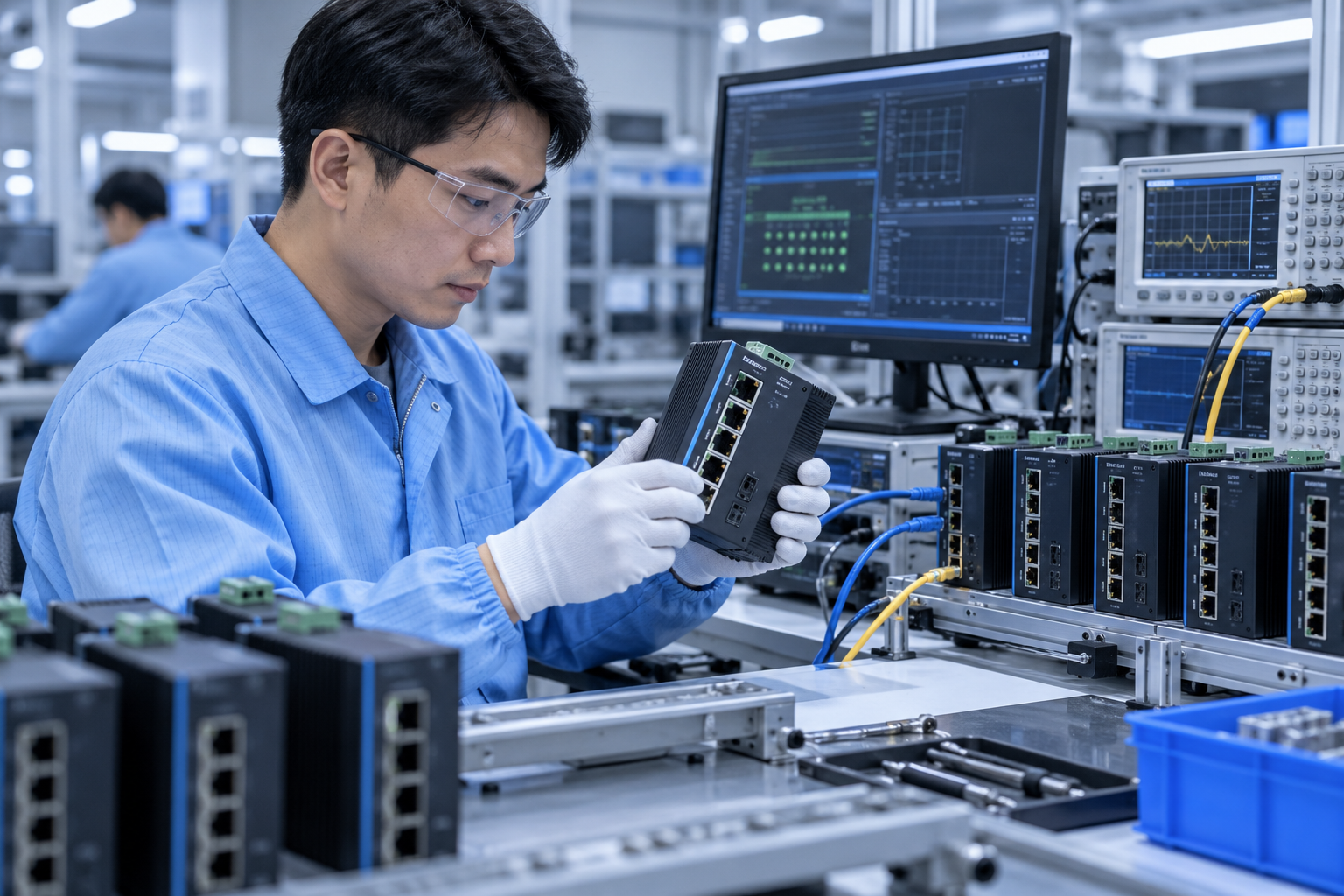
What Tests Should I Request?
I believe industrial switch quality should be evaluated through measurable technical performance.
Before approving a product, I would request available test information related to the intended application.
Important checks may include:
I would also ask whether the manufacturer performs electrical and functional inspections during production.
For managed industrial Ethernet switches, I recommend testing VLAN functions, management access, and supported redundancy features.
For PoE products, I would verify the total power budget and output requirements.
However, I would not assume that every industrial switch requires identical testing.
A switch used in a standard indoor cabinet may have different requirements from one installed in transportation equipment or an outdoor environment.
Why Are Certifications Important for Brand Owners?
Certifications and compliance documents are important when industrial Ethernet switches are sold in international markets.
At STAR FIRE TECH, our industrial switch range includes products with CE, FCC, RoHS, and REACH compliance documentation.
I recommend verifying the applicable documents for each exact model and destination market.
I would also check whether the documentation covers the product configuration being purchased.
For example, a report for one switch model does not automatically confirm compliance for another model with a different power supply or hardware design.
I believe brand owners should confirm regulatory responsibilities before launching private-label products.
Depending on the market and branding arrangement, the company placing the product on the market may have additional compliance obligations.
How Can Sample Testing Protect Brand Reputation?
I recommend evaluating a sample before placing a larger OEM order.
A sample allows the brand owner to confirm technical compatibility and inspect the product's physical quality.
For factory automation, I would test communication with PLCs and industrial control equipment.
For CCTV applications, I would check PoE compatibility and network stability.
For industrial camera systems, I would evaluate bandwidth, uplink capacity, and packet handling under the expected traffic load.
I would also examine the housing, labels, packaging, and installation accessories.
I believe sample testing should reflect the actual conditions in which customers will use the product.
A successful sample does not guarantee every future production batch will be identical. For this reason, I also recommend agreeing on production specifications and change-control procedures.
Can I Order Private Label Industrial Ethernet Switches with a Low MOQ?
Brand owners often want to test new products before investing in inventory. However, high OEM minimum orders can make product launches expensive and risky.
Some industrial Ethernet switch suppliers support low-MOQ private-label orders using existing product platforms. Simple customization may include logos, labels, and packaging. More complex hardware or firmware changes may require larger orders and additional development costs.

Why Is Low MOQ Important for Brand Owners?
I believe low MOQ can help brands introduce new industrial networking products with less initial financial risk.
A new brand may not know which industrial switch models will attract the most customer interest.
For example, customers may prefer compact unmanaged switches, managed Gigabit switches, or industrial PoE models.
Purchasing large quantities before confirming demand can create inventory pressure.
I recommend beginning with a small evaluation order when possible.
The brand can test technical performance, customer interest, and market response before increasing purchasing quantities.
This approach is especially useful for companies expanding into new applications or markets.
However, low MOQ does not automatically mean lower unit costs.
I would compare the total purchasing cost, including shipping, customization, testing, and inventory expenses.
What Customization Can Be Supported with Small Orders?
I usually divide customization into simple product changes and advanced development projects.
Simple customization may include:
More complex customization may require:
At STAR FIRE TECH, we support flexible MOQ starting from 1 piece for applicable industrial Ethernet switch models and simple customization requirements.
Our typical sample lead time is 3–5 days, subject to model availability and configuration.
I recommend discussing customization details before requesting a quotation.
A clear specification helps determine which changes are practical and whether additional costs or lead times apply.
How Can Low MOQ Reduce Product Launch Risk?
I recommend launching new industrial switch products in stages.
First, I would identify the target customers and application requirements.
Next, I would select suitable standard models and request samples.
After testing the products, I would evaluate branding and packaging options.
I would then introduce a limited product range and monitor customer feedback.
If demand becomes more predictable, I would increase purchasing quantities.
This approach can reduce the risk of holding large quantities of slow-moving products.
I believe flexible manufacturing arrangements can be particularly valuable for smaller industrial networking brands that want to grow carefully.
How Do I Choose the Right Industrial Ethernet Switch Models for My Brand?
A manufacturer may offer many industrial switch models, but not every product will fit your customers. Choosing the wrong portfolio can increase inventory costs and weaken market positioning.
I recommend selecting industrial Ethernet switch models based on customer applications, network requirements, port count, management functions, Ethernet speed, PoE demand, and environmental conditions. A focused product portfolio is often more practical than offering every available model.
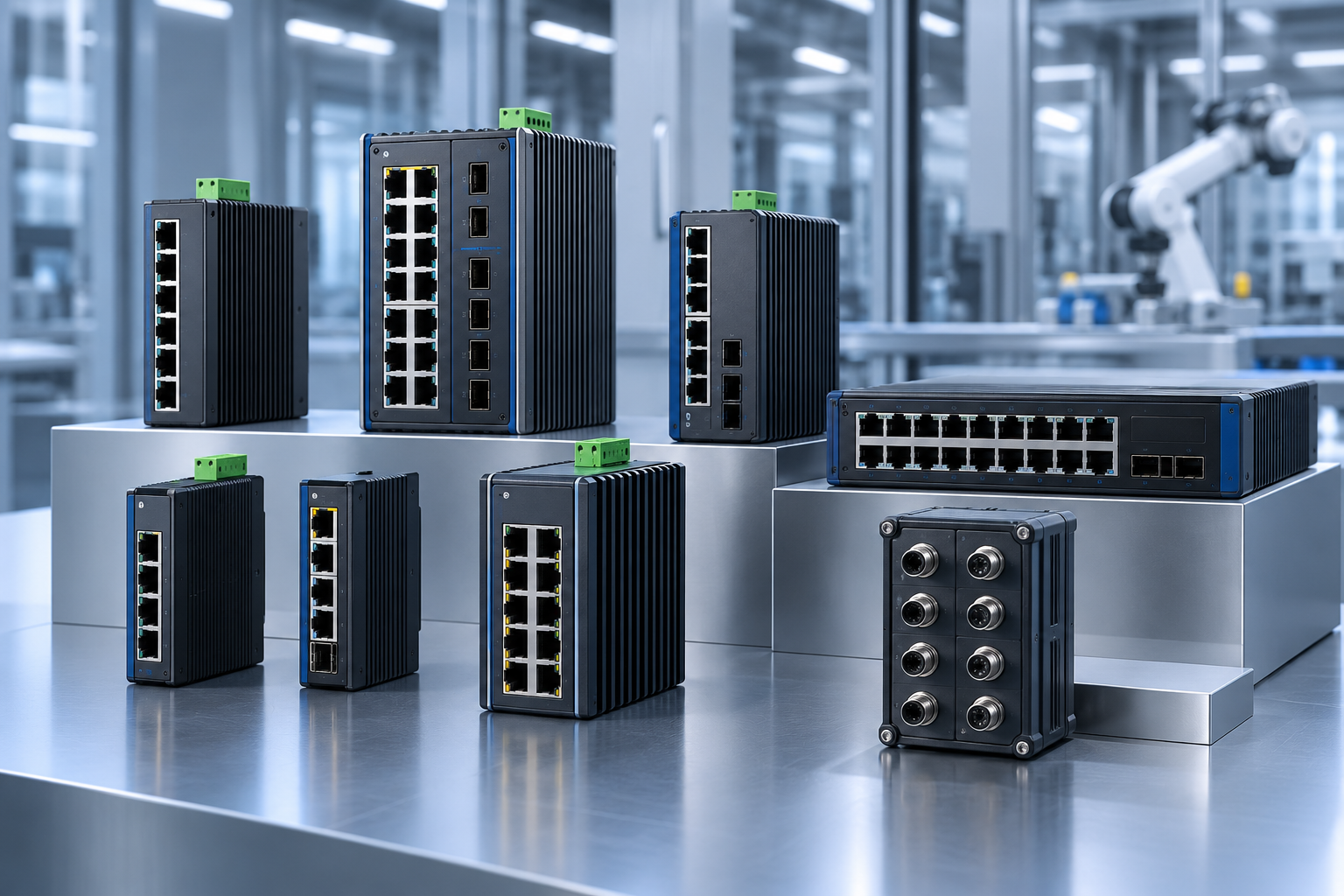
Which Industrial Ethernet Switch Types Should I Consider?
I believe a brand should begin by understanding its customers.
A company selling factory automation equipment may need different products from a brand serving CCTV installers.
At STAR FIRE TECH, our industrial communication range includes:
I recommend selecting models according to real application needs.
For example, a small control system may only require an unmanaged switch.
A larger network may need managed Layer 2 functions or Layer 3 routing.
A CCTV system may require PoE, while an industrial network with long-distance links may need SFP uplink options.
How Should I Match Products to Applications?
Target Market
Potential Product Requirements
Factory automation
Compact managed or unmanaged switches
CCTV surveillance
Industrial PoE switches
Smart cities
Industrial switches for distributed networks
Intelligent transportation
Reliable industrial connectivity
Machine vision
Gigabit ports and adequate switching capacity
Industrial parks
Managed switches and suitable network segmentation
Remote monitoring
Compact switches with appropriate uplinks
Power and energy
Application-specific reliability and compliance
Railway transportation
Models meeting relevant transport requirements
I would not assume that one model can serve every listed application.
Different projects may require specific temperature ratings, power supplies, redundancy protocols, or certifications.
I believe matching products to customer requirements is more useful than simply offering the largest possible catalog.
Why Does Portfolio Flexibility Matter?
Industrial networking brands may receive requests for different switch configurations.
One customer may need four Ethernet ports, while another requires eight ports and PoE.
A third customer may need a managed switch with fiber uplinks.
I believe working with a supplier that offers several product categories can make portfolio expansion easier.
However, I recommend checking product availability and long-term supply before adding a new model.
The brand should also confirm whether the manufacturer can provide consistent product documentation and technical support.
A broad portfolio creates opportunities only when the products can be supported reliably.
How Important Are MOQ, Lead Time, and Supply Chain Stability for OEM Brands?
A product may pass technical testing but still fail commercially if delivery is unreliable. Delayed shipments can affect product launches and customer confidence.
I recommend evaluating OEM industrial Ethernet switch manufacturers based on sample lead time, production capacity, component availability, MOQ flexibility, and delivery reliability. Brands should confirm realistic schedules and long-term supply arrangements before making commitments to customers.

How Can Sample Lead Time Affect Product Development?
I believe sample lead time is important when a brand is preparing to introduce a new product.
Before launching an industrial Ethernet switch, the brand may need to complete technical testing, packaging approval, and customer evaluation.
Long sample delays can slow these activities.
At STAR FIRE TECH, our typical sample lead time for applicable industrial Ethernet switch models is 3–5 days .
This can help brands begin product evaluation more quickly.
However, sample availability depends on the exact product and requested configuration.
I always recommend confirming sample preparation and shipping dates before planning a launch schedule.
Is Production Lead Time Different from Sample Lead Time?
Yes. I treat sample preparation and mass production as separate processes.
A sample may be available from an existing product platform.
A larger order may require material preparation, assembly, testing, and packaging.
At STAR FIRE TECH, our typical mass production lead time is approximately 30 days , subject to order quantity and configuration.
I recommend confirming the production schedule before placing an order.
I would also ask about component availability and the supplier's process for managing unexpected delays.
What Should I Ask About Long-Term Supply?
I believe long-term product availability is particularly important for industrial networking brands.
Customers may continue using the same switch model for several years.
A sudden hardware or firmware change can create compatibility issues.
I recommend discussing:
I would also ask whether the supplier can provide written notification before making important product changes.
This information can help brands manage customer expectations and reduce supply disruption.
How Can I Reduce OEM Industrial Ethernet Switch Manufacturing Costs Without Sacrificing Quality?
Brand owners need competitive prices, but choosing the cheapest supplier can create long-term problems. Product failures, excessive inventory, and poor support may cost more than the initial savings.
I recommend reducing OEM industrial Ethernet switch costs through suitable standard models, clear specifications, flexible MOQ, efficient product selection, and realistic purchasing plans. Brands should compare total costs rather than focusing only on unit price.
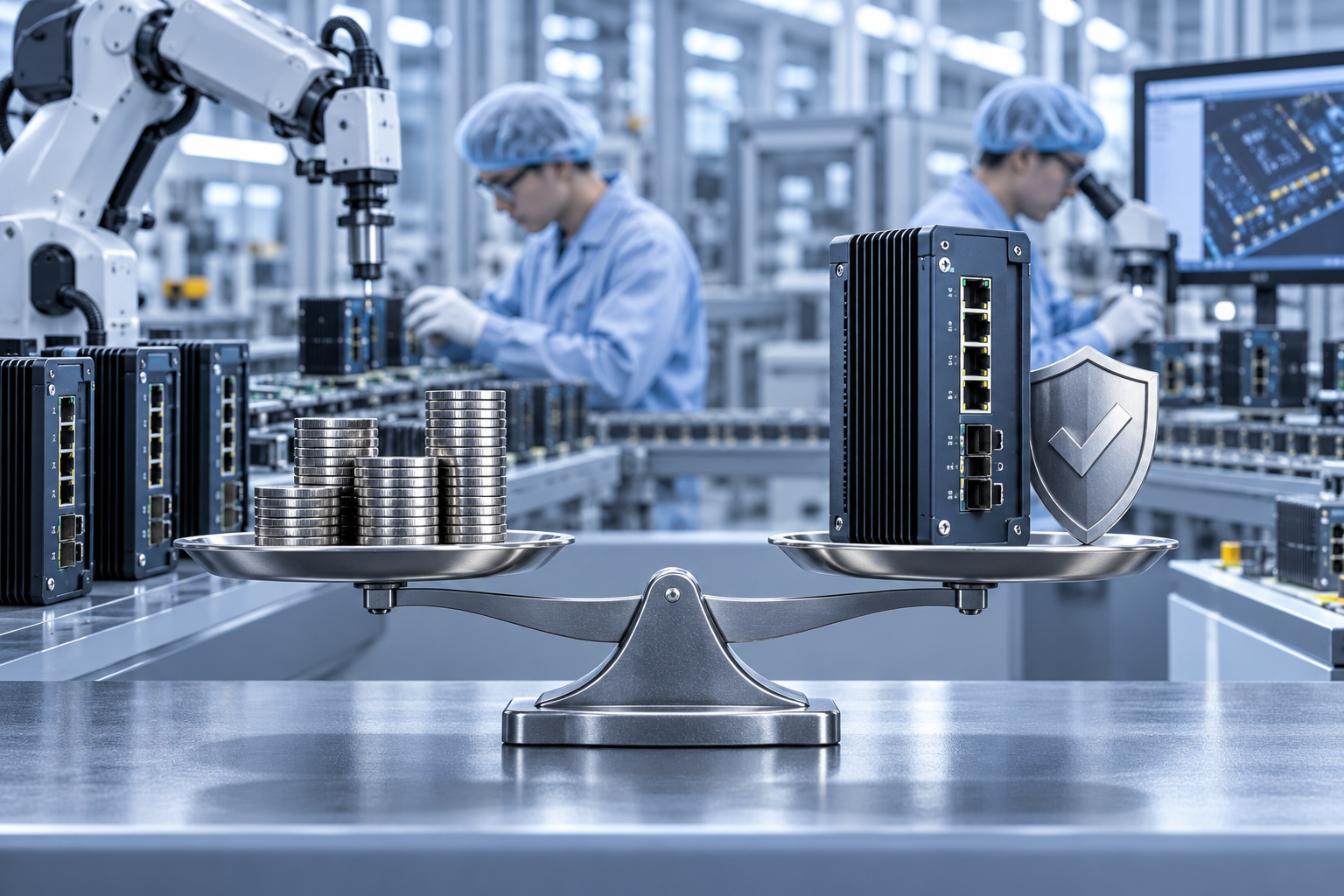
Why Is the Lowest Unit Price Not Always the Best Choice?
I believe purchasing price is only one part of the total cost.
A low-cost industrial Ethernet switch may appear attractive during supplier comparison.
However, the brand may face additional expenses if the product has quality problems or requires frequent replacement.
I recommend considering:
I would also check whether the quoted product includes the required power supply, mounting accessories, and management features.
A lower quotation may not include everything needed for the intended application.
How Can Standard Product Platforms Reduce Costs?
I recommend evaluating existing product models before requesting a fully customized design.
A standard platform may already provide the required Ethernet ports, network management functions, and industrial features.
If the product meets the technical requirements, the brand may only need selected changes to labeling or packaging.
This can reduce development work and simplify product testing.
However, I would not choose a standard model if it fails to meet important application requirements.
For example, a switch used in demanding transportation or power applications may need specific certifications and environmental performance.
I believe product suitability should come before cost reduction.
How Can STAR FIRE TECH Support Brand Owners?
At STAR FIRE TECH, we aim to help customers find suitable industrial communication products with flexible purchasing arrangements.
Our industrial Ethernet switch product range includes managed and unmanaged models, Layer 2, Layer 2+, and Layer 3 options, PoE and non-PoE configurations, and different port counts.
Our commercial advantages include:
Item
STAR FIRE TECH Offering
Industrial switch range
Unmanaged, managed, L2, L2+, L3
Ethernet speed
Fast Ethernet and Gigabit options
Port configurations
4, 8, 16, and 24 ports
PoE options
PoE and non-PoE
Special configurations
Desktop-style and M12 options
MOQ
From 1 piece for applicable models
Sample lead time
Typically 3–5 days
Mass production lead time
Approximately 30 days
Compliance
CE, FCC, RoHS, and REACH documentation for applicable models
Customization
Selected simple customization options
I believe flexible purchasing and a broad product range can help brands evaluate new market opportunities without unnecessary initial inventory.
However, I always recommend confirming the exact specifications, customization scope, availability, and commercial conditions before ordering.
For more information about our industrial Ethernet switch and connectivity solutions, please visit:
What Questions Should I Ask Before Choosing an OEM Industrial Ethernet Switch Manufacturer?
A supplier may promise low prices and fast delivery, but unclear terms can create problems after an order begins. I believe brand owners need a clear evaluation process.
Before choosing an OEM industrial Ethernet switch manufacturer, I recommend asking about product specifications, customization scope, testing procedures, compliance documentation, MOQ, production lead time, warranty, firmware support, and long-term availability. Clear written agreements help protect product quality and brand reputation.

What Should I Include in My First Inquiry?
I recommend providing enough project details for the supplier to evaluate the requirements.
My initial inquiry would include the intended application, target market, expected order quantity, and required delivery schedule.
I would also specify:
A detailed inquiry can reduce unnecessary communication and help suppliers recommend suitable models.
How Should I Compare Multiple OEM Suppliers?
I prefer using the same evaluation criteria for every supplier.
For example, I would request quotations for the same technical specifications and expected order quantities.
I would also compare sample availability, quality documentation, warranty terms, and production schedules.
If the products are not technically equivalent, I would not compare unit prices directly.
A lower-cost switch may have fewer functions or different environmental ratings.
I recommend requesting a sample from shortlisted suppliers and testing the products under the same conditions.
This provides stronger evidence than comparing marketing materials alone.
What Should I Confirm Before Placing the First Order?
I recommend confirming the approved sample and final product specifications in writing.
The agreement should define product configuration, labeling, packaging, delivery terms, payment conditions, and warranty responsibilities.
For managed switches, I would also confirm firmware version requirements and support arrangements.
If branding or design ownership is involved, I would clarify the related intellectual property terms.
I believe a successful OEM relationship depends on clear responsibilities from the beginning.
A manufacturer should understand what the brand expects, while the brand should understand what the manufacturer can realistically deliver.
This helps both sides build a stable and practical long-term partnership.
Conclusion
I believe a reliable OEM industrial Ethernet switch manufacturer should combine quality, flexibility, clear communication, and dependable delivery. The right partner helps protect your brand and support long-term growth.