Table Of Content
Table Of Content
 Why Outdoor Surveillance Needs the Right PoE Switch Outdoor surveillance projects often look simple at the beginning: install cameras, connect cables, and send video back to the control center. But in real projects, customers may face unstable video, camera rebooting, long-distance transmission issues, cabinet overheating, lightning risk, and maintenance difficulty. That is why choosing the right industrial PoE switch is critical for IP camera and outdoor monitoring systems. The switch must support stable power delivery and stable data transmission at the same time.
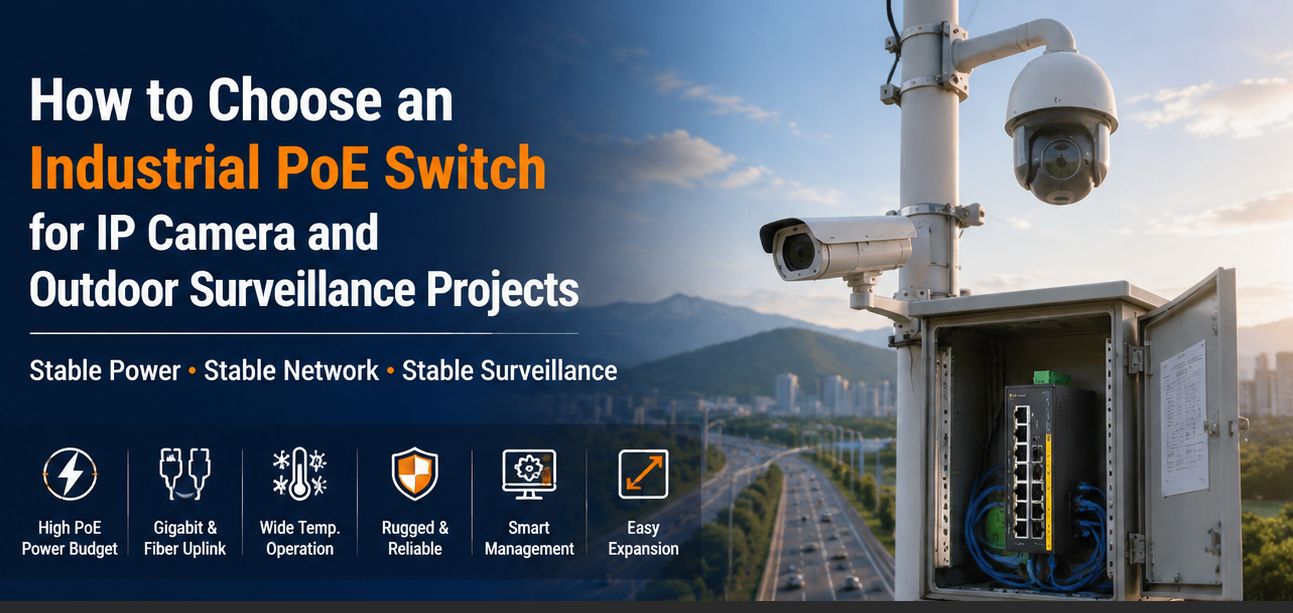
- Calculate the PoE Power Budget Different cameras have different power requirements. Cameras with infrared night vision, PTZ movement, heaters, or outdoor protection may consume more power than basic indoor cameras. Customers should calculate the total power demand and leave enough margin. A switch with insufficient PoE budget can cause cameras to disconnect or reboot during peak load, especially at night when infrared functions turn on.
- Plan the Uplink Design Multiple cameras can generate heavy video traffic. If all camera data is sent through a weak uplink, video may freeze, delay, or lose clarity. Gigabit uplinks and fiber SFP ports are useful for aggregating camera traffic and sending it over long distances. Fiber is especially valuable for outdoor, roadside, highway, tunnel, and industrial park networks because it supports distance and resists electromagnetic interference.
- Match the Switch to the Environment Outdoor surveillance switches are often installed in cabinets exposed to heat, cold, dust, vibration, moisture, and unstable power. A commercial PoE switch may not be suitable for this type of deployment. Industrial PoE switches with wide temperature range, rugged housing, DIN-rail mounting, EMC protection, and dual power input can help reduce failure risk and lower maintenance pressure.

- Use Management Features for Larger Systems In large surveillance systems, managed switches can help engineers monitor port status, check camera connections, separate traffic with VLANs, and prioritize video transmission with QoS. Remote management is especially valuable because many camera sites are difficult or expensive to visit. Engineers can check network status without opening every roadside cabinet or traveling to every camera location.
- Leave Room for System Expansion Customers should not only design for the cameras installed today. Future cameras, wireless devices, access control terminals, or edge devices may need additional ports and power. Planning extra capacity can reduce future upgrade cost and make the network easier to expand when the project grows.

Customer Application Scenarios Industrial PoE switches are widely used in highways, tunnels, parking areas, industrial parks, energy sites, factories, warehouses, and outdoor security systems. In these applications, one unstable switch can affect multiple cameras and create blind spots in monitoring. Stable connectivity helps customers maintain clear video, faster response, and stronger safety management.  STAR FIRE TECH Perspective At STAR FIRE TECH, we help customers choose industrial PoE switch solutions based on camera quantity, total wattage, uplink distance, environment, cabinet space, and management needs. A suitable PoE switch helps customers simplify cabling, reduce installation cost, improve video stability, and lower long-term maintenance pressure. For surveillance networks, stable signal means clear image. Clear image means faster response. Reliable connectivity creates real project value.
FAQ Q: How do I calculate PoE power budget for cameras? A: Add the maximum power consumption of all cameras and keep extra margin for peak load and future expansion. Q: Why do outdoor cameras reboot at night? A: Infrared lighting or heaters may increase power demand at night, and an insufficient PoE budget can cause rebooting. Q: Why use fiber uplinks in surveillance projects? A: Fiber supports long-distance transmission and helps reduce EMI-related signal problems. Q: Do surveillance networks need managed switches? A: Large or critical surveillance networks often benefit from VLAN, QoS, monitoring, and remote management. Q: What features matter for outdoor PoE switches? A: Wide temperature range, rugged housing, dual power input, EMC protection, Gigabit uplinks, and enough PoE power budget.
#IndustrialPoESwitch #IPCamera #OutdoorSurveillance #PoEBudget #FiberUplink #SecurityNetwork #IndustrialEthernet #TrafficMonitoring #RuggedSwitch #STARFIRETECH