Table Of Content
Table Of Content

In a PLC network, the cable is not just a passive component. It is part of the communication channel, the EMC strategy, the machine mechanics, and the maintenance plan.
A PLC may communicate perfectly on a bench yet become unstable after installation because the cable was selected by connector size alone. In industrial automation, an M12 cable must survive electrical noise, vibration, oil, repetitive motion, temperature changes, washdown, and years of mating cycles while preserving signal integrity.
For engineers, system integrators, machine builders, and Pro AV professionals working with converged Ethernet infrastructures, the right question is not simply, “Which M12 cable fits the port?”
The better question is:
What does the complete communication channel need to survive?
Start With the Protocol and Data Rate
The first decision is electrical, not mechanical.
PLC networks commonly use PROFINET, EtherNet/IP, or EtherCAT. Many PLC-to-I/O, drive, sensor, and machine-control links still operate at 100 Mbps, where a properly designed 4-position M12 D-coded Ethernet cable is widely used.
D-code is a strong choice for:
- 100 Mbps Industrial Ethernet
- PROFINET or EtherCAT device connections
- Rugged IP-rated field connectivity
- Compact machine-level installation
But industrial networks are becoming more data-intensive.
Machine vision cameras, industrial PCs, managed switches, edge computers, data aggregation points, and AV-over-IP systems can require more bandwidth. When Gigabit Ethernet or multi-gigabit capability is required, engineers should evaluate M12 X-code.
X-coded M12 uses eight contacts and four data pairs. Its internal pair separation helps reduce crosstalk and supports Cat 6A-class channels and data rates up to 10 Gb/s when the entire channel is designed accordingly.
The engineering lesson is simple:
Do not specify the connector before you know the bandwidth.
Select the Coding for the Function
M12 is not one universal interface. Coding prevents incompatible connections and separates signal, data, and power functions.
For PLC networking, three distinctions matter most:
M12 A-code
Commonly used for sensors, actuators, analog/digital signals, and device-level I/O.
M12 D-code
A four-position interface commonly used for 100 Mbps Industrial Ethernet.
M12 X-code
An eight-position, four-pair interface for higher-performance Ethernet, including Gigabit and up to 10 Gb/s applications.
Other M12 codings serve power or hybrid functions, but they are not interchangeable with Ethernet data interfaces.
This sounds basic, yet many RFQs still say only “M12 Ethernet cable” without defining coding, pinout, data rate, or device interfaces.
A professional RFQ should never stop at the words “M12 cable.”
Treat Shielding as Part of the Network Architecture
PLC networks rarely operate in electrically quiet environments.
VFDs, servo drives, motors, contactors, welding equipment, switching power supplies, and high-current conductors can generate electromagnetic interference.
For a shielded M12 Ethernet assembly, evaluate:
- Foil and braid construction
- Braid coverage
- 360-degree shield termination
- Shield continuity through the connector shell
- Grounding strategy at the equipment level
A cable can be “shielded” on a datasheet and still perform poorly if shield termination is weak.
At higher Ethernet frequencies, connector geometry and shield bonding become part of the transmission path. For Pro AV engineers moving into industrial AV-over-IP, control rooms, transportation, or broadcast environments, the principle is familiar: network reliability is a channel problem, not merely a cable problem.
Choose the Jacket for the Real Environment
PVC may be suitable for fixed indoor installations with limited motion. But many PLC networks live on machines where cables encounter oil, abrasion, coolant, flexing, robotic movement, or outdoor exposure.
PUR is frequently used because it can provide a strong combination of abrasion resistance, oil resistance, flexibility, and mechanical durability.
TPE can also be an excellent option for applications requiring high flexibility, low-temperature performance, or specialized continuous-motion behavior.
But “PUR” or “TPE” alone does not define cable life.
Performance depends on the complete construction:
- Conductor stranding
- Pair geometry
- Shield structure
- Insulation
- Jacket formulation
- Connector overmolding
- Strain relief
- Bend radius
- Torsion profile
A premium jacket cannot compensate for a poor conductor or termination design.
Fixed Installation and Drag Chain Are Different
One of the most common mistakes is using a flexible cable where a true continuous-flex cable is required.
A cable that feels flexible by hand is not necessarily drag-chain rated.
For moving PLC equipment, ask for validated values such as:
- Dynamic bend radius
- Flex-cycle count
- Traversing distance
- Speed and acceleration
- Torsion angle
- Dynamic temperature range
Current industrial PROFINET drag-chain assemblies can be specified for millions of bending cycles, but that number only has meaning when the test radius, travel, speed, and acceleration are also known.
“3 million flex cycles” is not a complete specification.
Motion life is a test condition, not a marketing number.

Check IP Rating—But Do Not Stop There
M12 is widely chosen because it supports rugged field connectivity, often with IP65/IP67 protection when correctly mated.
But an IP rating does not automatically prove long-term resistance to:
- Repeated washdown
- Oils and coolants
- UV
- Salt spray
- Thermal cycling
- Vibration
- Cable-entry fatigue
For packaging, food processing, transportation, outdoor equipment, and smart manufacturing, engineers should review the actual exposure profile.
Also remember: an IP-rated connector is only IP-rated when properly mated and installed according to specification.
Match the Cable to the Entire PLC Topology
The strongest M12 cable cannot fix a poorly designed network.
Map the complete topology:
PLC → industrial Ethernet switch → remote I/O → servo drive → machine vision camera → HMI → edge computer.
Then ask:
Where are the highest-bandwidth links?
Where is EMI strongest?
Which cables move?
Where will M12-to-RJ45 transitions occur?
Which links may need future Gigabit capacity?
Where would downtime be most expensive?
This often produces a mixed architecture:
- M12 D-code for 100 Mbps PLC-to-I/O links
- M12 X-code for Gigabit uplinks or high-data devices
- High-flex PUR assemblies on robot axes
- Fixed-installation cable inside protected routing
- M12-to-RJ45 assemblies at switch or cabinet transitions
That is better engineering than forcing one cable type across the whole machine.
Do Not Ignore Termination and Installation
Many intermittent network problems begin at the termination.
Poor conductor preparation, weak shield contact, excessive pair untwisting, incorrect torque, contamination, and tight bending immediately behind the connector can all reduce reliability.
For high-performance Ethernet, pair geometry must be preserved as close to the termination as possible.
Factory-molded assemblies provide repeatable termination quality. Field-attachable connectors remain useful, but they require disciplined installation.
Mating torque matters too.
Too loose can compromise sealing and shield continuity. Too tight can damage the connector.
Think Beyond Today’s PLC
Factories are becoming more data-intensive. PLC networks increasingly coexist with machine vision, predictive maintenance, edge computing, robotics, smart sensors, and centralized monitoring.
The same convergence is happening in Pro AV.
Control rooms, broadcast systems, digital signage, AV-over-IP endpoints, transportation hubs, and smart buildings increasingly share Ethernet-based infrastructure with automation systems.
That does not mean every PLC cable should be upgraded to 10 Gb/s.
It means engineers should identify the links where future bandwidth matters before the machine is built.
Good engineering is not maximum specification.
It is the correct specification with sufficient margin.
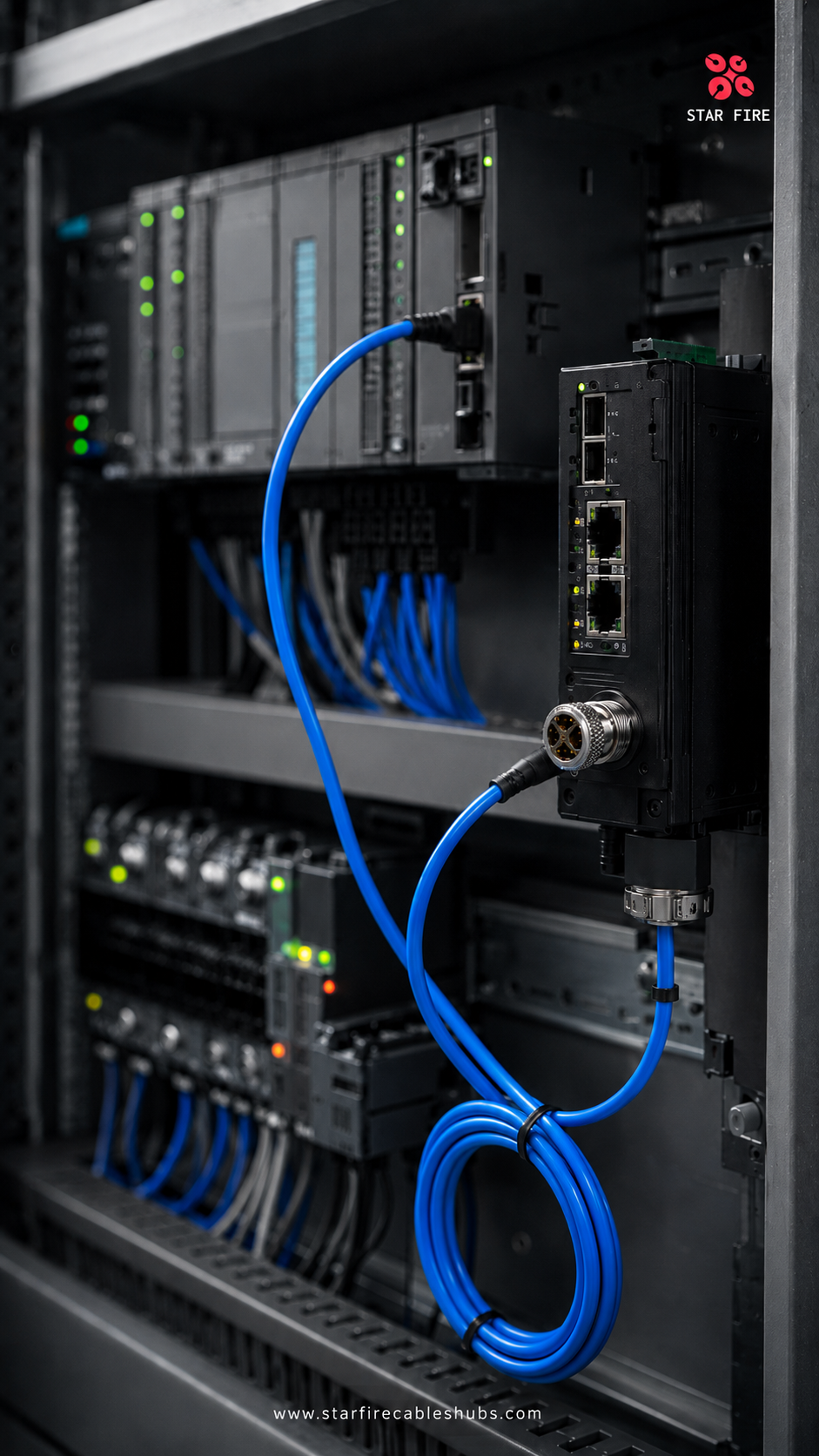
A Practical M12 Cable Selection Checklist
Before approving an M12 cable for a PLC network, confirm:
- Protocol — PROFINET, EtherNet/IP, EtherCAT, or another Industrial Ethernet protocol?
- Data rate — 100 Mbps, 1 Gb/s, or higher?
Coding — A, D, X, or another coding appropriate to the function?
Shielding — Is 360-degree shield continuity maintained?
Installation mode — Fixed, flexing, drag chain, torsion, or robotic motion?
Jacket — PVC, PUR, TPE, or another compound based on oil, abrasion, temperature, UV, and chemical exposure?
Environment — Required IP level, temperature range, washdown, and vibration?
Bend radius — Fixed and dynamic requirements?
Interfaces — M12-to-M12, M12-to-RJ45, straight, angled, male, female?
Validation — Does the supplier provide electrical, mechanical, and reliability data relevant to the application?
The Bigger Idea: Design the Channel, Not the Cable
After two decades in connectivity and Pro AV, one lesson remains consistent: system failures rarely respect product-category boundaries.
A network issue may begin as a connector problem, shielding problem, bend-radius problem, grounding problem, topology problem, or materials problem—and appear later as intermittent PLC communication.
That is why an M12 cable should not be purchased as a commodity line item.
It should be engineered as part of the communication channel.
At STAR FIRE TECH, we work across M8/M12 cable assemblies, Industrial Ethernet, high-speed copper, Hybrid AOC, and Pro AV connectivity. That cross-domain experience matters as factory automation, machine vision, edge networking, and AV-over-IP continue to converge.
The goal is not to specify the most expensive cable.
The goal is to build a network that remains stable after installation, after motion, after temperature cycles, and after years of operation.
That is the standard by which an industrial cable should be judged.