Table Of Content
Table Of Content
How to Choose M12 Cables for Machine Vision Systems
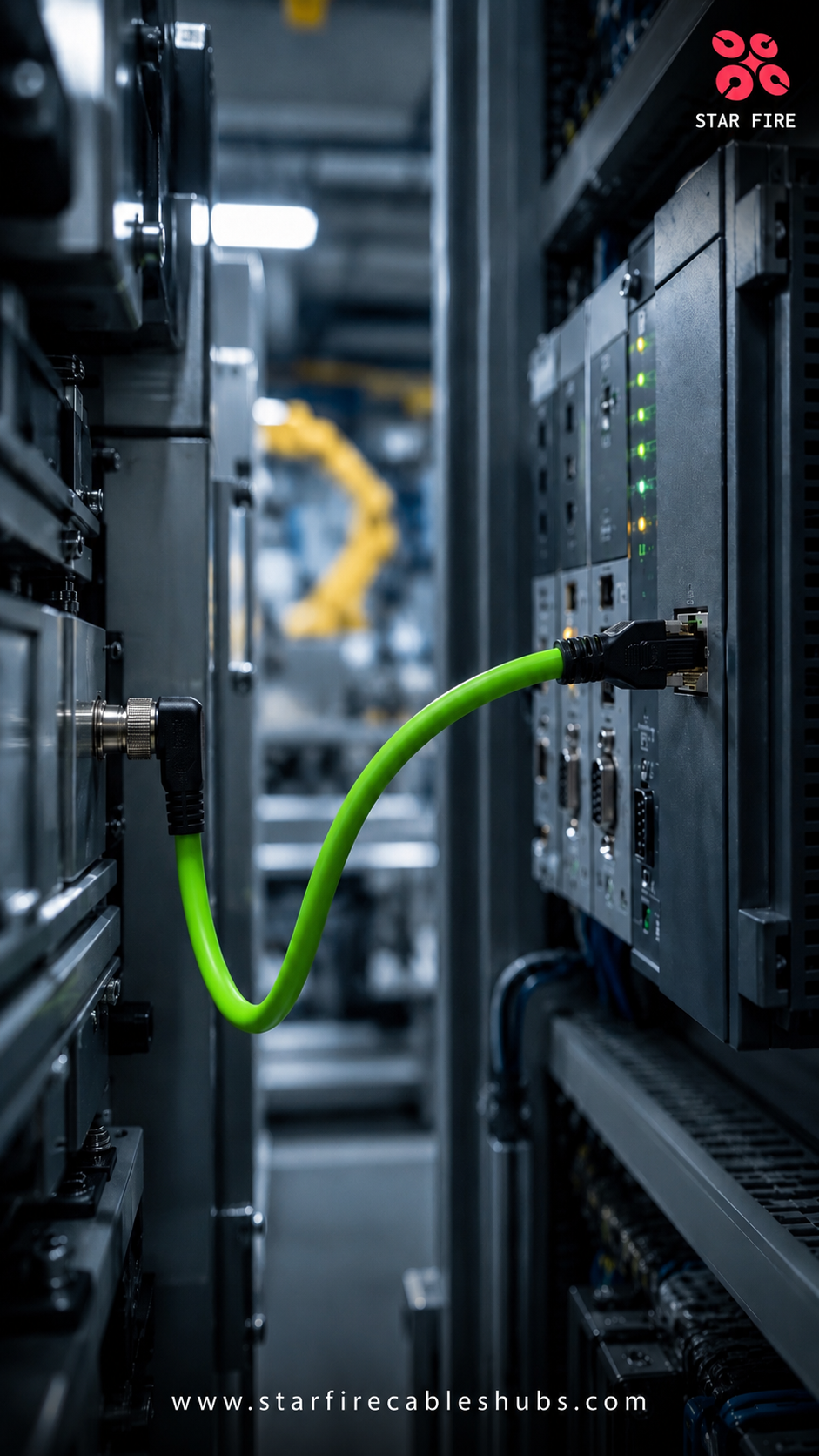
Machine vision systems depend on stable data transmission. Cameras, lighting controllers, sensors, industrial PCs, and switches must work together with very low communication errors.
When image data is delayed or interrupted, the problem may appear as missing frames, unstable inspection results, trigger errors, or inconsistent machine performance.
For customers, this is not just a cable problem. It can directly affect inspection accuracy, production efficiency, and quality control.
Why Machine Vision Is Sensitive to Cable Quality
Machine vision applications often require high-speed data, stable power, precise triggering, and reliable communication in a compact installation space.
At the same time, machine vision equipment may be installed near motors, drives, moving platforms, or other electrical equipment. This means the cable must handle both signal performance and environmental stress.
If the cable has poor shielding, weak connector stability, or unsuitable bending performance, the system may experience interference, packet loss, or unstable camera communication.

Key Factors When Choosing M12 Cables
For machine vision systems, customers should consider several technical factors.
First, choose the right connector coding. A-coded M12 connectors are commonly used for sensors and power connections. D-coded and X-coded M12 connectors are often used for industrial Ethernet communication.
Second, check the required data speed. Higher-resolution cameras and real-time inspection systems may require higher bandwidth and better signal performance.
Third, evaluate the installation environment. If the cable is installed near moving parts, drag chains, or robotic arms, high-flex cable construction is important. If the environment has dust, moisture, or oil, jacket material and IP protection should also be considered.
Fourth, consider connector direction. Straight and angled M12 connectors can help customers solve different space and routing challenges inside machines.

What Customers Should Avoid
Customers should avoid selecting cables only by connector appearance. Two M12 cables may look similar, but their internal structure, shielding, jacket material, and flex performance can be very different.
A low-cost cable may pass basic testing but fail in real production conditions. For machine vision systems, unstable connection can create hidden quality risks.
STAR FIRE TECH Perspective
At STAR FIRE TECH, we support customized M8 and M12 cable assemblies for machine vision and industrial automation applications.
Our solutions can include A-code, D-code, X-code, RJ45 connection, straight or angled connectors, male or female versions, PUR or TPE jackets, shielding options, and high-flex structures for moving equipment.
For customers, the goal is to build a more stable machine vision system with reliable signal transmission, stronger connector protection, and better long-term performance.
FAQ
Q: Why are M12 cables used in machine vision systems?
A: M12 cables provide reliable industrial connections for cameras, sensors, triggers, and Ethernet communication in automation environments.
Q: Which M12 coding is suitable for industrial Ethernet?
A: D-coded and X-coded M12 connectors are commonly used for industrial Ethernet applications.
Q: What causes unstable camera communication?
A: Common causes include poor shielding, cable bending damage, connector looseness, EMI interference, and insufficient cable quality.
#MachineVision #M12Cable #IndustrialEthernet #VisionSystem #IndustrialCamera #AutomationCable #XCodeM12 #DCodeM12 #FactoryAutomation #STARFIRETECH