Table Of Content
Table Of Content
Finding an industrial Ethernet switch supplier can be difficult when you only need a few units. High minimum orders can waste money, delay testing, and create unnecessary inventory.
To find a low-MOQ industrial Ethernet switch supplier, I recommend checking minimum order quantities, available switch models, sample lead times, technical specifications, and quality documentation. A reliable supplier should support small orders without compromising product compatibility, delivery reliability, or technical support.
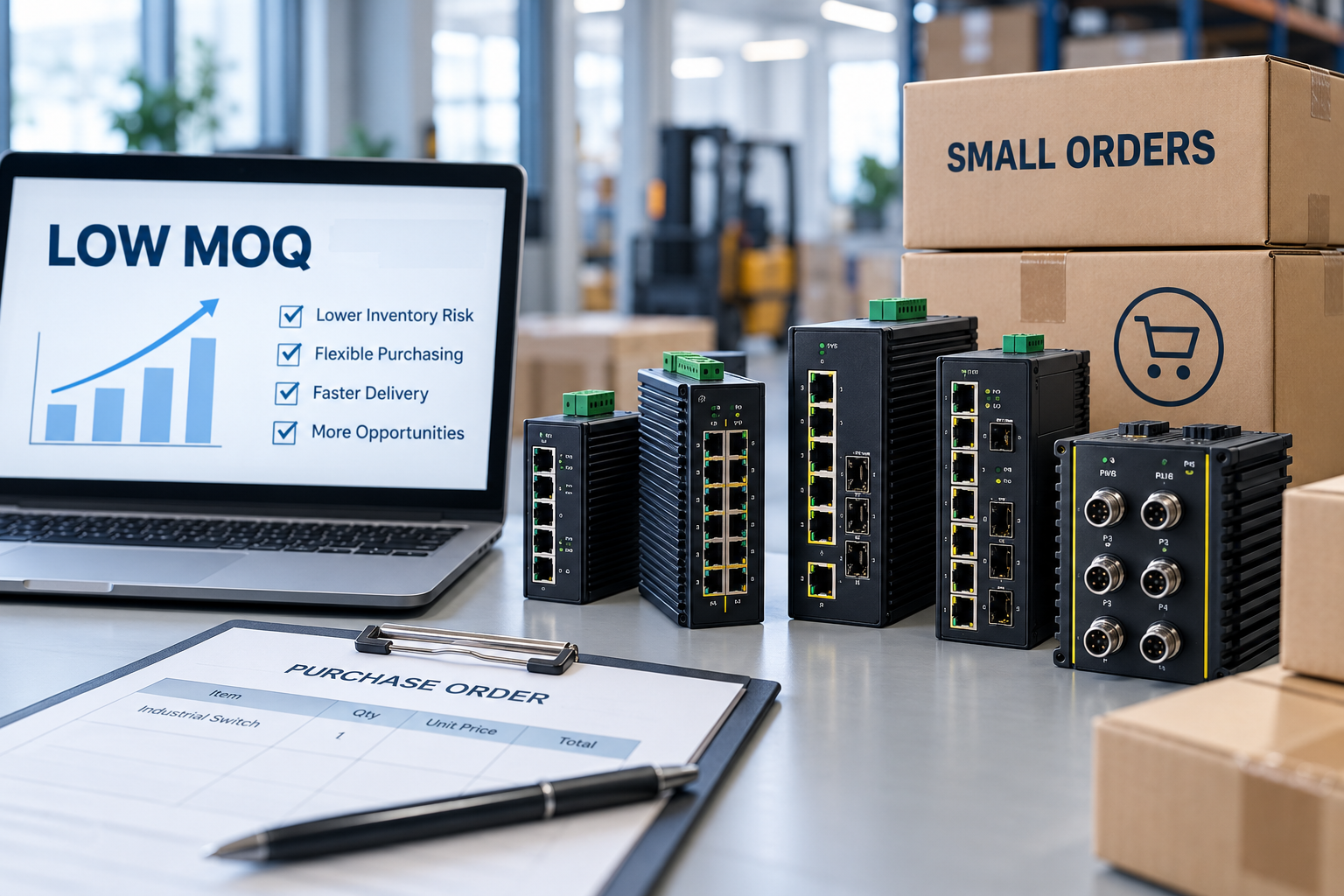
I believe industrial Ethernet switch purchasing has changed as more businesses handle smaller, specialized projects.
A distributor may need a few units to test a new product line. A system integrator may require only one switch for a factory upgrade. An equipment manufacturer may need a sample before approving a design.
In these situations, placing a large order makes little sense.
However, finding a supplier with a low MOQ is only the beginning. Buyers also need to check product quality, technical compatibility, and delivery reliability.
At STAR FIRE TECH, we have worked in connectivity solutions since 2006. Our industrial communication product range includes unmanaged, managed, Layer 2, Layer 2+, and Layer 3 industrial Ethernet switches.
In this article, I will explain how I would evaluate a low-MOQ industrial Ethernet switch supplier and avoid common purchasing problems.
What Is the Minimum Order Quantity for Industrial Ethernet Switches?
Some suppliers require large orders even when customers only need samples. This can make product testing expensive and create unnecessary inventory before demand is confirmed.
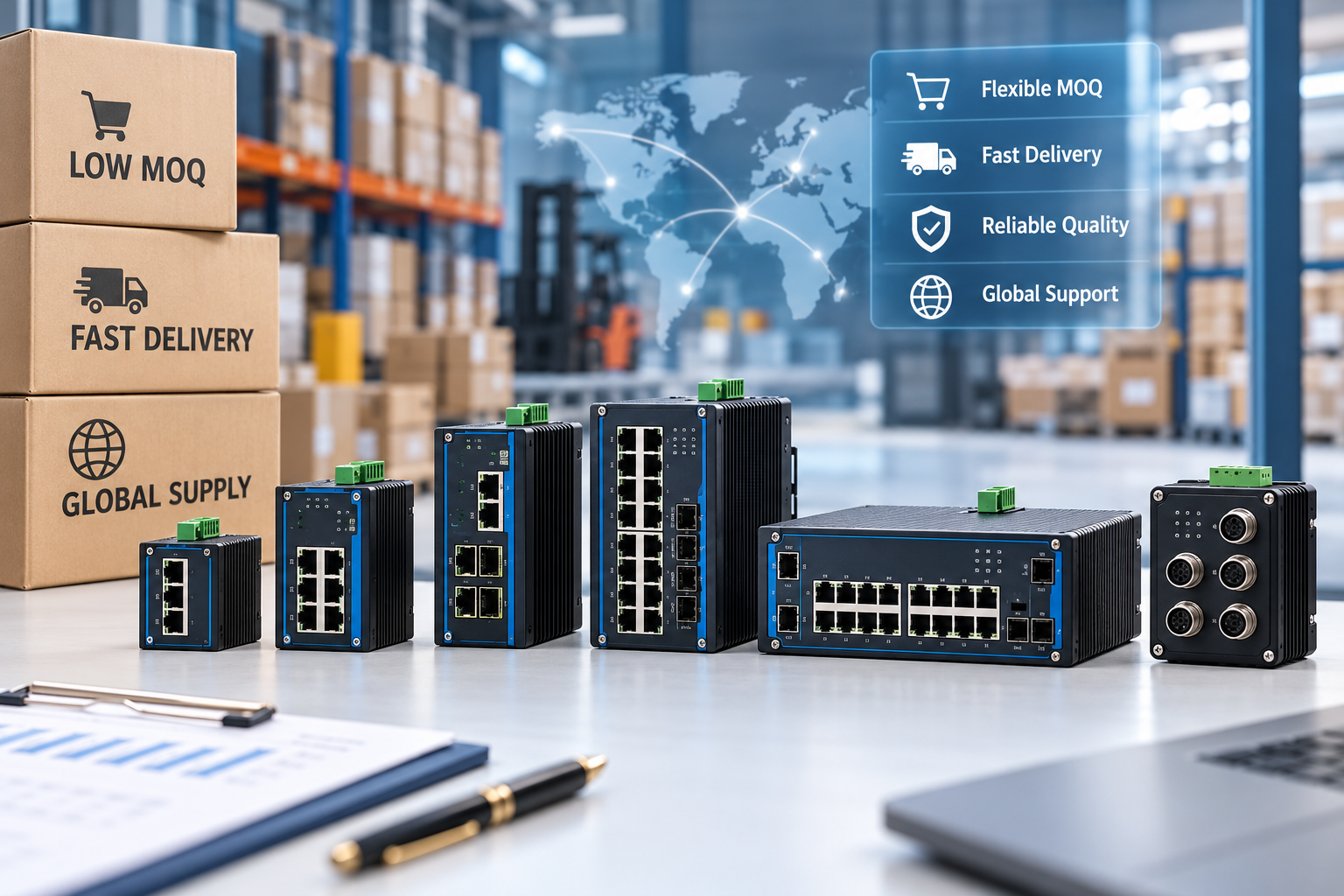
The minimum order quantity for industrial Ethernet switches depends on the supplier, model, and customization requirements. Some manufacturers support single-unit evaluation orders, while others require larger quantities. I recommend confirming the MOQ for the exact configuration before requesting a quotation.
Why Do Industrial Ethernet Switch MOQs Vary?
I believe buyers should understand why suppliers set different minimum order quantities. Industrial Ethernet switches contain circuit boards, chipsets, connectors, power components, and protective housings. Manufacturers must also consider production setup, assembly, testing, and packaging costs.
When a product is already available as a standard model, the supplier may be able to offer a small order quantity. However, a fully customized switch may require new hardware, firmware changes, or dedicated production arrangements. These requirements can increase the minimum order quantity.
I recommend separating three purchasing situations:
These categories may have very different purchasing conditions.
Can You Buy Just One Industrial Ethernet Switch?
Yes, some suppliers support single-unit orders for selected models. At STAR FIRE TECH, we support orders starting from 1 piece for applicable industrial Ethernet switches and simple customization requirements.
This can be useful for distributors, system integrators, and equipment manufacturers who want to evaluate a product before purchasing larger quantities. However, I would confirm the exact model and requested changes before promising a single-unit order.
For example, changing a product label may be easier than developing a new circuit board or adding a special network interface. I believe clear communication at the beginning helps prevent misunderstandings about MOQ and customization costs.
How Does MOQ Affect Purchasing Risk?
I recommend comparing the initial investment required by different suppliers. The following figures are an illustrative purchasing example, not actual market quotations.
Purchasing Item
High-MOQ Supplier
Low-MOQ Supplier
Minimum order
100 units
1 unit
Example unit price
USD 150
USD 150
Initial product cost
USD 15,000
USD 150
Inventory commitment
Higher
Lower
Sample evaluation
Larger initial purchase
Small initial purchase
Demand testing
More financial exposure
Less financial exposure
The difference in initial investment can be significant. However, I do not recommend choosing a supplier based on MOQ alone. Smaller orders may have higher unit prices or shipping costs. I always consider total purchasing cost, lead time, and product reliability before making a decision.
How Do I Choose a Reliable Industrial Ethernet Switch Supplier?
A low MOQ may look attractive, but poor product quality can create expensive problems. Industrial networks need reliable equipment, especially in demanding environments.
I recommend choosing an industrial Ethernet switch supplier based on product specifications, quality control, technical documentation, compliance records, delivery capability, and after-sales support. A low MOQ is useful only when the supplier can also provide suitable products and dependable service.
What Should I Check Before Contacting a Supplier?
I usually begin by checking whether the supplier offers the types of switches required for the project. Industrial Ethernet switches are available in many configurations. Some models are designed for simple local networks. Others provide advanced management functions and routing capabilities.
I recommend confirming the following details:
A supplier with a broad product range may help buyers compare several suitable options. However, I always check the exact model specifications instead of assuming that every switch supports the same functions.
Why Does Quality Control Matter?
Industrial Ethernet switches may operate continuously in factory environments. Electrical interference, temperature changes, vibration, and power instability can affect equipment reliability. I believe buyers should request technical documents and test information for the exact product being considered.
For example, I would ask whether the supplier can provide:
I would also ask how the supplier handles defective units. A clear warranty and replacement process can be important for distributors supporting overseas customers.
What Certifications Should an Industrial Ethernet Switch Have?
Certification requirements depend on the country and application. For example, buyers may need to consider CE, FCC, RoHS, REACH, or other market-specific requirements.
At STAR FIRE TECH, our industrial switch range includes products with CE, FCC, RoHS, and REACH compliance documentation. I recommend checking the documents for each specific model and destination market. I would not assume that one certification covers every industrial application.
Railway, hazardous-area, energy, and other specialized projects may require additional approvals. I believe checking compliance requirements before ordering is much easier than solving documentation problems after production.
What Is the Difference Between Managed and Unmanaged Industrial Ethernet Switches?
Buyers sometimes focus on price and port count while overlooking network management requirements. This can lead to equipment that cannot support the project's network design.
An unmanaged industrial Ethernet switch provides basic Ethernet connectivity without user-configured management functions. A managed industrial Ethernet switch can support features such as VLANs, network monitoring, traffic priority, and redundancy, depending on the model. I recommend choosing based on actual network requirements.
When Should I Choose an Unmanaged Industrial Switch?
I often consider unmanaged industrial Ethernet switches for small and simple networks. For example, a machine manufacturer may need to connect a PLC, an HMI, and several industrial devices.
If the network does not require VLAN configuration, advanced monitoring, or managed redundancy, an unmanaged switch may be sufficient. Unmanaged switches are generally easier to install because they do not require extensive configuration.
They can also offer a more economical solution for straightforward applications. However, I would still check the operating environment and network traffic requirements. A simple network does not remove the need for reliable industrial hardware.
When Is a Managed Industrial Ethernet Switch Better?
I recommend managed switches when the network requires additional control and monitoring. For example, a factory may need to separate production traffic from monitoring traffic.
A managed Layer 2 switch may provide VLAN support, QoS, port monitoring, and network redundancy functions. A suitable Layer 3 switch can add IP routing between different network segments.
However, the exact features depend on the selected product. I always verify whether the proposed model supports the protocols required by the project.
How Can I Compare Industrial Switch Types?
Switch Type
Main Characteristics
Typical Applications
Unmanaged
Basic Ethernet switching
Small machine networks
Managed Layer 2
VLANs and network management
Factory automation
Layer 2+
Advanced management and possible limited routing
Industrial network aggregation
Layer 3
IP routing and network management
Larger industrial networks
Industrial PoE
Ethernet data and compatible device power
CCTV and remote monitoring
M12 Industrial Switch
Industrial M12 connectivity
Vibration-prone installations
I consider this comparison a useful starting point. However, a category name alone cannot confirm every supported function. I recommend requesting the exact datasheet before placing an order.
How Can I Find an Industrial Ethernet Switch Supplier with Fast Delivery?
A supplier may accept small orders but still take weeks to ship. This can delay product evaluation and make urgent industrial projects difficult to complete.
To find an industrial Ethernet switch supplier with fast delivery, I recommend checking sample availability, standard model stock, customization requirements, and production lead times. Buyers should confirm the exact shipping schedule rather than relying only on general delivery claims.
Why Is Sample Lead Time Important?
I believe sample delivery can strongly affect the progress of a new industrial networking project. A system integrator may need to test a switch before approving it for a factory installation. An equipment manufacturer may need to check compatibility with PLCs, industrial cameras, or control systems.
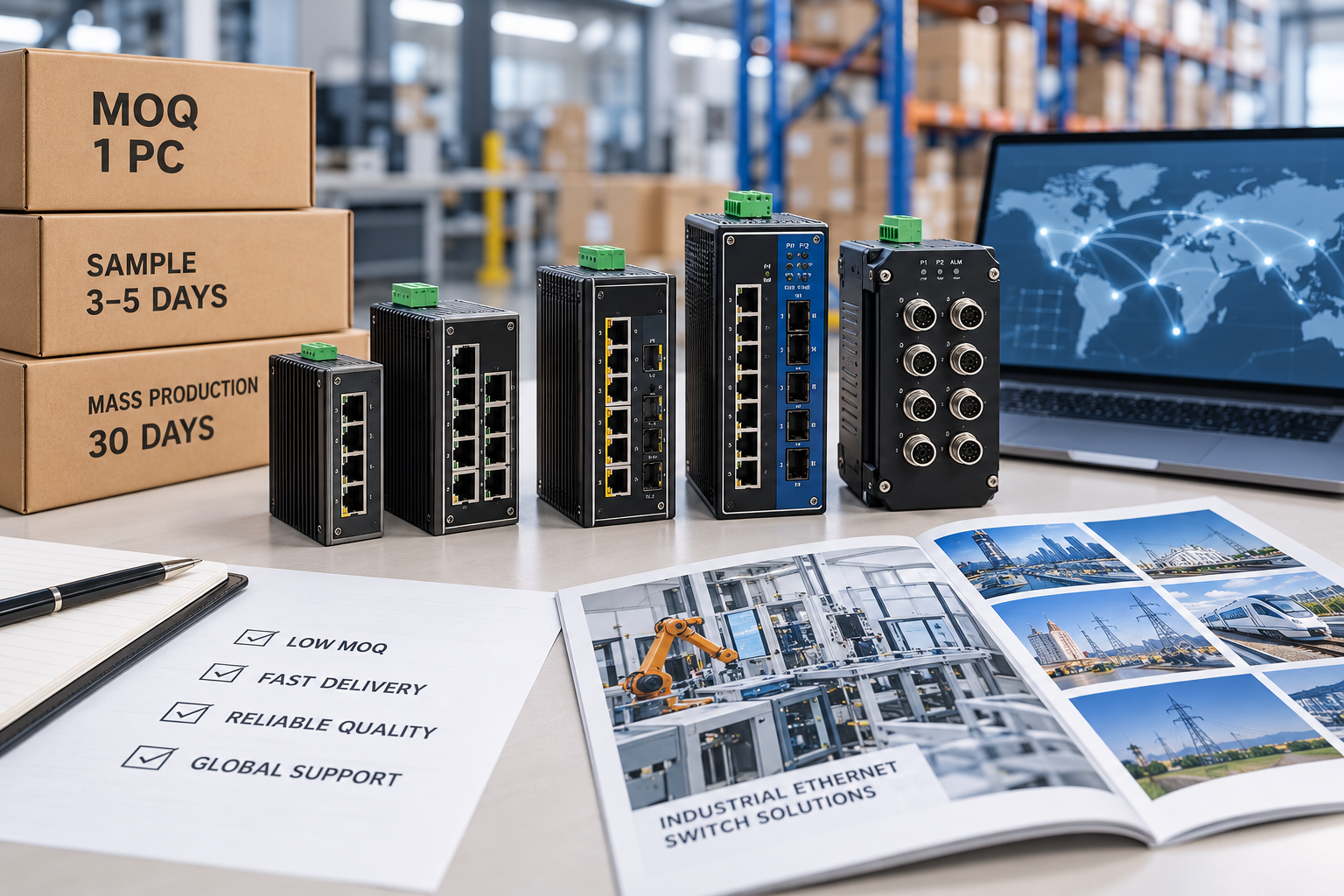
If sample delivery takes too long, product evaluation may delay the entire project. At STAR FIRE TECH, our typical industrial Ethernet switch sample lead time is 3–5 days, subject to model availability and configuration.
This gives buyers an opportunity to begin product evaluation without waiting for a full production order. However, I always recommend confirming the shipping date before making commitments to an end customer.
Is Sample Lead Time the Same as Production Lead Time?
No. I consider sample lead time and mass production lead time separate purchasing conditions. A sample may be available from existing stock or prepared using an established product configuration.
A production order may require component purchasing, assembly, quality testing, and packaging. At STAR FIRE TECH, the typical mass production lead time is approximately 30 days.
The actual schedule depends on the order quantity, customization requirements, and material availability. I recommend asking suppliers to confirm both timelines in writing.
What Questions Should I Ask About Delivery?
Before selecting a supplier, I would ask:
I believe reliable delivery information is more useful than a promise of the shortest possible lead time. For overseas customers, I would also consider international transportation and customs clearance. A product may leave the factory quickly but still require additional time to reach the final destination.
Can I Order Customized Industrial Ethernet Switches in Small Quantities?
Some industrial projects require special product configurations, but traditional customization often involves high minimum orders. This can discourage buyers from evaluating new solutions.
Small-quantity customization is possible when a supplier supports changes to existing industrial Ethernet switch models. Options may include labeling, branding, packaging, or selected configurations. More complex hardware and firmware changes may require higher MOQs, engineering costs, and longer development schedules.
What Customization Options Are Available?
I usually separate customization into simple changes and more complex engineering work. Simple customization may include:
More complex customization may involve:
I believe the supplier should clearly explain which changes are available on existing products. A customer may not need a completely new design. Sometimes, an existing industrial switch model can meet the project requirements with minor adjustments. This can reduce development time and purchasing risk.
Why Does Small-Batch Customization Matter?
Small-batch customization can be valuable for distributors and equipment manufacturers. For example, a distributor may want to evaluate a privately labeled industrial switch before introducing it into a new market.
An equipment manufacturer may need to confirm whether a particular switch fits inside a machine control cabinet. A system integrator may need a small quantity for an early project.
In these situations, a large minimum order can create unnecessary financial pressure. At STAR FIRE TECH, we support simple customization for selected industrial Ethernet switch models, with flexible MOQ arrangements starting from one piece where applicable.
I recommend confirming feasibility, cost, and lead time before beginning a customized order.
How Should I Evaluate OEM and ODM Capabilities?
I would ask the supplier to explain its actual engineering support. For example, I would want to know whether the supplier can provide product drawings, firmware details, and sample testing support.
I would also check whether the supplier has experience with similar industrial applications. A strong OEM or ODM relationship should include clear technical communication.
I believe buyers should request written confirmation of specifications, approved samples, and production requirements. This helps prevent disagreements after an order has been placed.
How Can Low-MOQ Industrial Ethernet Switches Reduce Inventory Risk?
Distributors often need to offer several switch models, but customer demand can change. Buying large quantities of every configuration can tie up capital.
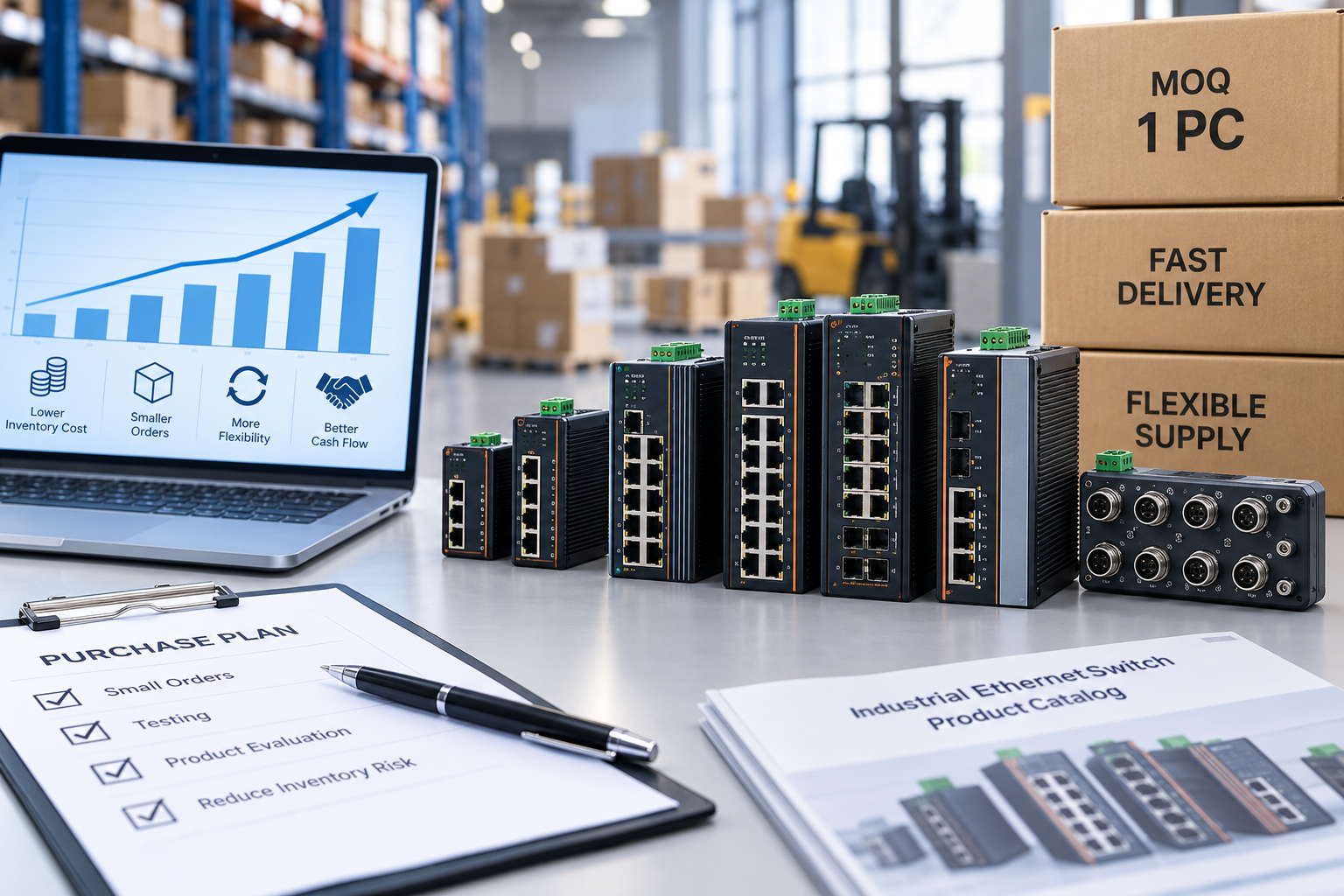
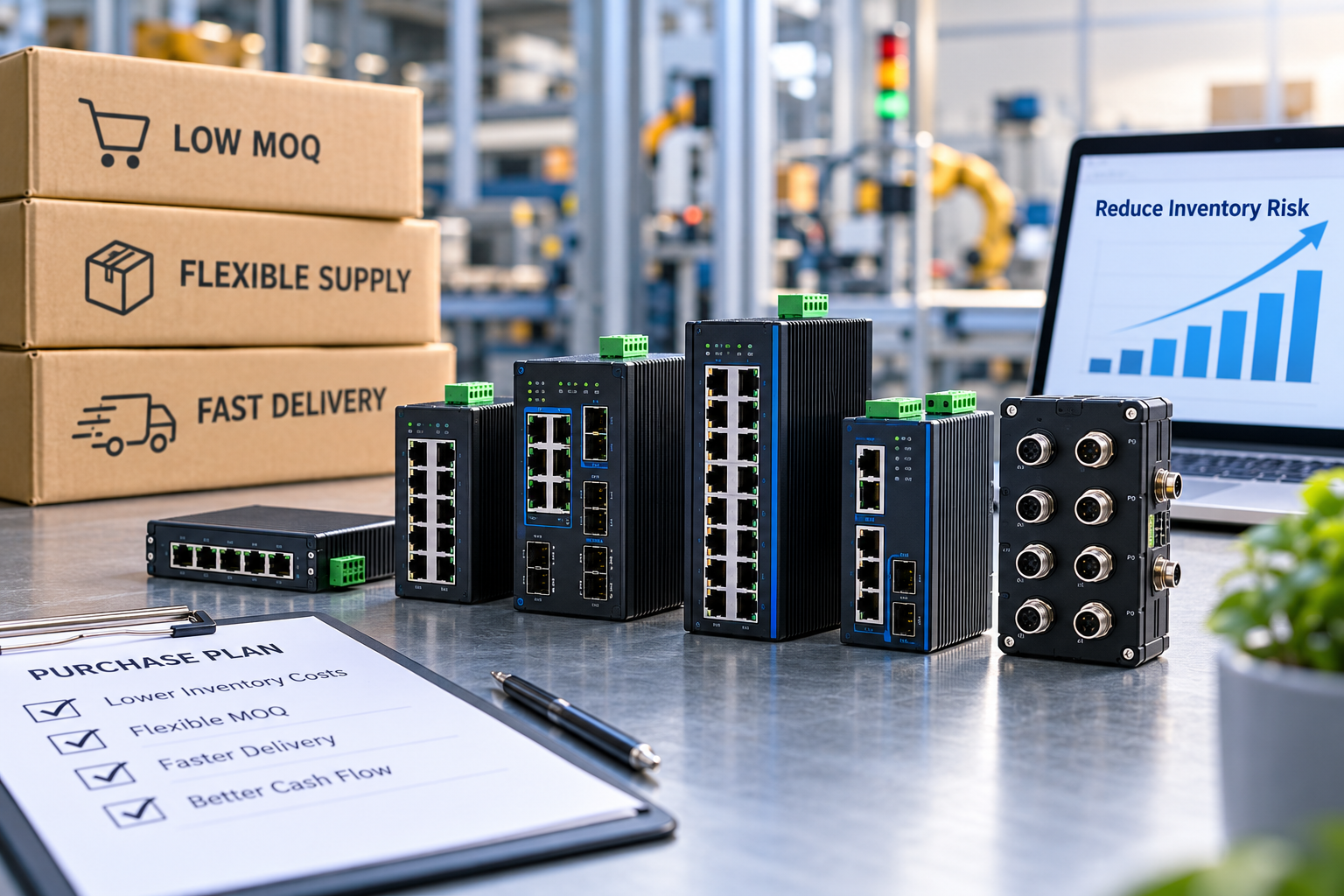
Low-MOQ industrial Ethernet switches help distributors reduce inventory risk by allowing smaller purchases based on customer demand. This can lower upfront costs, limit slow-moving stock, improve cash flow, and support new product testing without large initial commitments.
Why Is Inventory Risk Important for Distributors?
I believe inventory risk is one of the main reasons distributors should consider low-MOQ suppliers. Industrial Ethernet switches come in many configurations.
Some customers need compact unmanaged switches. Others require managed Gigabit switches, PoE models, or M12 industrial switches. A distributor may need several product categories but receive only occasional orders for certain models.
If each model requires a large purchase, the distributor may hold more stock than it can sell. This creates unnecessary cash-flow pressure. I recommend matching purchasing quantities to actual demand whenever possible.
How Can Small Orders Support New Product Testing?
I consider small orders particularly useful when a distributor wants to introduce a new industrial switch category. For example, a company that mainly sells unmanaged switches may want to explore managed PoE products.
The distributor may not know how much demand exists for the new category. Instead of purchasing a large quantity immediately, I would begin with a small evaluation order.
The distributor can then test the product, collect customer feedback, and review inquiries. If demand becomes more predictable, the distributor can gradually increase order quantities. This approach can help limit financial exposure during the early stages of product development.
Does Low MOQ Always Mean Lower Purchasing Costs?
Not necessarily. I believe buyers should distinguish between lower initial investment and lower total purchasing cost. A small order may reduce inventory commitments but increase unit prices or shipping costs.
For example, buying one industrial switch may involve a higher freight cost per unit than buying a full carton. I would compare the following factors:
Cost Factor
Why It Matters
Unit price
Direct product purchasing cost
MOQ
Initial capital commitment
Freight cost
Cost of international transportation
Inventory carrying cost
Cost of holding unsold products
Lead time
Ability to replenish stock
Product reliability
Potential replacement and service costs
Customization charges
Additional engineering or setup expenses
I recommend evaluating these costs together. A low-MOQ supplier can be especially valuable when demand is uncertain, but the best purchasing strategy depends on the customer's actual business model.
What Should I Ask an Industrial Ethernet Switch Supplier Before Placing an Order?
A low price and small MOQ may look attractive, but missing technical details can cause expensive mistakes. Buyers need clear answers before approving a supplier.
Before placing an industrial Ethernet switch order, I recommend confirming the exact model, MOQ, unit price, sample lead time, production schedule, technical specifications, applicable compliance documents, warranty terms, and customization requirements. Written confirmation helps reduce procurement risk and prevents misunderstandings.
What Information Should I Include in an RFQ?
I recommend preparing a clear request for quotation before contacting suppliers. An effective RFQ should include enough information for the supplier to identify a suitable product. For example, I would provide:
This information allows suppliers to recommend more suitable products and prepare accurate quotations. I believe a clear RFQ can save time for both the buyer and supplier.
How Should I Evaluate a Sample?
I recommend testing samples in the intended application whenever possible. For factory automation, I would check communication with PLCs and industrial control equipment.
For machine vision, I would verify bandwidth and data transmission stability under the expected camera load. For CCTV systems, I would test PoE compatibility and confirm that the total power budget meets the connected devices' requirements.
I would also check product installation, power input, network configuration, and environmental requirements. A sample should not be approved only because it powers on successfully. I believe the most useful test is one that reflects actual operating conditions.
What Makes STAR FIRE TECH a Potential Supplier for Small Orders?
At STAR FIRE TECH, we provide industrial communication solutions designed for different networking applications. Our industrial Ethernet switch range includes:
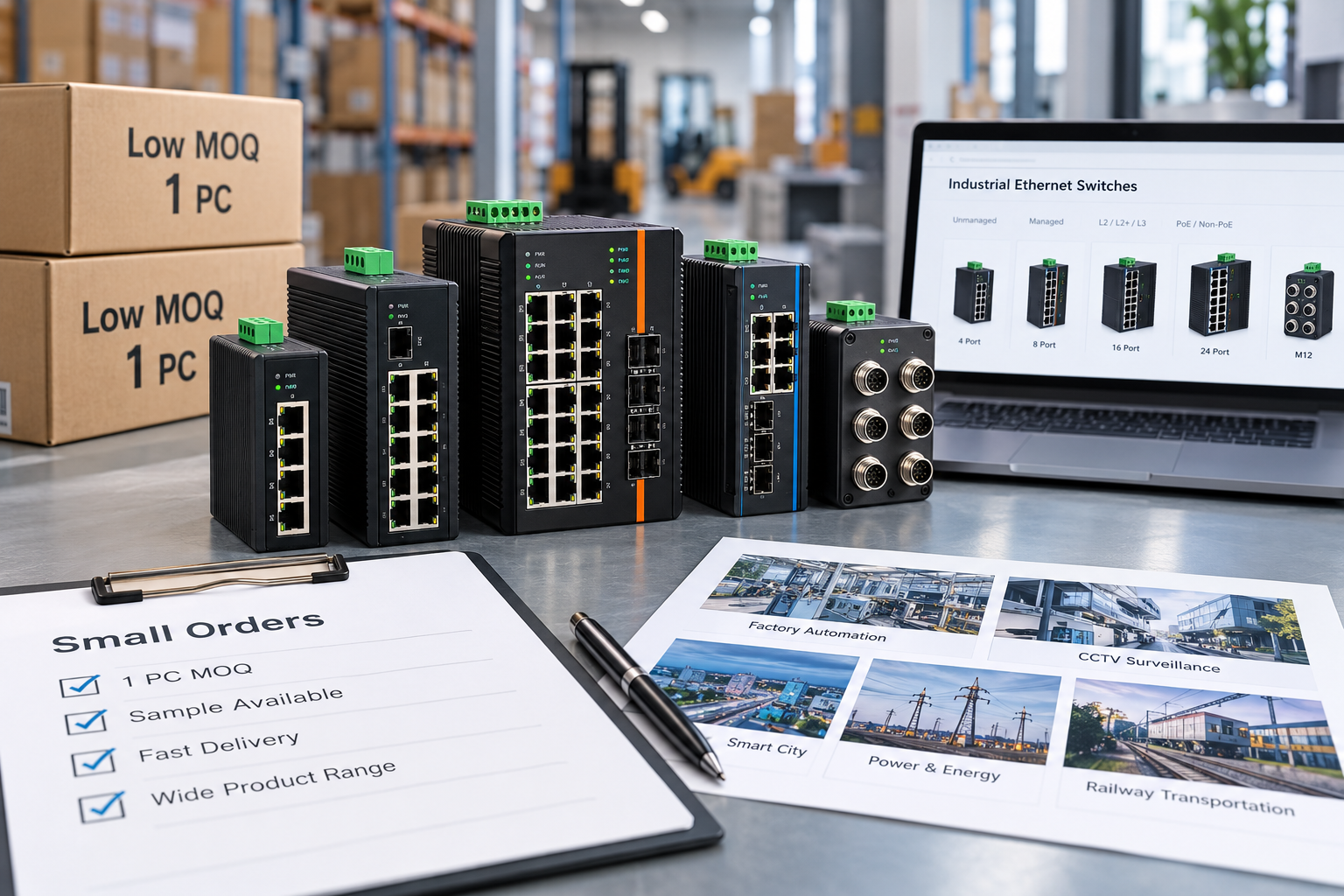
We support applications such as factory automation, CCTV surveillance, intelligent transportation, industrial parks, power and energy systems, and remote monitoring.
Our supply advantages include flexible MOQ starting from one piece for supported configurations, typical sample preparation within 3–5 days, and mass production lead times of approximately 30 days.
We also provide CE, FCC, RoHS, and REACH documentation for applicable models. I recommend confirming each product's technical specifications, compliance documents, available stock, and order conditions before purchasing.
I believe a reliable industrial Ethernet switch supplier should help customers choose the right product rather than simply encourage larger orders.
For more information about STAR FIRE TECH industrial communication products, please visit: https://www.starfirecableshubs.com
Conclusion
I recommend choosing a low-MOQ industrial Ethernet switch supplier that combines flexible ordering, verified quality, technical support, and reliable delivery. The right supplier can reduce purchasing risk.