Table Of Content
Table Of Content
In industrial connectivity, “PUR or TPE?” sounds like a simple material question. It is not.
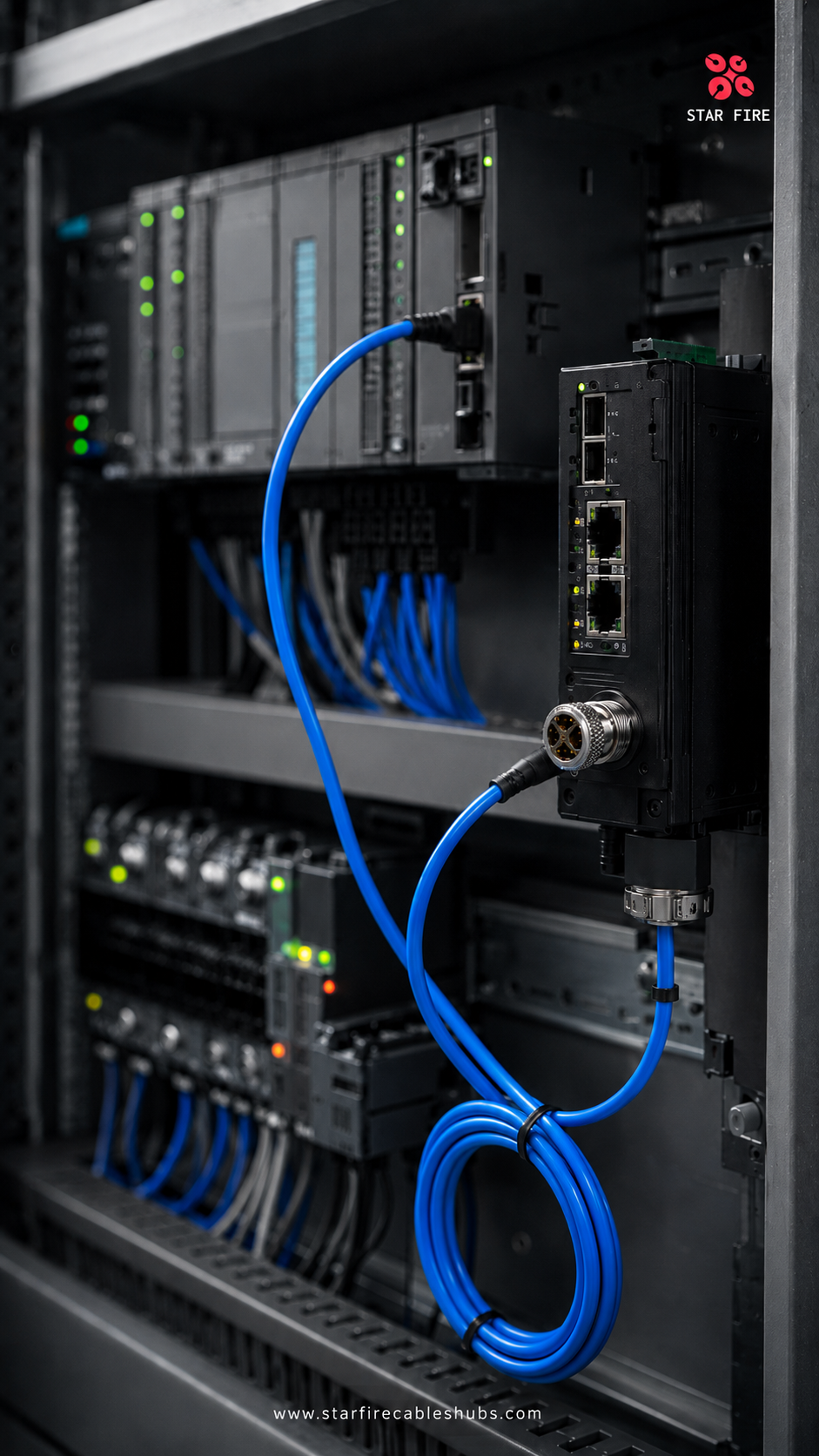
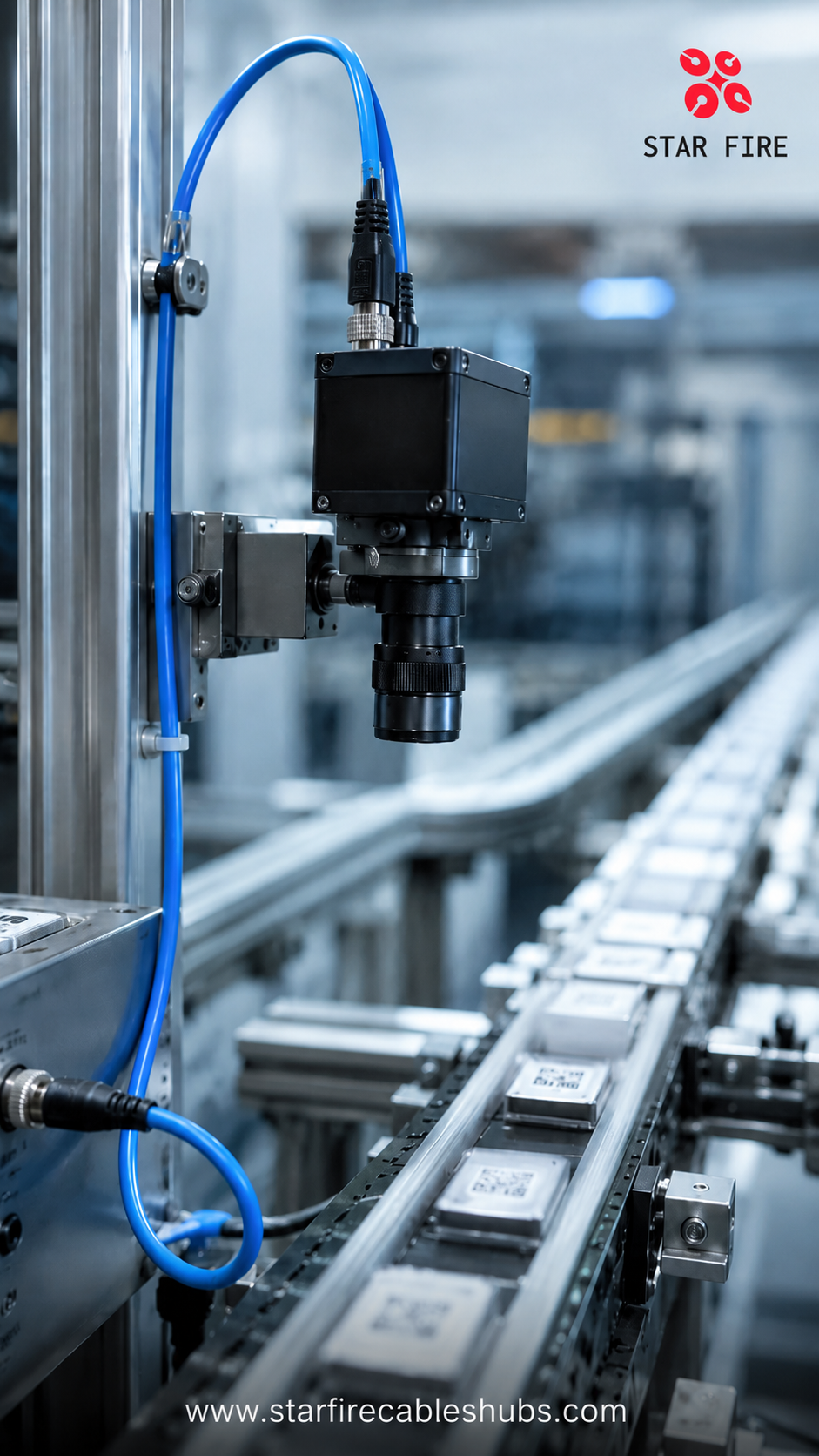
For M8 and M12 cable assemblies used with sensors, actuators, industrial cameras, remote I/O, PROFINET, EtherNet/IP, EtherCAT, machine vision, robotics, and AV-over-IP infrastructure, the jacket affects far more than appearance. It influences abrasion life, flexibility, oil resistance, drag-chain performance, installation behavior, and long-term reliability.
The more useful engineering question is not “Which material is better?” but:
Which cable construction is better for this motion profile, environment, bend radius, temperature range, electrical performance, and expected service life?
That distinction matters because PUR and TPE are both excellent materials when used correctly—and both can fail when selected by name alone.
PUR: Strong Where Mechanical Abuse Dominates
PUR, or polyurethane, remains one of the most common jacket choices for industrial cable assemblies because it offers an effective balance of toughness and flexibility.
PUR is often the stronger starting point when the application involves:
- continuous rubbing or abrasion
- oils, coolants, and common industrial fluids
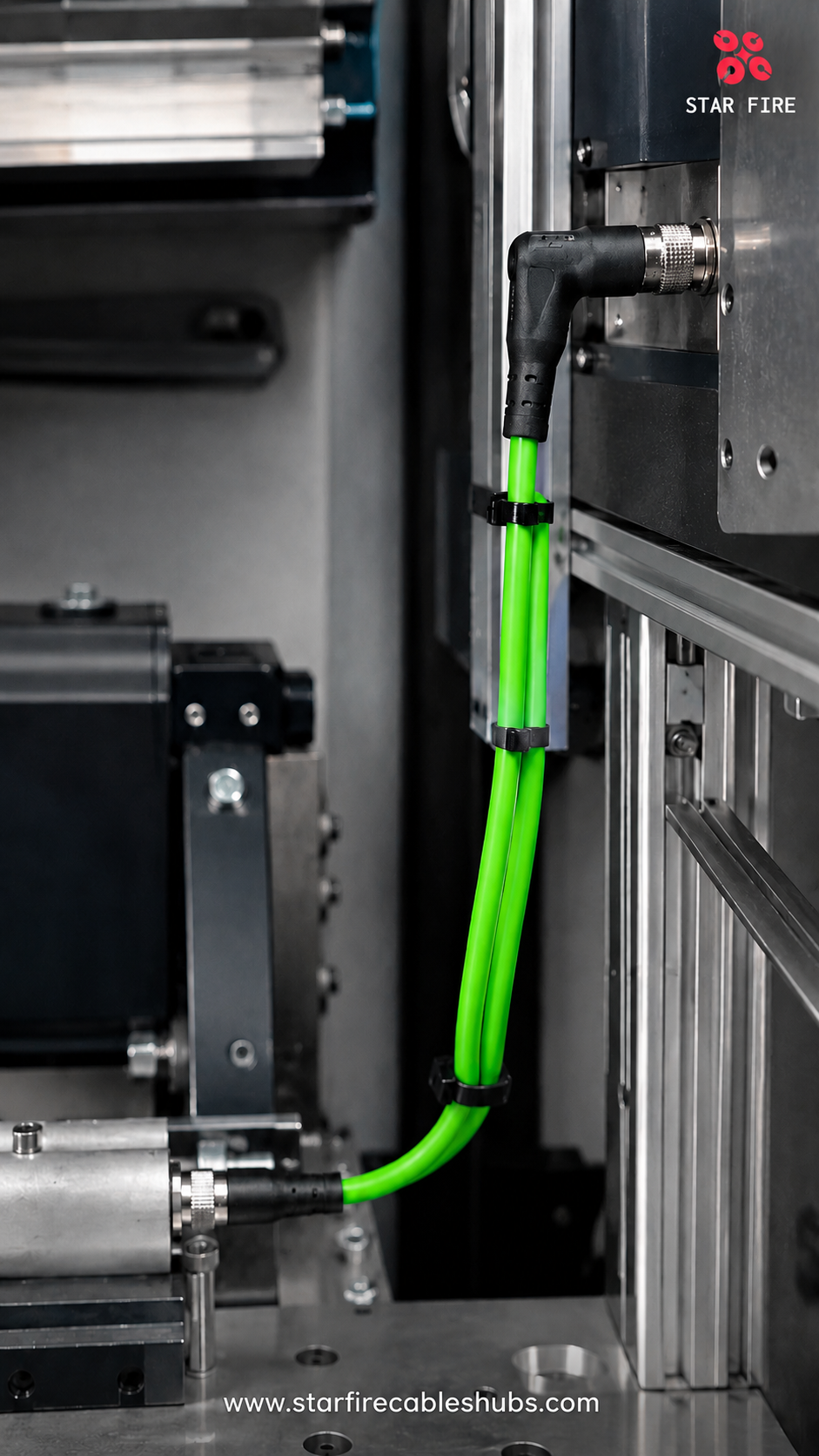
- cable carriers and drag chains
- machine tools and packaging equipment
- exposed routing around metal structures
- compact M8/M12 installations where cable OD matters
Its abrasion and notch resistance make PUR especially attractive in harsh factory environments. A good PUR construction can protect the cable core without requiring an excessively thick jacket, which helps routing density and bend performance.
But “PUR” alone does not guarantee drag-chain life. Two PUR cables can perform very differently depending on conductor stranding, pair geometry, insulation, shielding, fillers, braid design, jacket wall thickness, and connector strain relief.
TPE: More Than Just a Softer Alternative
TPE, or thermoplastic elastomer, is a broad family of compounds rather than one single material.
A well-designed high-flex TPE cable can be an excellent choice when the priorities are:
- very soft handling
- continuous motion
- lightweight moving assemblies
- tight routing spaces
- low-temperature flexibility
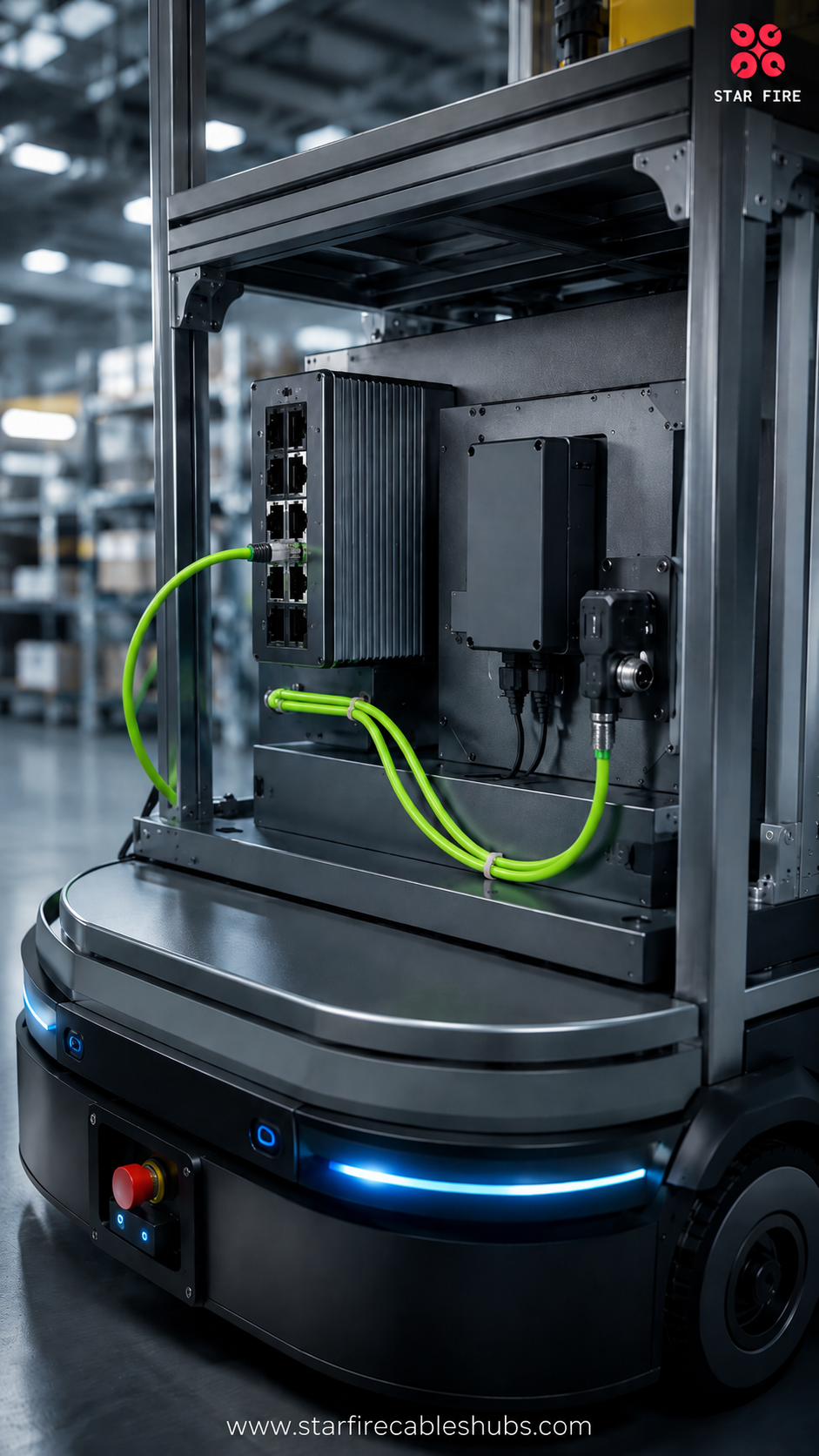
- moving vision heads or robotic end-of-arm tooling
- on-machine Ethernet
TPE should not be treated as a lower-grade substitute for PUR. In some dynamic applications, a validated TPE design may outperform a generic PUR cable because the entire construction was optimized for motion.
This is why engineers should evaluate test data, not assumptions.
Drag-Chain Life Is a System Property
One of the most common sourcing mistakes is writing “PUR drag-chain cable” in an RFQ and assuming the product is now suitable for millions of cycles.
Real dynamic life depends on the complete cable architecture:
- conductor strand size and lay
- insulation flexibility
- pair or quad geometry
- filler design
- braid angle and shield coverage
- jacket compound
- cable diameter
- dynamic bend radius
- travel distance
- speed and acceleration
- torsion
- operating temperature
A claim such as “3 million flex cycles” has limited engineering value unless the test conditions are also defined.
Three million cycles at 10× cable OD is not the same test as three million cycles at 6× OD. A short travel at moderate speed is not equivalent to a high-acceleration robotic axis. Torsion changes the stress profile again.
For M8/M12 cable development, flex-cycle data should always be discussed together with bend radius and motion conditions.
Bend Radius Is a Reliability Parameter
Minimum bend radius is not simply an installation recommendation. In dynamic applications, it directly affects fatigue life.
Repeated bending can damage copper strands, shield braids, insulation, and the geometry of Ethernet pairs. For a simple sensor cable, degradation may first appear as intermittent continuity. For Gigabit Industrial Ethernet or machine vision, it can show up much earlier as:
- packet errors
- dropped camera frames
- link renegotiation
- intermittent communication faults
- unexplained network instability
This is where mechanical engineering and signal integrity become the same problem.
A cable can look perfectly intact on the outside while its electrical performance is already deteriorating.
Machine Vision and Industrial Ethernet Need More Than a Tough Jacket
For moving industrial cameras and high-speed Ethernet links, jacket selection cannot be separated from electrical construction.
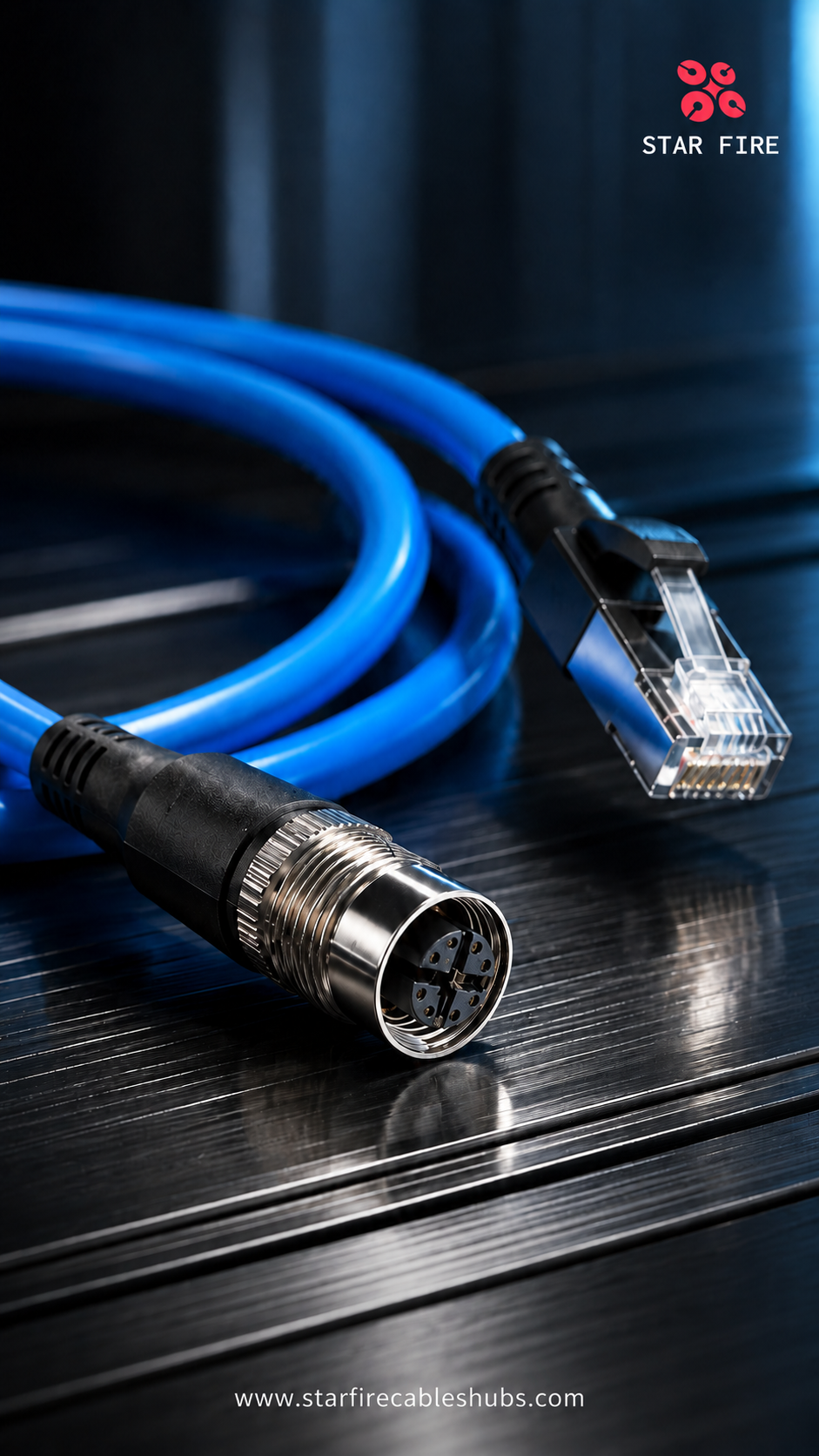
An M12 X-coded cable used in machine vision may be exposed to continuous movement, motors, servo drives, vibration, and EMI. The cable must maintain its transmission geometry while the mechanical structure is repeatedly stressed.
Engineers should therefore verify not only PUR or TPE, but also:
- Ethernet category and bandwidth
- 100-ohm impedance control
- pair geometry after flexing
- foil and braid shielding
- shield continuity through the connector
- M12 coding and pin assignment
- dynamic bend-life validation
- IP67 performance when properly mated
Neither PUR nor TPE is an EMI solution by itself. The jacket protects the shielding system; it does not replace it.
Temperature and Chemical Resistance Need Context
“Oil resistant” and “-40°C to +80°C” are useful only when the test condition is understood.
Which oil or cleaning agent? Splash or immersion? Fixed or continuously flexing? How long is the exposure?
Similarly, many cables have a wider temperature rating for fixed installation than for continuous motion. At low temperatures, some materials become stiffer; at elevated temperatures, mechanical life can fall.
For outdoor automation, cold storage, transportation, industrial cameras, rooftop systems, or harsh Pro AV installations, always ask for the dynamic operating temperature—not only the fixed-installation range.
The PRO AV Connection
M8 and M12 are traditionally associated with industrial automation, but the engineering principles increasingly matter to Pro AV.
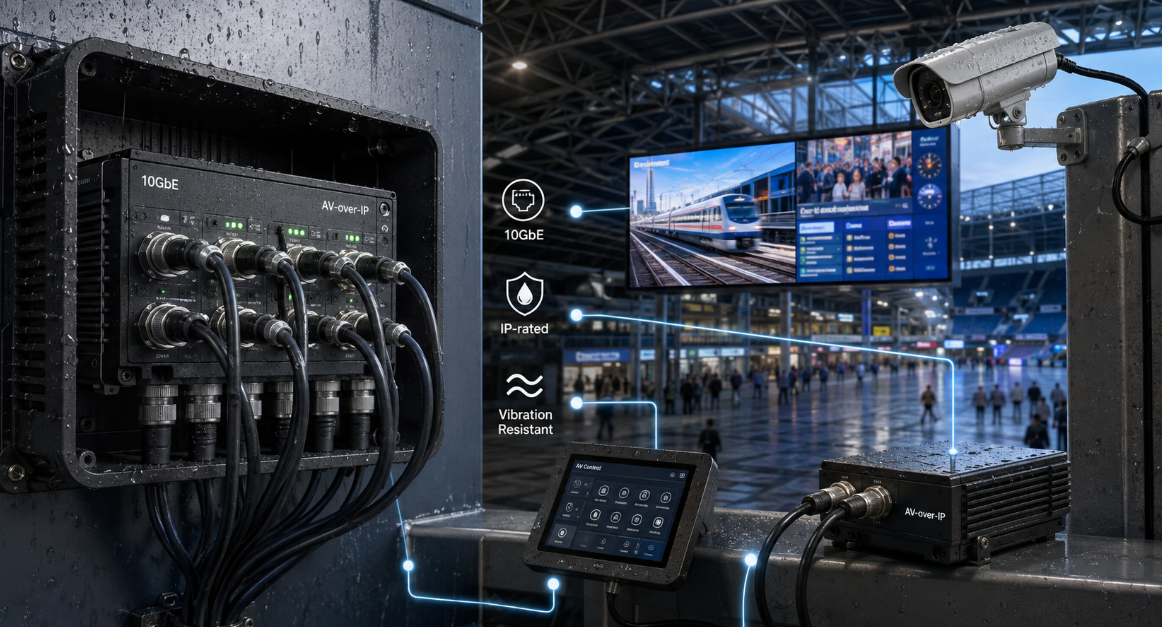
AV-over-IP, digital signage, broadcast systems, stadium infrastructure, transportation hubs, control rooms, smart buildings, and outdoor displays are moving closer to industrial networking. Ethernet, PoE, fiber, ruggedized switches, cameras, sensors, and automation platforms increasingly share the same infrastructure.
As a result, Pro AV engineers are asking industrial questions:
Can the cable survive vibration and repeated movement?
Can it operate near motors and VFDs?
Will shield continuity remain stable?
Can the jacket tolerate UV, oil, water, or cleaning chemicals?
Will the cable remain electrically stable after years of thermal and mechanical stress?
Bandwidth is only one part of system reliability.
A Practical PUR vs. TPE Selection Guide
Choose PUR first when the dominant risks are:
- abrasion and scraping
- oils and coolants
- mechanical abuse
- rugged drag-chain routing
- harsh factory environments
- compact industrial cable routing
Consider high-flex TPE when the dominant priorities are:
- maximum flexibility
- low-temperature movement
- lightweight moving systems
- tight routing envelopes
- robotic or on-machine motion
- stronger validated dynamic-life data for the specific construction
Then verify the complete application:
- Fixed, occasional-flex, drag-chain, or torsional motion?
- Required number of bending cycles?
- Actual minimum bend radius?
- Travel distance, speed, and acceleration?
- Oil, coolant, water, UV, or cleaning chemicals?
- Fixed and dynamic temperature range?
- M8 or M12, and which coding?
- Sensor signal, PROFINET, EtherNet/IP, EtherCAT, or Gigabit Ethernet?
- Shielded or unshielded?
- Required ingress protection and compliance standards?
If these questions are unanswered, the specification is still at the catalog level—not the engineering level.
What a Better RFQ Looks Like
Instead of writing:
“M12 cable, PUR, IP67, 5 m.”
A stronger RFQ might say:
“M12 X-coded shielded Industrial Ethernet cable assembly, 5 m, dynamic installation, target 2–3 million bending cycles, defined machine bend radius, oil-resistant jacket, specified dynamic temperature range, IP67 when mated, high shield continuity, and Ethernet performance maintained after motion testing.”
That gives the manufacturer something meaningful to engineer and validate. It also prevents two suppliers from quoting cables that look identical in a spreadsheet but have very different service lives.
Final Takeaway
PUR and TPE are both capable industrial jacket technologies.
PUR is often the stronger default for abrasion, oils, mechanical toughness, and harsh factory environments. High-flex TPE can be the better choice for extreme flexibility, low-temperature motion, lightweight routing, and selected on-machine applications.
But the jacket name should never be the final decision.
The real specification is the complete combination of conductor design, shielding, cable geometry, jacket formulation, connector termination, strain relief, bend radius, motion profile, environment, and electrical performance over time.
Do not buy a polymer. Engineer the complete signal path.
At STAR FIRE TECH, we support application-specific M8/M12 cable assemblies for industrial automation, machine vision, industrial cameras, Industrial Ethernet, sensors, robotics, and rugged Pro AV connectivity. For dynamic projects, we prefer to start with the real motion and environmental conditions rather than a generic “PUR” or “TPE” request.