Table Of Content
Table Of Content
An unreliable OEM supplier can damage your brand. Delayed deliveries, inconsistent quality, and high minimum orders may increase costs, frustrate customers, and weaken long-term business relationships.
I recommend considering a new industrial Ethernet switch OEM supplier when repeated quality problems, delivery delays, high MOQs, limited customization, or poor technical support affect your business. I would evaluate the current supplier's performance, test alternative products, and confirm supply reliability before making a change.
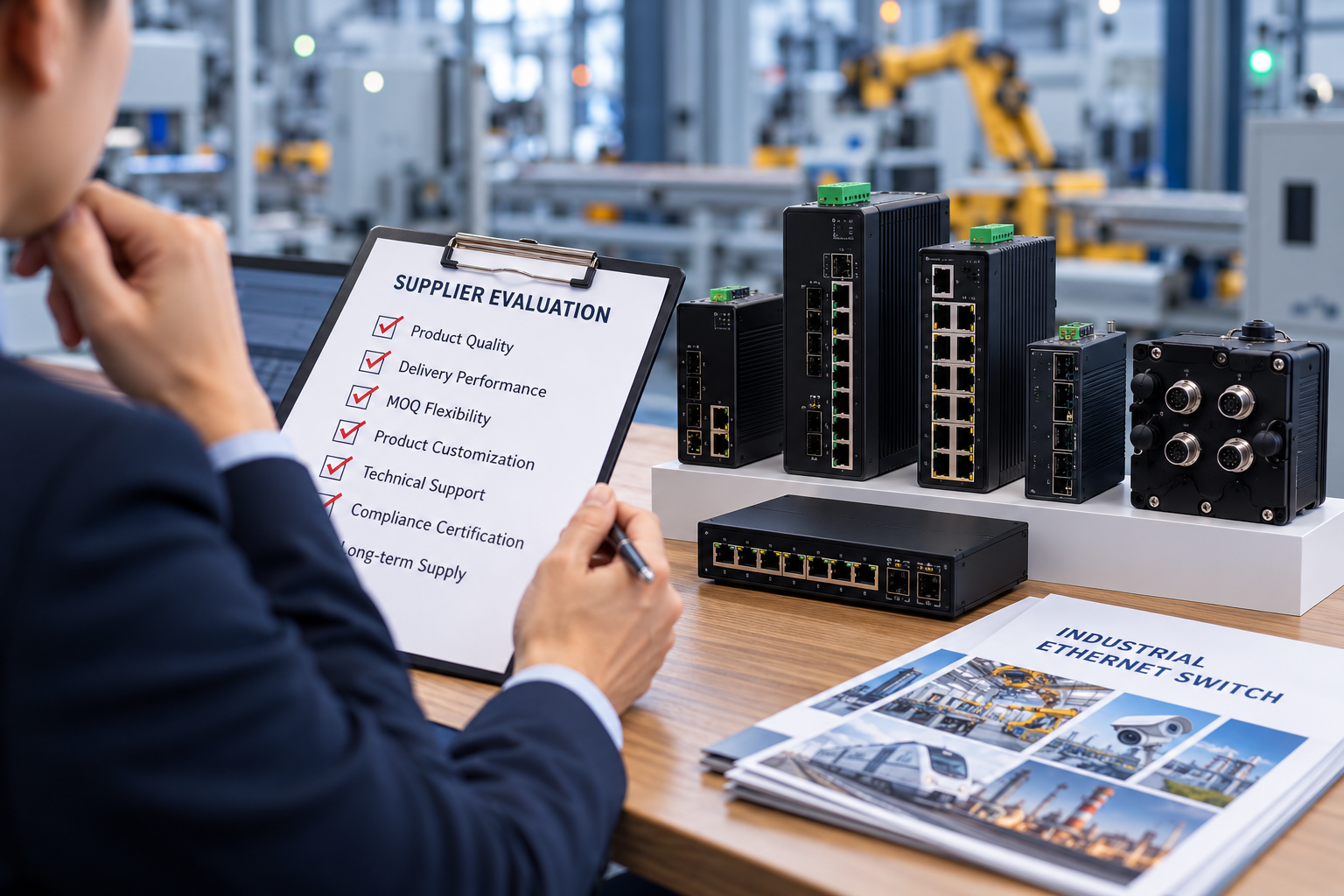
I believe choosing the right OEM supplier is one of the most important decisions for an industrial networking brand.
A brand owner may invest heavily in product development, marketing, and customer relationships. However, the manufacturer's performance directly affects the final product.
If an industrial Ethernet switch fails during operation, the end customer usually contacts the brand rather than the factory that produced it.
This means supplier problems can quickly become brand problems.
In industrial automation, CCTV surveillance, intelligent transportation, and remote monitoring, customers expect stable network communication and dependable equipment.
I believe a reliable manufacturing partner should help brands maintain product quality, control purchasing risks, and respond to changing market requirements.
At STAR FIRE TECH, we have been providing connectivity solutions since 2006. Our industrial communication portfolio includes unmanaged, managed, Layer 2, Layer 2+, and Layer 3 industrial Ethernet switches.
From my perspective, brands should not wait until supplier problems cause serious customer losses before reviewing their manufacturing partnerships.
What Are the Most Common Signs of an Unreliable Industrial Ethernet Switch OEM Supplier?
Small supplier problems may seem manageable at first. However, repeated delays, quality issues, and poor communication can gradually weaken a brand's reputation and profitability.
I consider repeated quality failures, missed delivery dates, inconsistent specifications, slow technical responses, and unclear warranty support major warning signs of an unreliable industrial Ethernet switch OEM supplier. I recommend tracking these problems over time before deciding whether to change manufacturers.

Why Should Brands Monitor Supplier Performance?
I believe supplier reliability should be measured rather than judged only through personal experience.
A supplier may deliver acceptable products for several orders but begin experiencing problems when production volumes increase.
For example, a brand may notice that an industrial Ethernet switch model occasionally arrives late.
One delay may be manageable.
However, repeated delays can affect customer projects and create additional shipping costs.
The same principle applies to product quality.
An isolated defect does not automatically mean a manufacturer is unreliable. However, repeated problems involving Ethernet ports, power input, firmware, or network stability deserve investigation.
I recommend recording supplier performance using clear indicators.
Warning Sign
Possible Business Impact
Recommended Action
Repeated delivery delays
Missed customer deadlines
Review on-time delivery records
Inconsistent product quality
Higher warranty costs
Request test and inspection records
Unexpected specification changes
Product compatibility problems
Require product change notifications
Slow technical responses
Longer troubleshooting periods
Evaluate technical support capability
Unclear warranty terms
Disputes and replacement costs
Confirm warranty responsibilities
High MOQ requirements
Excess inventory and cash pressure
Compare alternative purchasing terms
I believe brands should pay particular attention when several warning signs appear together.
For example, delayed shipments combined with weak technical support may indicate deeper operational problems.
Before changing suppliers, I would document the issues and give the current manufacturer an opportunity to explain and correct them.
How Can Poor Industrial Ethernet Switch Quality Damage Your Brand?
Industrial customers expect equipment to operate reliably. When switches fail in demanding environments, the resulting downtime can affect customer trust and future purchasing decisions.
Poor industrial Ethernet switch quality can damage a brand through network failures, customer complaints, warranty claims, and lost repeat orders. I recommend investigating recurring defects, checking production consistency, and testing products under real operating conditions before approving additional orders.

What Quality Problems Should Brand Owners Watch For?
I believe industrial Ethernet switch quality should be evaluated through technical performance and manufacturing consistency.
Industrial switches often operate near motors, machinery, electrical cabinets, and other equipment.
These environments may expose network devices to temperature changes, vibration, and electromagnetic interference.
A switch that works during a short office test may not perform the same way in an industrial installation.
I recommend watching for recurring problems such as:
For managed switches, I would also verify whether the required VLAN, QoS, routing, and redundancy functions operate as specified.
However, I would not automatically blame the switch for every network failure.
Cabling, power supplies, connected devices, and incorrect configurations can also cause communication problems.
I believe a responsible supplier should help investigate the complete system before identifying the root cause.
How Can I Evaluate Manufacturing Quality?
I recommend requesting technical documentation and testing information for the exact product model.
Important information may include product specifications, functional test procedures, inspection criteria, and available environmental test reports.
I would also ask whether the manufacturer performs incoming material inspections and finished-product testing.
For international markets, I recommend checking applicable CE, FCC, RoHS, and REACH documentation.
However, I would verify the documents for the specific model and destination market.
I believe quality consistency is more valuable than a supplier's general promise of high quality.
A reliable OEM partner should be willing to discuss product failures, investigate their causes, and explain corrective actions.
When Should Delivery Delays Make You Consider a New OEM Manufacturer?
Late shipments can disrupt product launches and customer installations. When delivery promises are repeatedly missed, even competitively priced products may become difficult to sell.
I recommend reviewing an OEM supplier when repeated delivery delays affect customer commitments, inventory planning, or product launches. A reliable industrial Ethernet switch manufacturer should provide realistic sample lead times, clear production schedules, and timely updates about material or manufacturing delays.
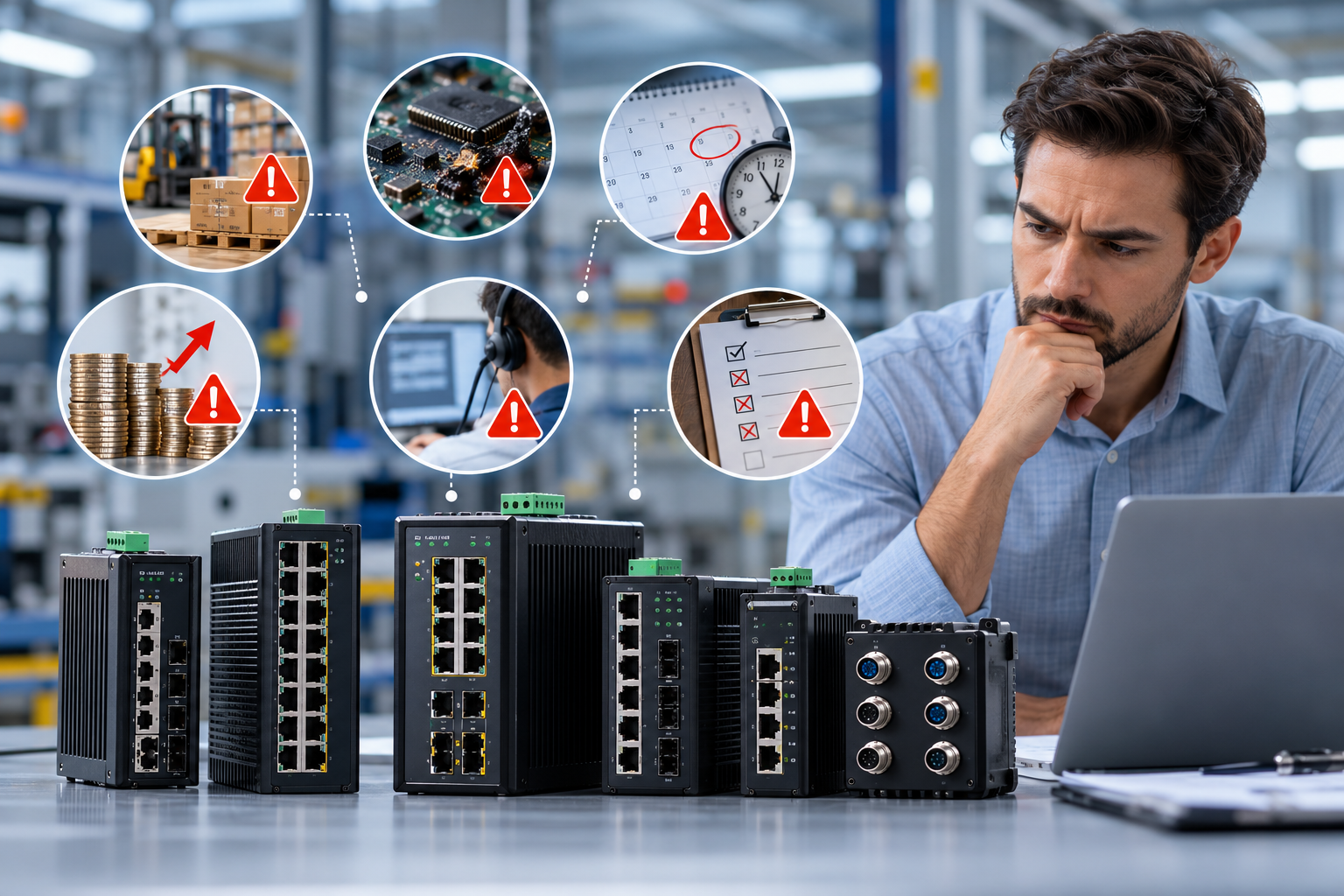
Why Does Delivery Reliability Matter to Industrial Brands?
I believe delivery reliability plays a major role in customer satisfaction.
Industrial networking brands often serve system integrators, equipment manufacturers, and project contractors.
These customers may work with fixed installation schedules.
For example, a factory automation project may require industrial switches before equipment commissioning begins.
If the switches arrive late, the system integrator may need to delay testing or installation.
This can create additional labor costs and affect the relationship between the brand and its customer.
I recommend tracking the supplier's actual delivery performance against confirmed schedules.
I would also distinguish between production delays caused by the supplier and delays caused by transportation or customs clearance.
These problems require different solutions.
What Delivery Performance Should I Expect?
I do not believe every manufacturer should be expected to offer the same lead time.
Industrial Ethernet switch production depends on component availability, order quantity, product configuration, and testing requirements.
However, I believe suppliers should communicate realistic schedules.
At STAR FIRE TECH, our typical industrial Ethernet switch supply arrangements include:
Supply Item
STAR FIRE TECH Capability
Minimum order quantity
From 1 piece for supported configurations
Typical sample lead time
3–5 days
Typical mass production lead time
Approximately 30 days
Product customization
Simple customization on applicable models
Product range
Managed, unmanaged, L2, L2+, and L3 switches
Actual lead times depend on the selected model, customization requirements, and material availability.
I recommend confirming availability and production schedules before placing an order.
How Can Brands Reduce Delivery Risks?
I recommend avoiding complete dependence on a single untested supply route.
A brand can reduce risk by maintaining clear forecasts, confirming delivery dates, and reviewing supplier performance regularly.
For critical products, I would also consider evaluating a qualified second supplier.
However, I would not switch manufacturers simply because an alternative promises faster delivery.
I would verify the new supplier's product quality, capacity, and actual shipment performance before transferring important orders.
Can High MOQ Requirements Become a Reason to Change Industrial Ethernet Switch Suppliers?
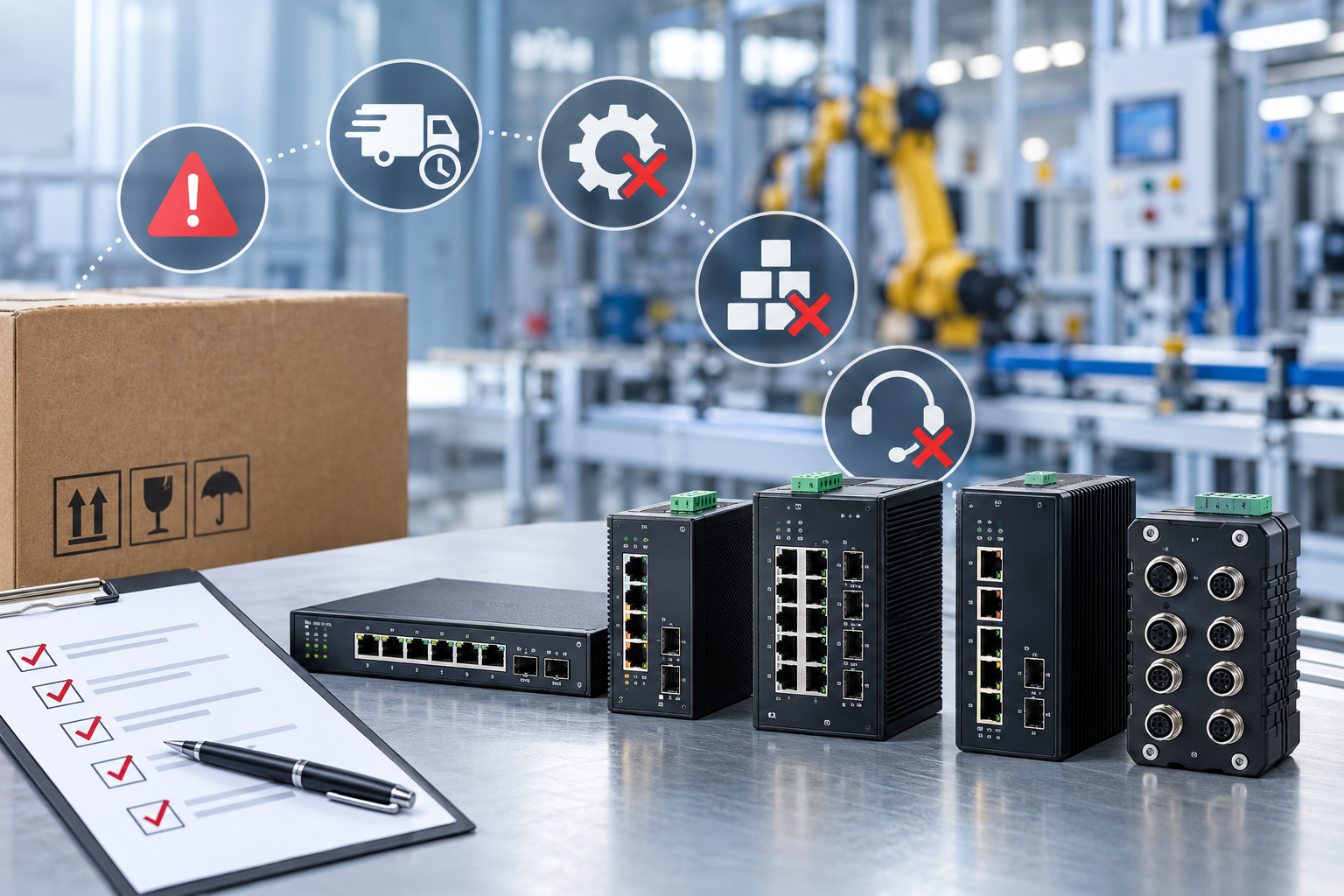
Large minimum orders can make new product launches expensive. Brands may be forced to hold inventory long before customer demand becomes clear.
High MOQ requirements can justify reviewing an OEM supplier when they create excessive inventory, restrict product testing, or limit market expansion. I recommend comparing suppliers that support smaller orders while also evaluating unit price, freight cost, delivery reliability, and product quality.
Why Is MOQ Important for Industrial Networking Brands?
I believe MOQ flexibility is especially valuable when a brand wants to introduce new products.
Industrial Ethernet switches are available in many configurations.
Customers may request different port counts, Ethernet speeds, management functions, and PoE capabilities.
For example, a brand may want to introduce:
However, demand for every model may not be predictable.
If a manufacturer requires large orders for each configuration, the brand may need to invest substantial capital before confirming market demand.
I recommend matching initial order quantities to realistic sales expectations.
How Can Low MOQ Reduce Financial Risk?
I use a simple purchasing example to explain this issue.
The following figures are illustrative and do not represent actual supplier quotations.
Purchasing Factor
High-MOQ Supplier
Flexible-MOQ Supplier
Minimum order
100 units
1 unit
Example unit price
USD 150
USD 150
Initial product investment
USD 15,000
USD 150
Initial inventory exposure
Higher
Lower
Product testing flexibility
More limited
More flexible
The initial investment difference can be substantial.
However, I would also consider whether smaller orders involve higher unit prices or shipping costs.
Low MOQ does not automatically guarantee the lowest total purchasing cost.
I believe its greatest value is allowing brands to test demand before making larger commitments.
How Can STAR FIRE TECH Support Small Orders?
At STAR FIRE TECH, we support industrial Ethernet switch orders starting from one piece for applicable models and simple customization.
Our product range includes unmanaged, managed, PoE, non-PoE, Fast Ethernet, Gigabit Ethernet, and M12 industrial switch options.
I believe this flexibility can help brands evaluate alternative products without immediately committing to large inventories.
For a new brand or product line, I recommend starting with sample evaluation and expanding the order quantity after technical and commercial requirements are confirmed.
What Happens When an OEM Supplier Cannot Support New Product Development?
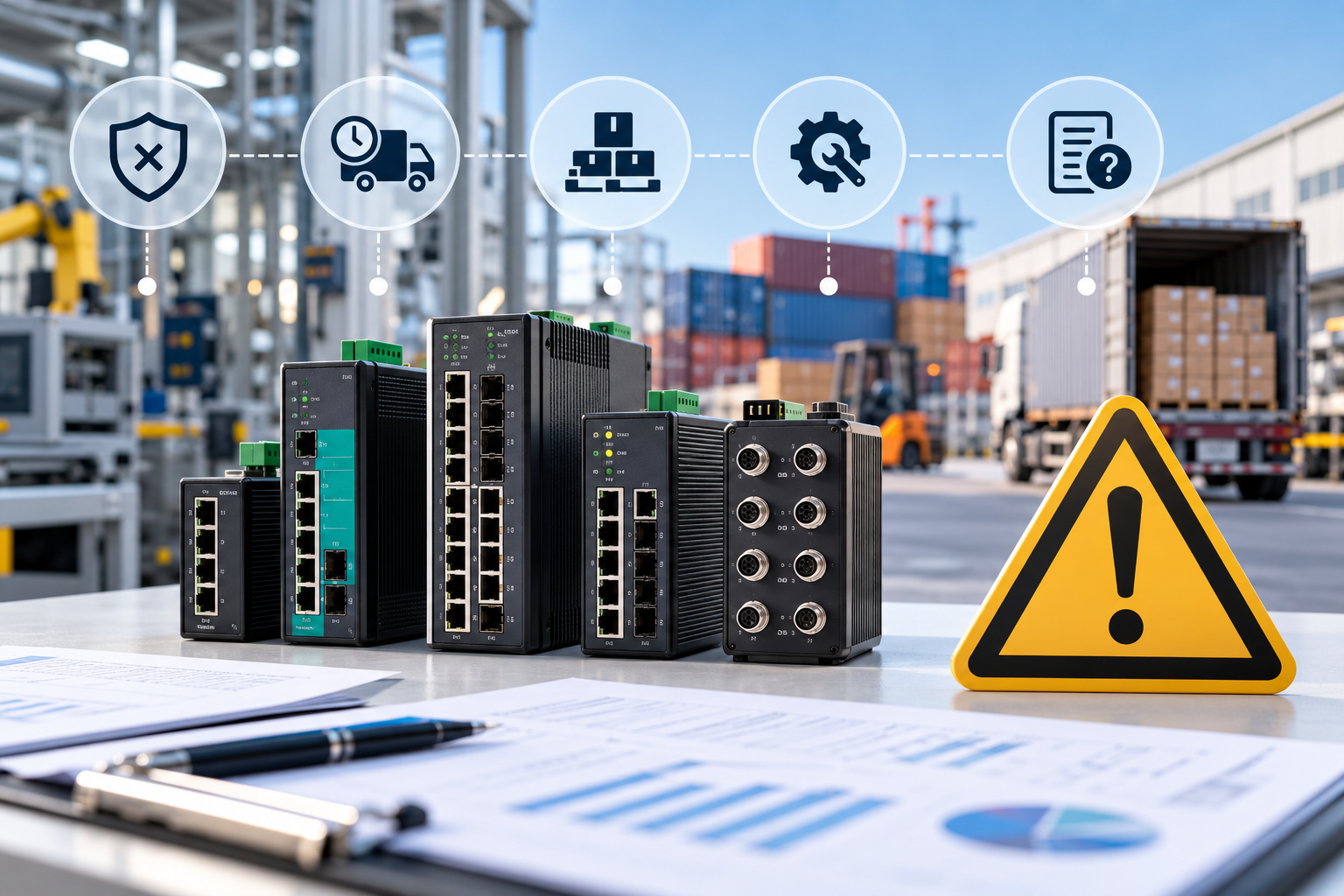
Industrial networking requirements change as customers adopt new equipment and applications. A supplier with limited product options may prevent a brand from responding to new opportunities.
I recommend considering an alternative OEM supplier when the current manufacturer cannot provide required industrial Ethernet switch configurations, suitable customization, or timely product support. Brands should compare available product platforms and verify whether proposed models meet customer applications.
Why Does Product Portfolio Flexibility Matter?
I believe a brand's product range should reflect its customers' changing requirements.
A company that originally sold unmanaged switches may begin receiving requests for managed models.
A CCTV equipment brand may need industrial PoE switches.
A factory automation brand may require Gigabit Ethernet, fiber uplinks, or specific network management features.
If the current manufacturer offers only a narrow range, the brand may struggle to respond.
I recommend reviewing the manufacturer's existing product platforms before requesting a completely new design.
At STAR FIRE TECH, our industrial communication portfolio includes:
I believe a broad product range can help brands evaluate different market opportunities.
However, I always recommend checking the actual functions of each model.
When Does Customization Become Important?
OEM brands often need products that fit their market positioning.
For example, a brand may require customized product labels, packaging, or selected configurations.
Some projects may require more advanced hardware or firmware modifications.
I recommend distinguishing between simple OEM customization and full product development.
Simple customization may be possible using an existing product platform.
New PCB designs, firmware changes, or special industrial certifications may require significant engineering work.
I believe brands should ask suppliers to explain which customization requests are technically and commercially practical.
At STAR FIRE TECH, we support simple customization on selected industrial Ethernet switch models.
For more advanced requirements, I recommend confirming technical feasibility, development scope, and commercial conditions before proceeding.
Why Is Poor Technical Support a Warning Sign for OEM Industrial Ethernet Switch Brands?
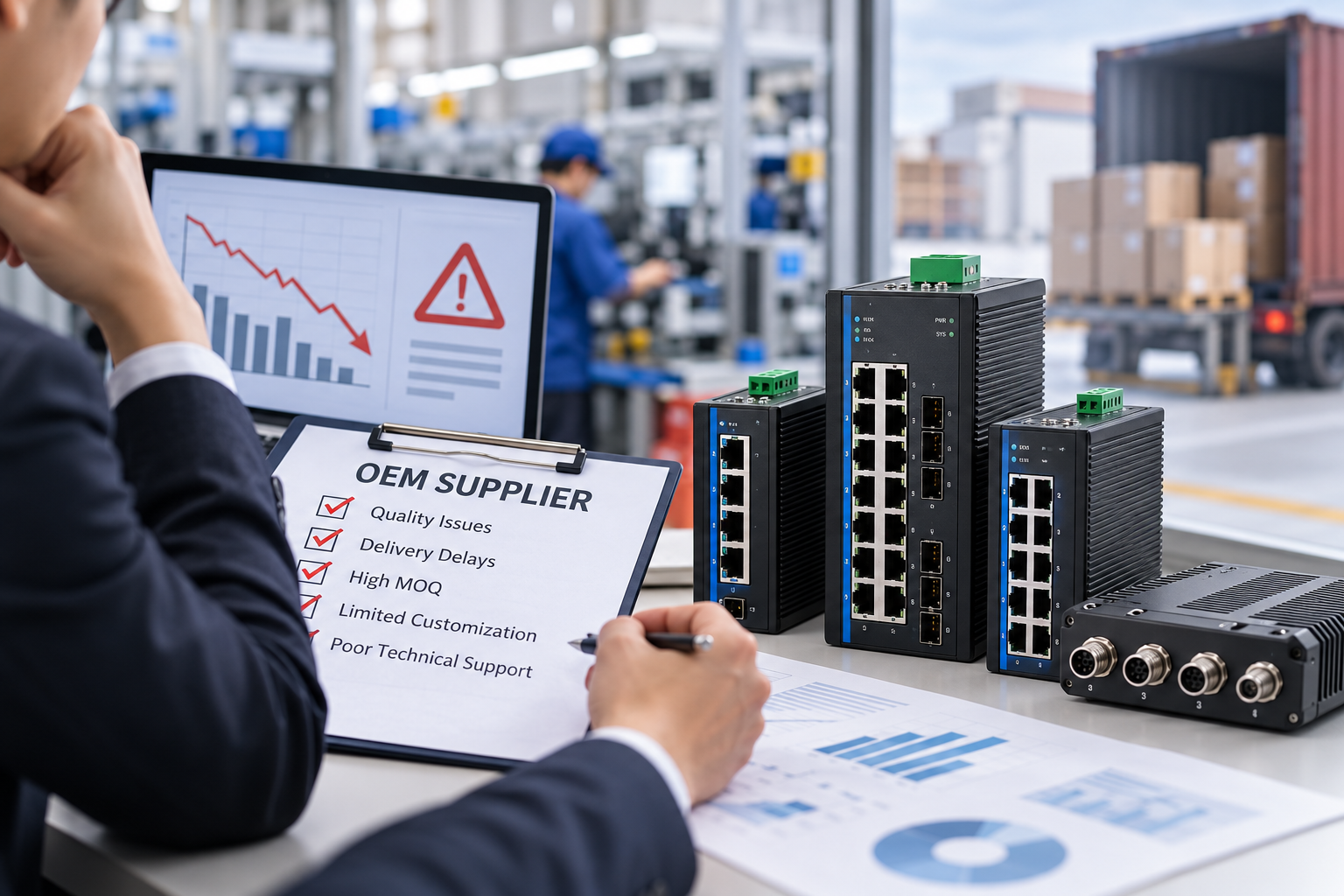
Technical problems do not always appear during initial testing. Without responsive manufacturer support, brands may struggle to solve customer issues after products reach the market.
I consider slow technical responses, incomplete documentation, weak troubleshooting support, and unclear firmware maintenance serious supplier warning signs. I recommend working with manufacturers that provide model-specific information, clear support procedures, and practical assistance during product evaluation and after-sales service.
Why Is Technical Support Important for Industrial Switches?
I believe technical support is an essential part of an OEM manufacturing relationship.
Industrial Ethernet switches are used in networks with different operating requirements.
A factory may connect PLCs, industrial cameras, sensors, and control computers.
A transportation system may include remote monitoring equipment and communication cabinets.
A CCTV project may require PoE power management and reliable uplink connections.
When communication problems occur, customers may need help identifying whether the cause is the switch, cabling, configuration, or connected equipment.
I recommend evaluating how quickly and clearly the manufacturer responds to technical questions.
For managed switches, I would also ask about firmware versions, configuration guides, and available troubleshooting documentation.
What Technical Documents Should I Request?
I recommend requesting the documents needed for the exact product and application.
These may include:
I would also check whether the supplier can explain the limitations of the proposed product.
For example, a managed Layer 2 switch does not automatically support IP routing.
Similarly, a PoE switch must provide enough power for the connected devices.
I believe clear technical information helps brands avoid incorrect product claims and customer misunderstandings.
When Should I Escalate Support Problems?
I would first define the issue and provide relevant technical evidence.
For example, I might share a network diagram, firmware version, power input details, and a description of the failure.
I would then request a troubleshooting plan and a reasonable response schedule.
If the supplier repeatedly fails to respond or cannot provide meaningful assistance, I would treat this as a serious concern.
However, I would not expect every technical problem to be solved immediately.
I believe reliable suppliers should provide transparent communication and make measurable progress toward resolving issues.
How Can Brands Safely Switch to a New Industrial Ethernet Switch OEM Supplier?
Changing suppliers can solve existing problems, but a rushed transition may create new ones. Product incompatibility, missing documentation, and supply gaps can disrupt customers.
I recommend switching industrial Ethernet switch OEM suppliers through a controlled process. Brands should compare specifications, qualify samples, verify compliance documents, test real applications, confirm production terms, and gradually transfer orders before ending the existing supply arrangement.
What Should I Check Before Replacing a Supplier?
I believe the first step is identifying the actual reason for changing suppliers.
A brand may want better quality, more flexible MOQ, faster delivery, or additional product options.
However, the replacement product must still meet the original technical requirements.
I recommend comparing specifications such as:
Evaluation Item
Questions I Would Ask
Ethernet ports
Does the replacement have the required port configuration?
Network speed
Does it support the required transmission rate?
Management functions
Are the necessary VLAN, QoS, and routing functions available?
PoE capability
Does the power budget meet the application requirements?
Fiber uplinks
Are the required SFP interfaces supported?
Power input
Is it compatible with the installation?
Operating environment
Does it meet temperature and protection requirements?
Compliance
Are the required documents available for the destination market?
Firmware
Are the required features and versions supported?
Supply terms
Are MOQ, price, and delivery acceptable?
I believe a technically similar product is not always a direct replacement.
Even products with the same number of ports may differ in power requirements, physical dimensions, and supported network functions.
Why Is Sample Testing Essential?
I recommend evaluating replacement products in actual application conditions.
For example, I would test a switch used in factory automation with the intended PLCs and control devices.
For machine vision, I would check bandwidth and communication stability with the expected camera traffic.
For CCTV applications, I would verify PoE operation and uplink performance.
I would also inspect mechanical dimensions, mounting accessories, labeling, and packaging.
If the product passes testing, I would document the approved specifications before placing a larger order.
Should Brands Replace Their Current Supplier Immediately?
I usually recommend a gradual transition.
First, I would evaluate potential manufacturers and compare available products.
Next, I would request samples and complete technical testing.
I would then place a limited production order and monitor product quality and delivery performance.
If the new supplier performs consistently, I would consider transferring a larger share of future orders.
This process helps reduce the risk of unexpected supply interruptions.
I believe maintaining a qualified second supplier can also be useful when customer demand is uncertain or product availability is critical.
How Can a Reliable OEM Manufacturer Help Protect Your Industrial Networking Brand?
A supplier relationship affects more than purchasing prices. Product quality, technical support, and long-term availability all influence how customers experience a brand.
I believe a reliable industrial Ethernet switch OEM manufacturer helps brands protect their reputation through consistent quality, practical customization, clear communication, and dependable supply. Flexible MOQ and responsive sample support can also reduce the risk of launching new products.
Why Should Brands Evaluate Long-Term Partnership Value?
I believe the best supplier is not always the one offering the lowest quotation.
A lower unit price may look attractive at first.
However, quality problems, delayed shipments, and poor technical support can create additional expenses.
These costs may include warranty replacements, customer complaints, extra freight charges, and lost business opportunities.
I recommend comparing suppliers based on total purchasing cost and long-term performance.
I would also consider whether the supplier can support future product requirements.
For example, a brand may begin with unmanaged industrial switches and later expand into managed, PoE, or M12 models.
A manufacturer with suitable existing product platforms may help simplify this process.
However, I would still verify each model's technical suitability and availability.
How Can STAR FIRE TECH Support Industrial Ethernet Switch Brands?
At STAR FIRE TECH, we provide industrial communication solutions for factory automation, CCTV surveillance, smart cities, intelligent transportation, industrial parks, power and energy applications, and remote monitoring.
Our industrial Ethernet switch portfolio includes unmanaged, managed, Layer 2, Layer 2+, and Layer 3 products.
We also offer different Ethernet speeds, port configurations, and PoE options.
Our purchasing arrangements include flexible MOQ starting from one piece for supported products and simple customization requirements.
Our typical sample lead time is 3–5 days, while mass production generally requires approximately 30 days, depending on the model and order conditions.
We also provide applicable CE, FCC, RoHS, and REACH documentation for relevant industrial switch models.
I believe these capabilities can help brands evaluate new products, reduce initial inventory commitments, and respond to different customer requirements.
What Is My Recommendation for Brands Considering a New Supplier?
I recommend beginning with a technical and commercial review rather than an immediate purchasing commitment.
A brand can share its current switch specifications, target application, expected order quantity, and required compliance documents.
The potential supplier can then identify available models for comparison.
If a suitable alternative is available, I recommend requesting a sample and completing an application-specific evaluation.
I believe this approach allows brands to make purchasing decisions based on evidence rather than marketing claims.
For more information about our industrial Ethernet switches and connectivity solutions, please visit:
Conclusion
I recommend reviewing OEM suppliers when quality, delivery, MOQ, or technical support problems persist. A carefully tested alternative can strengthen supply reliability and protect brand reputation.