Table Of Content
Table Of Content
As data-intensive applications such as generative AI, autonomous driving, 5G/6G, and high-performance computing (HPC) continue to scale, data centers are under unprecedented pressure to deliver higher bandwidth, lower latency, and greater scalability. One technology emerging at the center of this evolution is 224G PAM4.
What Is 224G PAM4?
224G PAM4 is a high-speed data transmission technology that delivers 224 gigabits per second (Gbps) per lane using four-level pulse amplitude modulation (PAM4). It represents the next major step beyond 112G, effectively doubling the data rate to meet rapidly growing performance and bandwidth demands in modern data centers.
PAM4 vs. NRZ: Why PAM4 Wins at High Speeds
Unlike traditional NRZ (Non-Return-to-Zero) signaling, which uses two voltage levels to represent one bit per symbol, PAM4 uses four voltage levels, enabling two bits per symbol. This allows PAM4 to achieve the same data rate at half the symbol rate, improving bandwidth efficiency and reducing power consumption at higher speeds.
Because of these advantages, PAM4 has become the preferred signaling method for next-generation high-speed interconnects. However, PAM4 also introduces unique design challenges, particularly around signal integrity. With smaller voltage margins, PAM4 systems are more susceptible to inter-symbol interference (ISI), making advanced equalization, high-quality connectors, and robust system-level design essential.
How Does PAM4 Enable 224 Gbps?
At 224 Gbps, PAM4 operates at 112 Gbaud, whereas an equivalent NRZ system would require a 224 Gbaud symbol rate—significantly increasing power consumption and limiting scalability. Beyond modulation, achieving reliable 224G performance also depends on the design of connectors, cables, PCB layouts, and transceivers, all of which must support extremely high frequencies and tight signal integrity margins.

Why 224G Matters for Next-Generation Data Centers
For emerging workloads such as generative AI and HPC, 224G is no longer optional—it is becoming foundational.
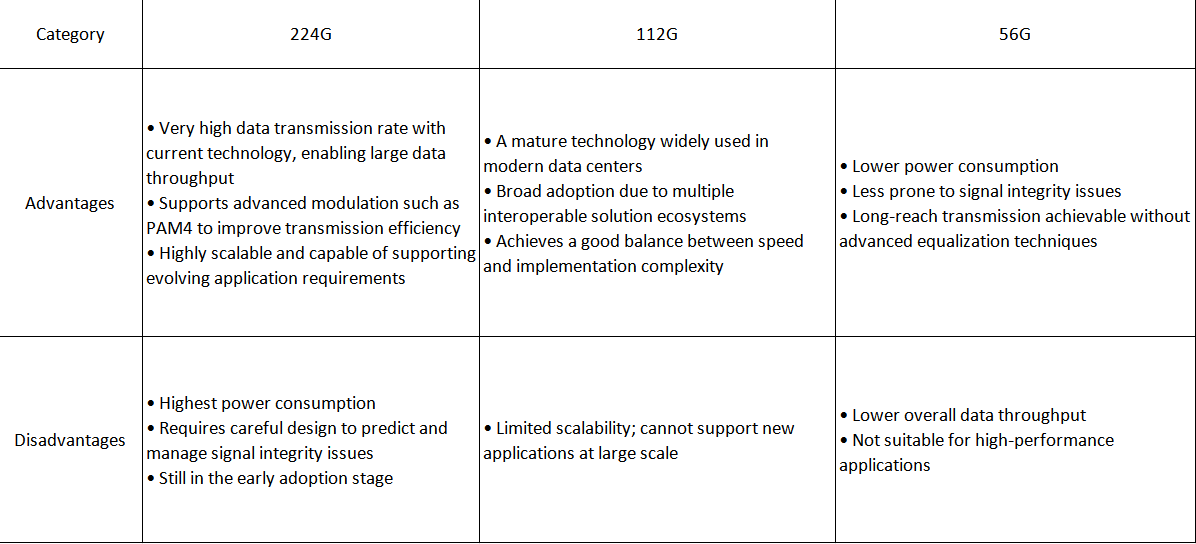
Higher speed and bandwidth Compared to 112G and 56G, 224G delivers a substantial leap in throughput, enabling applications such as AI model training, facial recognition, V2X communications, and future 5G/6G deployments.
Lower latency 224G PAM4 helps reduce end-to-end latency, which is critical for real-time and mission-critical applications including AR/VR, remote surgery, autonomous vehicles, and immersive video experiences.
Improved mechanical robustness Next-generation 224G interconnect components are designed for higher mechanical reliability, helping data centers maintain stable operation under high thermal loads and vibration.
Scalability for the future Technologies such as 6G, edge computing, and modular AI infrastructure demand scalable, flexible architectures. 224G solutions enable systems to scale efficiently as bandwidth and compute requirements evolve.
Applications That Benefit Most from 224G
Although many 224G use cases are still emerging, adoption is accelerating rapidly across multiple domains:
Generative AI – Training and inference workloads generate massive data volumes.
Machine Learning – Data-heavy models require fast, reliable interconnects.
High-Performance Computing (HPC) – Increased scalability dramatically enhances compute capability.
Digital Twins – Real-time simulation and predictive modeling depend on high bandwidth and low latency.
Internet of Things (IoT) – Tens of billions of connected devices rely on fast cloud data movement.
Streaming Media – High-resolution, low-latency content delivery continues to grow.
5G, 6G, and Beyond – Future wireless networks demand higher speed and reliability.
Autonomous Vehicles – V2X communication requires ultra-low latency and high bandwidth.
Edge Computing – Enables responsive, high-performance edge applications.
Quantum Computing – Requires extremely high-bandwidth data movement to unlock its potential.
Signal Integrity Challenges at 224G
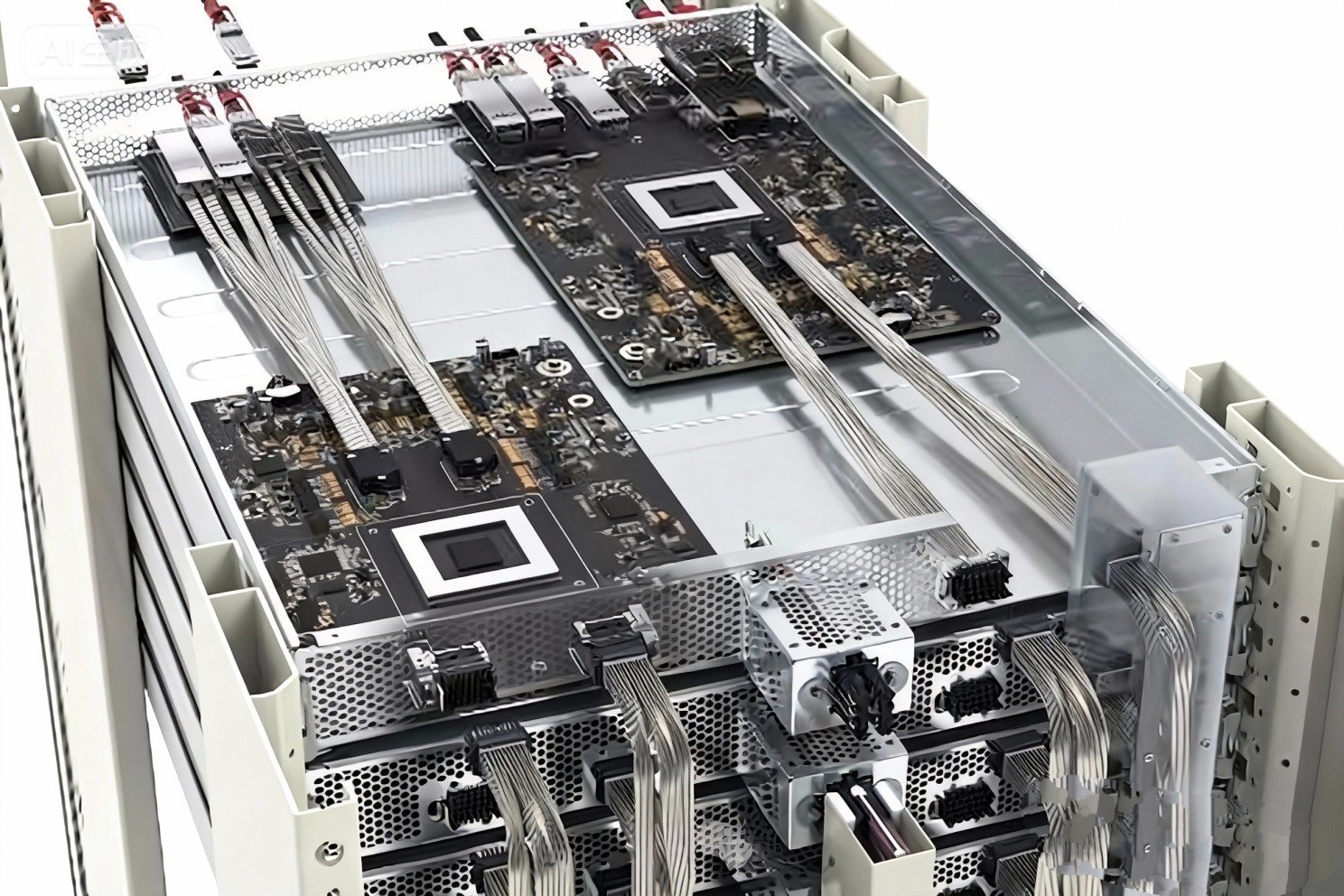
Moving to 224G introduces significant design complexity, particularly in balancing signal integrity with form factor and mechanical constraints. Proven system-level modeling using S-parameters is essential. Key factors affecting signal integrity include:
Connector interfaces – Impedance control, crosstalk, and radiated emissions
Chip I/O – Pad design, capacitance, and package inductance
Printed circuit boards (PCBs) – Parasitic effects and transmission line losses
Copper traces – Managing roughness loss, dielectric loss, and crosstalk, especially near the Nyquist frequency
What Comes After 224G?
Looking ahead, the evolution of high-speed interconnects continues.
Higher bandwidths (800G, 1.6T, and beyond).
Longer reach through advanced materials and signal conditioning.
Thinner, lighter copper cables for easier routing.
Lower power consumption without sacrificing performance.
Hybrid copper–optical solutions.
Increased adoption of liquid cooling.
Continued standardization and ecosystem development.
Discover more: www.starfirecableshubs.com
#datacenter #copper patch cord #keystonejack #RJ45plug #patchpanel