Table Of Content
Table Of Content
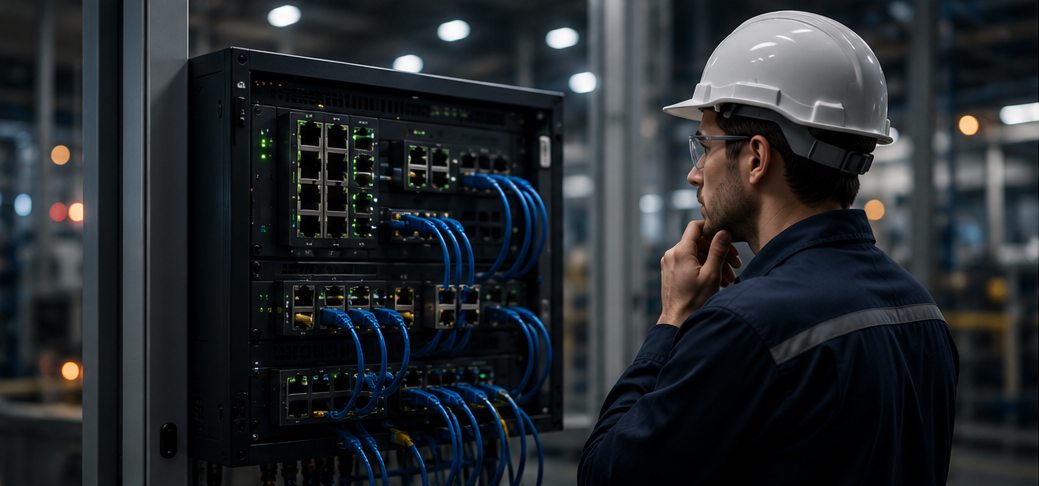
 Why Industrial Ethernet Matters More in Industry 4.0 Industrial Ethernet is becoming the communication foundation of Industry 4.0. As factories become more connected, the network must support more devices, more data, faster decisions, and higher reliability. For customers, this means the switch is no longer just a basic connection device. It becomes part of the factory’s digital infrastructure, supporting automation, visibility, predictive maintenance, and smarter production decisions.
Trend 1: More Industrial IoT Devices More sensors, cameras, controllers, robots, HMIs, barcode readers, and edge devices are being connected to factory networks. This creates more data, but also more pressure on network stability. Customers need industrial switches that can support scalable architecture, reliable uplinks, and better traffic management. As the number of connected devices grows, network planning becomes more important than simply adding more ports.
Trend 2: Edge Computing Closer to Machines Instead of sending every piece of data to the cloud, many industrial systems now process data closer to machines. Edge computing can reduce latency, improve response speed, and support real-time decision-making. For edge computing to work well, the local network must be stable, low-latency, and easy to monitor. A weak network can limit the value of advanced automation even when the software and devices are powerful.
Trend 3: Higher Demand for Uptime and Redundancy In smart manufacturing, downtime becomes more expensive because systems are more integrated. A network problem can affect production visibility, machine coordination, quality inspection, safety monitoring, and data collection. Managed industrial switches with redundancy features, ring topology support, dual uplinks, and dual power input will become more important. Redundancy is not only a feature. It is a strategy for protecting production continuity.
Trend 4: Fiber Backbone for Larger Data Flows As data volume grows, factories need long-distance, high-bandwidth, EMI-resistant connections. Fiber uplinks help connect production areas, remote cabinets, machine lines, and control rooms more reliably. Fiber is especially valuable in environments with motors, drives, power lines, and other sources of electromagnetic interference. For customers planning factory upgrades, fiber backbone design can improve long-term network stability.
Trend 5: Time-Sensitive Networking Time-Sensitive Networking, or TSN, is designed to support more deterministic communication for time-critical industrial applications. Adoption depends on the industry, system requirements, and equipment compatibility, but the direction is clear: industrial networks need more predictable performance. For customers, the value of deterministic communication is not only technical. It can support better synchronization, more stable machine coordination, and stronger confidence in time-critical operations.
Trend 6: AI-Driven Manufacturing AI quality inspection, predictive maintenance, machine vision, and automated decision-making all depend on stable data transmission. If the network is weak, the data foundation becomes weak. Connectivity quality will directly influence the value customers can get from AI applications. A reliable industrial Ethernet network helps ensure that data is collected, transmitted, and used more effectively.
What Customers Should Plan Now Future-ready industrial networks should be scalable, segmented, redundant, and easy to maintain. Customers should consider VLAN planning, fiber uplinks, PoE demand, remote management, cybersecurity planning, and maintenance visibility. The goal is not only faster speed. The real goal is reliable data flow, better system visibility, easier troubleshooting, and room for future expansion.  STAR FIRE TECH Perspective At STAR FIRE TECH, we see industrial switches as part of a long-term connectivity strategy. Customers should choose solutions that match today’s application while leaving room for future expansion, fiber backbone, PoE devices, managed control, and smart factory upgrades. In Industry 4.0, connectivity is not a background system. It is one of the core foundations of intelligent manufacturing.
FAQ Q: What is the role of industrial Ethernet in Industry 4.0? A: It connects machines, sensors, cameras, controllers, and data systems for smart manufacturing. Q: Why is edge computing important? A: Edge computing processes data closer to machines, reducing latency and improving response speed. Q: What is TSN? A: Time-Sensitive Networking is a set of technologies designed for more deterministic Ethernet communication. Q: Why will fiber become more important? A: Fiber supports long distance, higher bandwidth, and EMI-resistant backbone communication. Q: What should customers consider for future-ready networks? A: Scalability, redundancy, VLAN planning, fiber uplinks, PoE demand, remote management, and maintenance visibility.
#Industry40 #IndustrialEthernet #IndustrialIoT #SmartFactory #EdgeComputing #TSN #AIManufacturing #FactoryAutomation #IndustrialNetworking #STARFIRETECH