Table Of Content
Table Of Content
A single cable failure can stop an entire production line. When industrial connections become unstable, factories face unexpected downtime, delayed orders, and costly maintenance.
Reliable M12 cable assemblies help prevent connection failures and reduce factory downtime through secure locking connectors, suitable environmental protection, and durable cable construction. When correctly selected and installed, they support stable signal, data, and power connections in industrial automation systems.
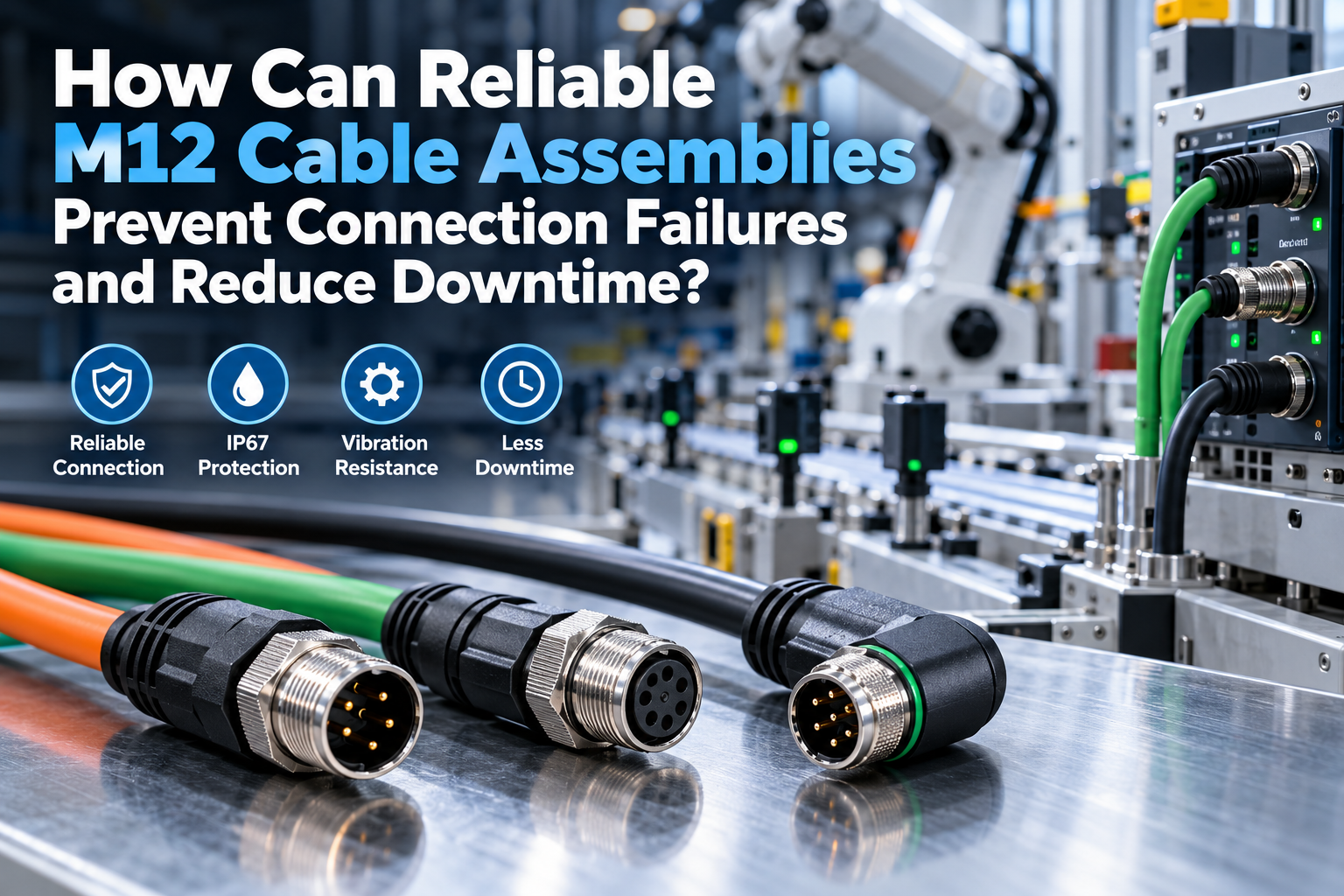
In modern factories, automation systems depend on thousands of electrical connections. Sensors monitor equipment. PLCs control production processes. Industrial Ethernet networks transfer important data between machines.
However, even advanced equipment cannot operate reliably when its cable connections fail.
I believe that many manufacturers focus heavily on machine performance but pay less attention to the cables connecting their equipment.
This creates a hidden risk.
A cable may represent only a small part of the total equipment cost. However, a connection failure can affect an entire production process.
At STAR FIRE TECH, we have worked in connectivity solutions since 2006. From my perspective, industrial cable selection should focus on long-term reliability, not just the initial purchase price.
I will explain the common causes of M12 connection failures, how reliable cable assemblies help reduce downtime, and what buyers should check before choosing an industrial cable solution.
What Causes M12 Cable Connection Failures in Industrial Automation?
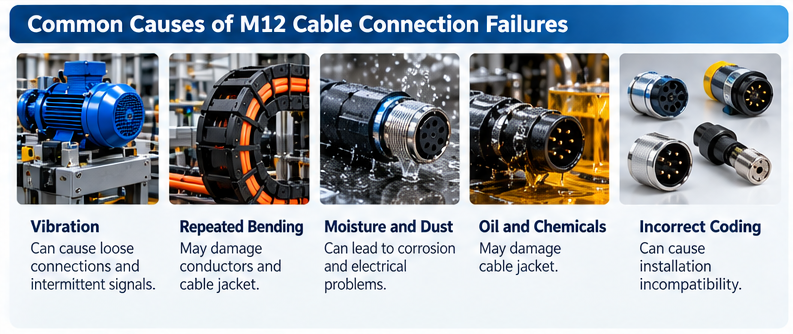
Industrial equipment operates under demanding conditions. Continuous vibration, repeated bending, moisture, and poor installation can damage cable assemblies and interrupt machine communication.
M12 cable connection failures commonly result from loose connections, damaged conductors, incorrect connector coding, unsuitable cable jackets, and improper sealing. Selecting the correct assembly and following proper installation practices can reduce these risks.
How Does Machine Vibration Affect M12 Connections?
Industrial machines generate vibration during normal operation.
Conveyor systems, motors, robotic arms, and packaging equipment may run for many hours each day.
These movements place mechanical stress on cable connections.
If a connector becomes loose, the connected device may experience intermittent electrical contact.
For example, imagine an automated packaging line with several proximity sensors.
One sensor monitors whether a product has reached the correct position.
If its connection becomes unstable, the PLC may receive an incorrect signal or lose the signal completely.
The control system may then stop the machine.
The production team must identify the problem, inspect the equipment, and restart the process.
A small connection problem has now become a production delay.
M12 connectors commonly use threaded locking mechanisms. These mechanisms help maintain secure connections when the connectors are properly mated and tightened.
However, I always recommend checking the manufacturer’s installation instructions.
Even a well-designed connector can fail when it is installed incorrectly.
Can Repeated Cable Bending Cause Unexpected Downtime?
Many industrial cables remain fixed after installation.
Others move continuously with automated equipment.
Robotic arms, cable carriers, and moving machinery can bend cables thousands of times during operation.
Over time, repeated mechanical stress may damage conductors, insulation, or connector terminations.
The cable may look normal from the outside while an internal conductor begins to fail.
This can create intermittent problems that are difficult to identify.
I believe this is one reason why choosing the correct cable construction matters so much.
A cable designed for fixed installation should not automatically be used in a continuous-flex application.
For moving equipment, buyers should check the specified bending radius, bending-cycle test conditions, cable jacket, and strain-relief design.
What Other Factors Can Cause M12 Cable Failures?
Failure cause
Possible result
Recommended prevention
Continuous vibration
Loose connection or intermittent signals
Secure locking connector
Repeated bending
Conductor fatigue or breakage
Suitable continuous-flex cable
Moisture exposure
Corrosion or electrical problems
Properly sealed, IP-rated connection
Oil or chemical exposure
Cable jacket damage
Compatible PUR or TPE material
Incorrect connector coding
Installation incompatibility
Verify connector coding and pinout
Poor cable routing
Excessive mechanical stress
Correct bend radius and strain relief
Incorrect installation
Reduced sealing or connection stability
Follow installation specifications
I recommend that industrial buyers review these risks before approving a cable assembly. Preventing a connection problem during product selection is usually easier than troubleshooting it after installation.
How Do M12 Cable Assemblies Improve Reliability and Reduce Factory Downtime?
Unexpected machine stops often begin with unstable connections. A damaged cable can interrupt sensor signals or network communication and delay production.
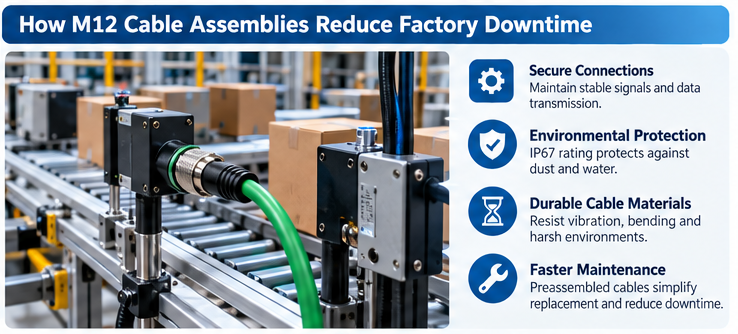
Reliable M12 cable assemblies can reduce downtime by providing secure connections, environmental protection, and suitable cable construction. Preassembled, correctly specified cables can also simplify replacement and help maintenance teams restore equipment operation faster.
Why Are Secure Connections Important for Factory Automation?
Modern industrial systems rely on communication between different devices.
A typical automated production line may include sensors, actuators, PLCs, industrial switches, and machine vision cameras.
Each connection has a specific purpose.
A sensor cable carries information about machine conditions.
An industrial Ethernet cable transfers data between network devices.
A power cable supplies electrical energy to connected equipment.
If one important connection fails, the machine may stop or operate incorrectly.
M12 cable assemblies offer a compact connection system designed for industrial applications.
Their locking design helps reduce the risk of accidental disconnection.
Some M12 assemblies also provide protection against dust and water when correctly mated.
For example, an IP67-rated connection provides protection against dust and temporary immersion under specified test conditions.
However, I want to emphasize that the complete assembly must meet the required protection rating.
A connector alone does not guarantee that every cable assembly has the same environmental performance.
How Can Cable Materials Improve Service Life?
Cable jacket selection is another important part of industrial reliability.
Different environments require different material properties.
For example, a cable installed near industrial machinery may encounter oil, abrasion, or repeated movement.
A cable used in a clean, fixed installation may have less demanding requirements.
PUR and TPE are common jacket materials for industrial cable assemblies.
Depending on their formulation and construction, these materials can provide flexibility, abrasion resistance, or resistance to certain industrial chemicals.
I recommend choosing the material based on actual working conditions rather than assuming that one jacket is always better.
Cable requirement
What buyers should check
Fixed installation
Suitable mechanical and electrical specifications
Continuous movement
Verified flex-life performance
Oil exposure
Oil resistance of the specific jacket
Outdoor installation
Temperature, moisture, and UV requirements
Wet environments
Complete assembly sealing and IP rating
Industrial Ethernet
Correct cable category and shielding
Compact machinery
Connector orientation and bend radius
At STAR FIRE TECH, we provide industrial cable solutions with PUR and TPE jacket options.
We also support M8/M12 cable assembly configurations for different industrial applications.
For projects involving repeated movement, we can discuss cable constructions designed for flexing applications.
I believe that manufacturers should always confirm the tested performance of the exact cable design before approving it for demanding installations.
Can Preassembled M12 Cables Make Maintenance Easier?
Maintenance efficiency plays an important role in reducing downtime.
When a cable fails, technicians need to identify the problem and replace the damaged component.
A factory-assembled M12 cable can simplify this process when a compatible replacement is available.
Technicians may be able to disconnect the damaged assembly and install a new one without performing extensive field termination.
However, the replacement must match the original technical requirements.
Connector coding, pin assignment, cable length, electrical rating, and shielding requirements all matter.
I recommend keeping a list of approved cable part numbers for important production equipment.
Factories can also consider keeping suitable spare assemblies for critical connections.
This approach can reduce the time spent searching for compatible replacement parts.
Why Should Buyers Consider Downtime Costs Instead of Cable Price Alone?
I believe the industrial connectivity market is gradually moving toward a stronger focus on total operating cost.
The cheapest cable is not always the most economical choice.
Consider a simple example.
A factory estimates that one hour of stopped production costs $3,000.
If a cable failure causes a two-hour shutdown, the estimated production loss reaches $6,000.
This example is illustrative. Actual downtime costs vary greatly between factories.
Still, it shows why buyers should consider more than the unit price.
A cable that performs reliably over a longer service period may provide better overall value than a lower-priced alternative that requires frequent replacement.
For critical automation systems, I recommend comparing cable reliability, maintenance requirements, expected service life, and total ownership cost.
How Do You Choose the Right M12 Cable Assembly for Industrial Applications?
Choosing an M12 cable based only on appearance or price can lead to compatibility problems. Buyers must match the cable assembly to the equipment and operating environment.
To select the right M12 cable assembly, verify connector coding, pin configuration, cable length, IP rating, jacket material, shielding, and mechanical requirements. The complete assembly should match the equipment interface and expected working conditions.
Which M12 Connector Coding Should You Choose?
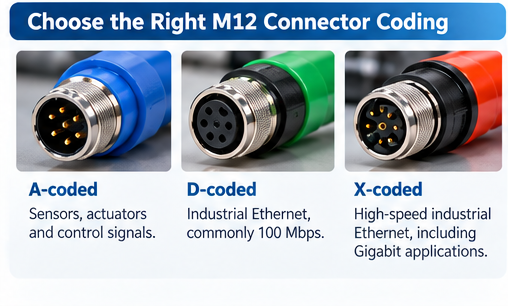
M12 connectors are available in different coding types.
The coding system helps prevent incompatible connectors from being mated.
However, different coding types are designed for different applications.
I recommend identifying the equipment interface before selecting a cable.
M12 coding
Typical application
Important consideration
A-coded
Sensors, actuators, and control signals
Pin count and electrical requirements
D-coded
Industrial Ethernet, commonly 100 Mbps
Network interface and cable specification
X-coded
Gigabit and higher-speed industrial Ethernet
Data rate, shielding, and cable category
For example, an industrial sensor may use an A-coded M12 connector.
A 100 Mbps industrial Ethernet device may use a D-coded connector.
A high-bandwidth machine vision camera may require an X-coded interface.
These applications have different electrical requirements.
I believe buyers should never assume that all M12 connectors are interchangeable.
The connector coding is only the first step.
The pinout, cable construction, and equipment requirements must also match.
What Should Buyers Check Before Ordering Custom M12 Cable Assemblies?
Custom industrial cable assemblies can help equipment manufacturers meet specific installation requirements.
However, customization also increases the importance of clear technical information.
I recommend that buyers prepare a detailed specification before requesting a quotation.
The following information can help suppliers evaluate a project.
Specification
Why it matters
Connector coding
Confirms the correct interface
Male or female connector
Defines mating compatibility
Straight or angled connector
Matches available installation space
Pin count and wiring diagram
Confirms electrical connections
Cable length
Supports installation planning
Cable jacket material
Matches environmental requirements
Shielding requirement
Supports suitable data transmission performance
IP rating
Defines dust and water protection
Bending requirements
Matches fixed or moving applications
Operating temperature
Confirms environmental suitability
Order quantity
Supports production and pricing planning
For OEM and ODM projects, I also recommend providing drawings whenever possible.
A clear drawing can prevent misunderstandings about connector orientation, pin assignments, and cable dimensions.
At STAR FIRE TECH, we support customized industrial cable assemblies based on customer specifications.
Our product options include M8/M12 connections, M12-to-RJ45 configurations, straight and angled connectors, and different cable jacket choices.
Our team can review the requested construction and application requirements before sample development.
What Should Manufacturers Expect From an Industrial Cable Supplier?
I believe that industrial buyers increasingly need suppliers who understand the complete application.
A supplier should not focus only on connector appearance or price.
The supplier should also consider how the cable will perform after installation.
For example, a cable used in a moving robotic system should be evaluated differently from a cable installed inside a stationary control cabinet.
A cable exposed to moisture requires different protection from one used in a dry indoor environment.
A high-speed Ethernet cable also requires different electrical considerations from a simple sensor cable.
These differences can affect product design, material selection, and testing requirements.
Since 2006, STAR FIRE TECH has developed connectivity solutions across professional AV, optical fiber communication, and industrial communication.
For M12 cable assembly projects, we aim to help customers identify suitable configurations based on their technical requirements.
We support OEM/ODM customization, including connector options, cable lengths, jacket materials, and related product details.
I encourage industrial equipment manufacturers, automation system integrators, and distributors to share their application requirements early in the sourcing process.
This helps both sides identify potential compatibility or reliability issues before production begins.
How Is the Industrial Connectivity Market Changing?
From my perspective, factory automation is placing greater demands on industrial connectivity.
Modern production systems use more sensors, cameras, controllers, and networked equipment than many traditional manufacturing lines.
These devices create more connection points across the factory.
Each connection becomes another part of the system that needs to operate reliably.
At the same time, manufacturers want to reduce maintenance costs and improve production efficiency.
This creates an important opportunity for industrial cable suppliers.
I believe that suppliers who can provide consistent quality, suitable customization, and technical support will become more valuable to industrial customers.
For buyers, the best approach is to treat cable assemblies as important system components rather than simple accessories.
Reliable connections help support reliable production.
If you are sourcing custom M12 cable assemblies for industrial automation, our team at STAR FIRE TECH can discuss your connector specifications, application environment, and OEM/ODM requirements.
Learn more: https://www.starfirecableshubs.com
Conclusion
I believe reliable M12 cable assemblies can help reduce factory downtime through secure connections, suitable materials, and correct installation. Careful cable selection supports long-term industrial reliability.