Table Of Content
Table Of Content
When building an industrial network, many customers ask a simple question:
Do I need a managed industrial Ethernet switch, or is an unmanaged switch enough?
The answer depends on your application.
An unmanaged switch is simple. A managed switch gives you more control. But the best choice should be based on network size, device type, reliability requirements, and future expansion.
Choosing the wrong switch may not cause problems on day one.
But later, when the system grows, cameras increase, PLC communication becomes unstable, or troubleshooting becomes difficult, the cost of the wrong choice becomes much higher.
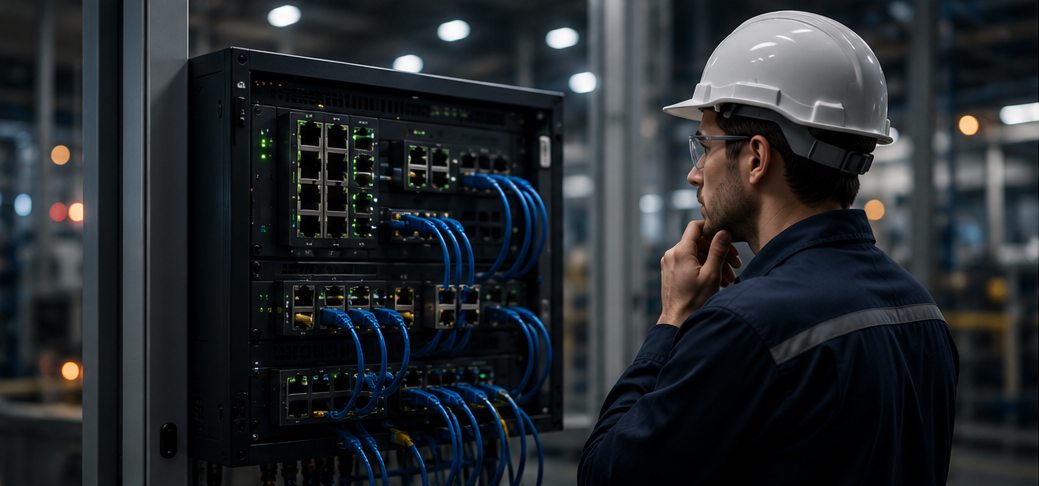
What is an unmanaged industrial switch?
An unmanaged industrial Ethernet switch is usually plug-and-play.
You connect the devices, power on the switch, and the network starts working. It does not require software configuration.
This type of switch is suitable for small and simple systems, such as:
Small control cabinets Basic machine networks Simple PLC-to-HMI communication Small IP camera systems Local equipment connection Projects with limited network management needs
The advantage is simple installation and lower cost.
But the limitation is clear: you cannot control or monitor the network in detail.
If there is packet loss, broadcast storm, traffic congestion, or device disconnection, troubleshooting can be difficult.
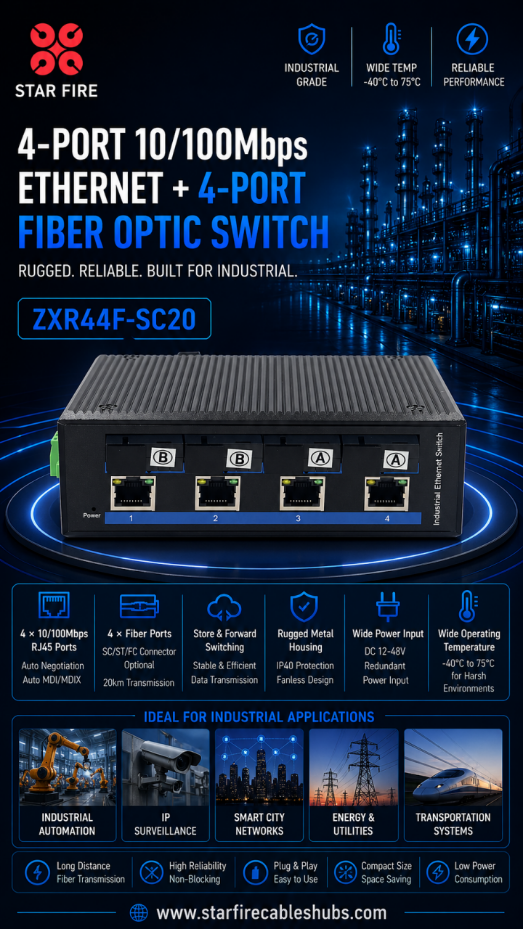
What is a managed industrial switch?
A managed industrial switch provides network control and monitoring functions.
It can support features such as:
VLAN QoS RSTP/STP/MSTP Ring redundancy IGMP snooping Port monitoring Remote management Traffic control Network diagnostics Security settings
For industrial systems, these functions are important because the network often carries different types of traffic at the same time.
For example, a factory network may include PLCs, HMIs, industrial cameras, sensors, robots, SCADA systems, and IP surveillance cameras. These devices may not have the same priority.
Control data is more critical than general monitoring traffic.
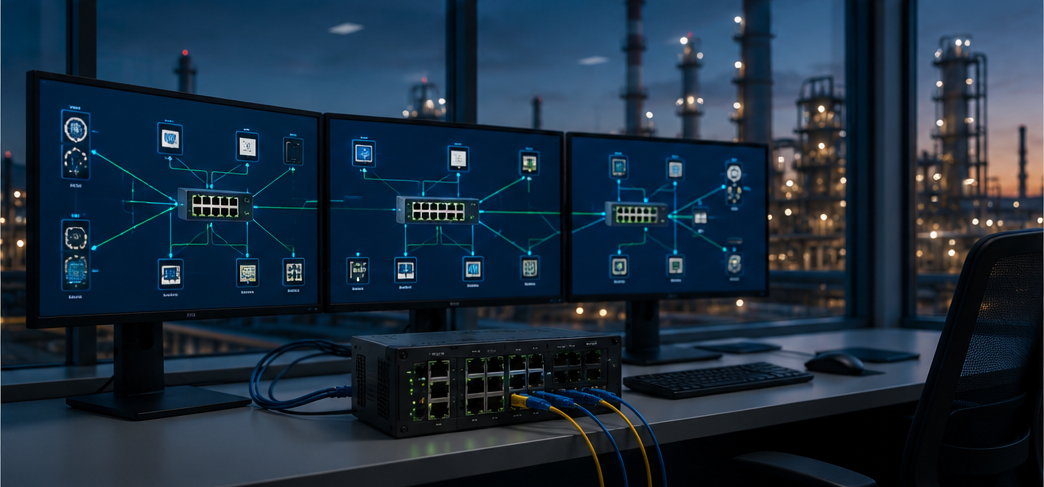
A managed switch helps engineers separate, prioritize, and protect the network.
When is an unmanaged switch enough?
An unmanaged industrial switch may be enough when:
The system is small The network structure is simple There are only a few devices No VLAN is required No remote monitoring is required Downtime risk is low The installation environment still requires industrial-grade hardware
For example, a small machine cabinet with several Ethernet devices may not need a managed switch.
But it may still need an industrial switch because the environment has vibration, temperature changes, or electrical noise.
This is an important point:
Unmanaged does not mean non-industrial.
You can still choose an unmanaged industrial Ethernet switch when the application is simple but the environment is harsh.
When should you choose a managed industrial switch?
A managed industrial switch is recommended when:
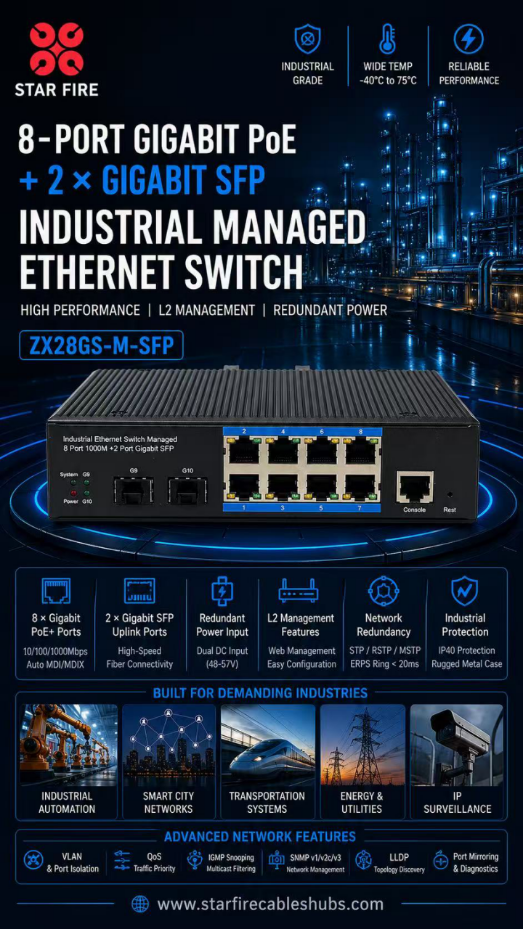
The system has many devices The network connects PLCs, cameras, and control systems Network downtime is expensive Remote troubleshooting is required Fiber uplink is needed Redundancy is required Traffic needs to be separated by VLAN Video, control, and data traffic exist in the same network The system may expand in the future
For example, in a highway surveillance system, multiple IP cameras may connect to industrial PoE switches inside roadside cabinets. These switches may use fiber uplinks to send data back to the control center.
In this type of application, managed functions are valuable.
They help improve visibility, reduce downtime, and make maintenance easier.
How to choose the right one
Here is a practical selection guide.
Choose an unmanaged industrial switch if your project is small, local, and simple.
Choose a managed industrial switch if your project needs reliability, visibility, redundancy, or long-term scalability.
Choose a managed PoE industrial switch if your system includes IP cameras, wireless APs, access control devices, or other powered edge equipment.
Choose a fiber industrial switch if your system requires long-distance transmission or better EMI immunity.
Choose a Layer 3 industrial switch if your system requires routing, larger network segmentation, or core aggregation functions.
FAQ
Is a managed switch always better than an unmanaged switch? Not always. A managed switch provides more control, but an unmanaged switch is still suitable for simple industrial networks with limited devices.
Can I use an office switch in a factory? It is not recommended for harsh environments. Industrial switches are designed for temperature variation, vibration, EMI, and 24/7 operation.
Why do industrial networks need VLAN? VLAN helps separate traffic, reduce broadcast impact, improve security, and organize different device groups such as PLCs, cameras, and management systems.
What is the benefit of redundancy in industrial Ethernet? Redundancy helps maintain communication when one link fails. This is important for automation, transportation, energy, and surveillance systems.
When should I choose a PoE industrial switch? Choose PoE when your devices need both power and data through Ethernet, such as IP cameras, access control systems, wireless APs, and some industrial edge devices.
For industrial networks, the right switch is not only about port count.
It is about system reliability, maintainability, and long-term performance.
At STAR FIRE TECH, we provide industrial Ethernet switch solutions for automation, surveillance, transportation, energy, and harsh-environment networking applications.
Stable network. Reliable communication. Better system uptime.
#ManagedSwitch #UnmanagedSwitch #IndustrialEthernetSwitch #IndustrialNetworking #FactoryAutomation #SmartFactory #IndustrialAutomation #VLAN #QoS #NetworkRedundancy #PoESwitch #DINRailSwitch #IndustrialCommunication #SCADA #PLCNetwork #STARFIRETECH