Table Of Content
Table Of Content
Introduction
As industries continue to embrace digital transformation, the underlying network infrastructure is becoming increasingly critical. Among the key components enabling this shift is the industrial Ethernet switch. Once considered a basic connectivity device, it is now evolving into a sophisticated platform that supports real-time communication, edge intelligence, and secure data exchange across industrial environments.
This article explores the technological evolution, core capabilities, and emerging trends shaping the future of industrial Ethernet switches.
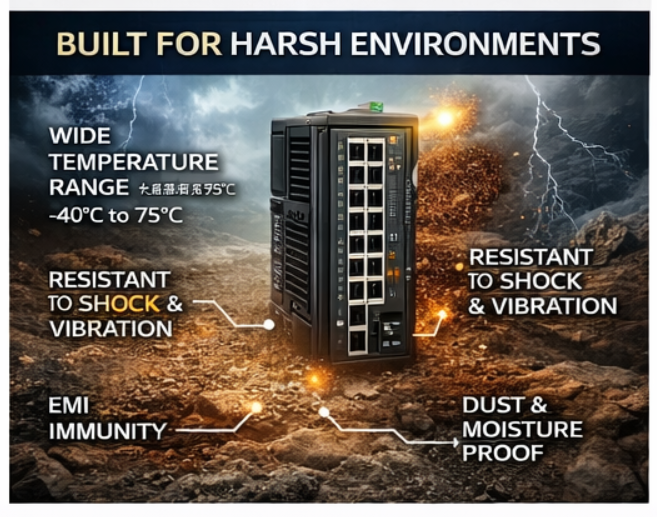
1. Foundations: Designed for Harsh Environments
Industrial Ethernet switches were originally engineered to operate reliably under extreme conditions. Unlike commercial-grade networking equipment, they must withstand:
- Wide temperature ranges
- High levels of vibration and shock
- Electromagnetic interference (EMI)
- Dust, moisture, and corrosive environments
In addition to physical robustness, industrial switches have historically emphasized:
- Deterministic communication for control systems
- High reliability and long operational lifecycles
- Support for industrial protocols and real-time data exchange
These characteristics remain fundamental, but modern industrial applications demand significantly more advanced capabilities.
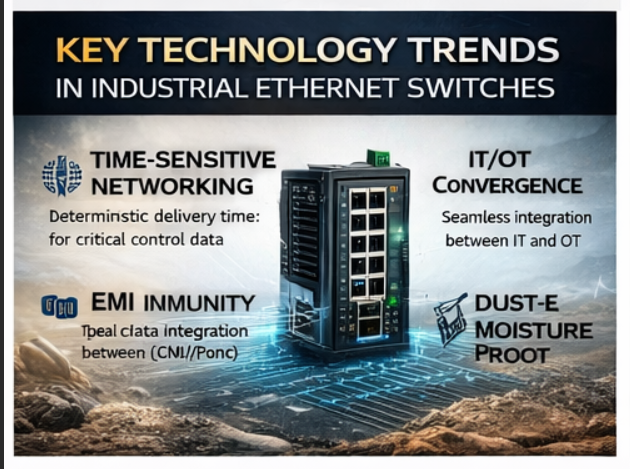
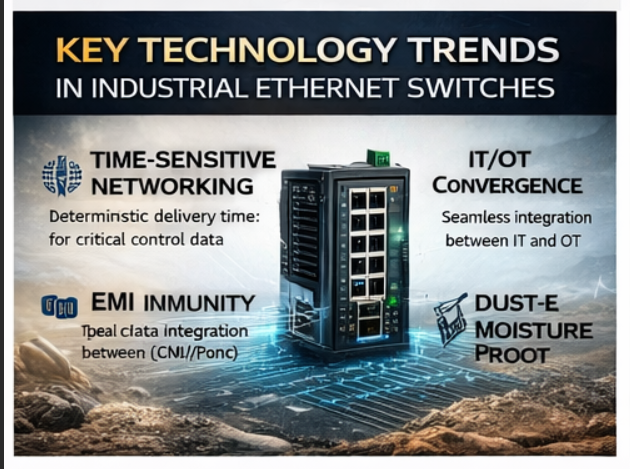
2. Key Technology Trends Driving Transformation
2.1 Time-Sensitive Networking (TSN)
Time-Sensitive Networking is one of the most significant advancements in industrial communication. TSN enhances standard Ethernet by enabling deterministic, low-latency data transmission.
Key benefits include:
- Guaranteed delivery times for critical control data
- Convergence of multiple traffic types (control, video, IT data)
- Reduced need for separate network infrastructures
TSN is expected to play a central role in future-proof industrial networks.
2.2 IT/OT Convergence
The traditional separation between Information Technology (IT) and Operational Technology (OT) is rapidly diminishing. Industrial Ethernet switches are now required to bridge these domains by supporting:
- Standard Ethernet and IP-based protocols
- Seamless integration with enterprise systems
- Scalable and interoperable architectures
This convergence enables better data visibility, analytics, and decision-making across organizations.
2.3 Integration of Edge Intelligence
Modern industrial switches are increasingly incorporating edge computing capabilities. Rather than simply forwarding data, they can now:
- Perform local data processing and filtering
- Analyze network traffic in real time
- Support intelligent decision-making at the edge
This reduces latency, optimizes bandwidth usage, and enhances system responsiveness—especially in time-critical applications.
2.4 Network Resilience and High Availability
In industrial environments, network downtime can lead to significant operational and financial losses. As a result, resilience has become a core design principle.
Common approaches include:
- Ring topologies with rapid failover mechanisms
- Redundancy protocols ensuring minimal recovery time
- Self-healing network architectures
These features ensure continuous operation even in the event of component or link failures.
2.5 Built-in Cybersecurity
As industrial networks become more connected, they also become more vulnerable to cyber threats. Security is no longer optional—it is a fundamental requirement.
Modern industrial switches typically incorporate:
- Access control mechanisms (e.g., port-based authentication)
- Traffic filtering and segmentation
- Secure management interfaces
- Monitoring and anomaly detection capabilities
Embedding security at the network level helps protect critical infrastructure from evolving threats.
3. Expanding Application Scenarios
The role of industrial Ethernet switches is expanding across a wide range of industries:
Smart Manufacturing
They enable real-time communication between controllers, sensors, and robotic systems, supporting automation and predictive maintenance.
Energy and Utilities
Industrial switches facilitate grid automation, remote monitoring, and reliable communication across geographically distributed assets.
Transportation Systems
They support intelligent traffic systems, rail communication networks, and infrastructure monitoring.
Logistics and Warehousing
With the rise of automation, switches connect autonomous mobile robots, IoT devices, and warehouse management systems.
4. Future Outlook
Looking ahead, the evolution of industrial Ethernet switches will be shaped by three primary directions:
Increased Determinism
The adoption of TSN will continue to expand, enabling more precise and predictable communication.
Greater Intelligence
Edge computing capabilities will become more advanced, turning switches into active participants in data processing and system optimization.
Stronger Security Integration
Security features will be further embedded into hardware and software architectures, ensuring robust protection against cyber threats.
5. Suggested Visual Content
To enhance readability and engagement—especially for professional platforms—consider incorporating the following visuals:
- Industrial Network Topology Diagram
Illustrate ring, star, and mesh topologies within a factory setting. - TSN Communication Model
Show how deterministic traffic flows are prioritized within a unified Ethernet network. - Smart Factory Environment
Depict interconnected machines, sensors, and control systems. - Edge Computing Architecture
Visualize the industrial switch as an intermediary layer between field devices and cloud platforms.
Conclusion
The industrial Ethernet switch is no longer just a networking component—it is becoming a foundational element of modern industrial intelligence. As technologies such as TSN, edge computing, and cybersecurity continue to evolve, these devices will play an increasingly strategic role in enabling efficient, reliable, and secure industrial operations.
Organizations that understand and leverage these advancements will be better positioned to build resilient, future-ready infrastructure in the era of Industry 4.0.