Table Of Content
Table Of Content
A Practical Comparison for High-Performance Infrastructure Decisions
The Reality: Not All Cabling Solutions Scale with Your Business
As data centers evolve toward AI workloads, cloud computing, and ultra-high bandwidth demands, many infrastructure decisions made just a few years ago are starting to show limitations.
One of the most overlooked factors?
The cabling architecture behind your network.
Many organizations still rely on:
- Passive copper cables (DAC)
- Standard Active Optical Cables (AOC)
While these solutions have worked in the past, they often struggle to meet today’s requirements for speed, density, efficiency, and scalability.
The Comparison: Hybrid AOC vs. Traditional Solutions
To understand where Hybrid AOC stands, let’s break it down across the dimensions that matter most to your operation.
1. Performance & Latency

Traditional Copper (DAC):
- Limited bandwidth over distance
- Signal degradation becomes significant beyond short ranges
- Higher latency under heavy loads
Standard AOC:
- Good high-speed performance
- Requires separate power handling
Hybrid AOC:
- Combines optical data transmission with integrated power
- Maintains high bandwidth with low and stable latency
- Performs consistently even in demanding environments
✅ Takeaway: Hybrid AOC delivers the most stable performance for high-speed, high-density systems.
2. Cable Management & Density
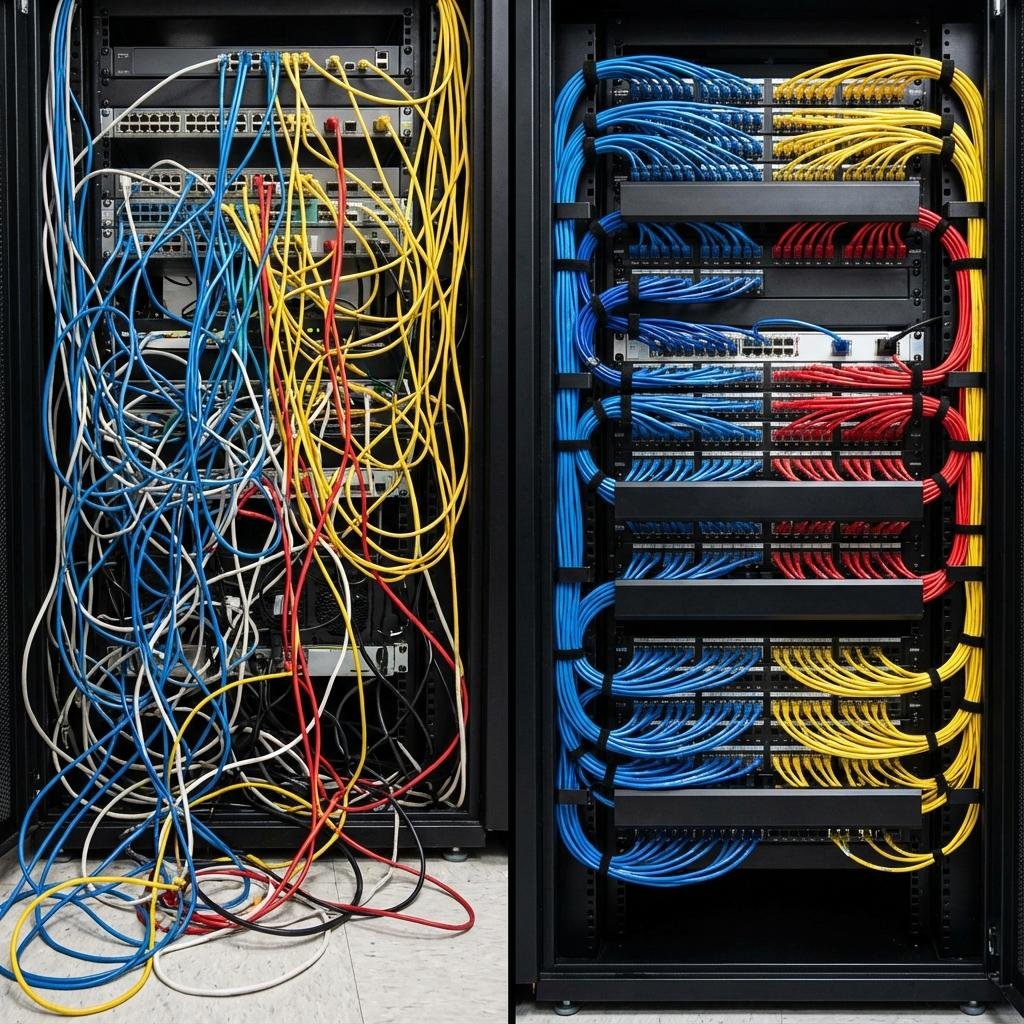
Traditional Copper:
- Thick, heavy cables
- Difficult to manage in high-density racks
- Blocks airflow, contributing to overheating
Standard AOC:
- Thinner than copper
- Still requires additional infrastructure for power
Hybrid AOC:
- Lightweight and compact
- Reduces cable clutter significantly
- Improves airflow and rack organization
✅ Takeaway: Hybrid AOC enables cleaner, more efficient high-density deployments.
3. Power Efficiency & Infrastructure Complexity
Traditional Copper:
- Higher power consumption due to electrical resistance
- Inefficient for longer distances
Standard AOC:
- Requires external power modules or additional components
- Adds complexity to system design
Hybrid AOC:
- Integrates power and data into a single cable
- Eliminates need for separate power infrastructure
- Reduces overall system complexity
✅ Takeaway: Hybrid AOC simplifies architecture while improving energy efficiency.
3. Scalability & Future Readiness

Traditional Copper:
- Not suitable for long-distance, high-speed scaling
- Requires frequent upgrades
Standard AOC:
- Better scalability than copper
- Still limited by infrastructure complexity
Hybrid AOC:
- Designed for AI, HPC, and next-gen workloads
- Supports long-term scalability without major redesign
- Ideal for evolving data center architectures
✅ Takeaway: Hybrid AOC is built for future growth, not just current needs.
What This Means for Decision Makers
Choosing the right cabling solution is no longer a simple cost comparison—it’s a strategic infrastructure decision.
If your organization is dealing with:
- Increasing data traffic and bandwidth demands
- Rack space limitations
- Rising energy and cooling costs
- Expansion plans for AI or cloud services
Then your cabling choice will directly impact your ability to scale efficiently.
When Hybrid AOC Makes the Most Sense
Hybrid AOC is particularly valuable in:
- AI training and inference clusters
- High-performance computing (HPC) environments
- Cloud data centers
- High-density enterprise networks
- Latency-sensitive applications
Final Takeaway
Traditional cabling solutions were built for a different era.
Today’s infrastructure requires more than just connectivity—it requires:
- Efficiency
- Simplicity
- Scalability
Hybrid AOC addresses all three.
Instead of asking,
“What works today?”
the better question is:
“What will still work 3–5 years from now?”
�� Industry Keywords
#HybridAOC
#ActiveOpticalCable
#DataCenterDesign
#HighSpeedNetworking
#AIInfrastructure
#CloudComputing
#FiberOptics
#HPC
#NetworkOptimization
#NextGenDataCenter