Table Of Content
Table Of Content

In industrial networking, connector selection is often treated as a mechanical detail. It should not be.
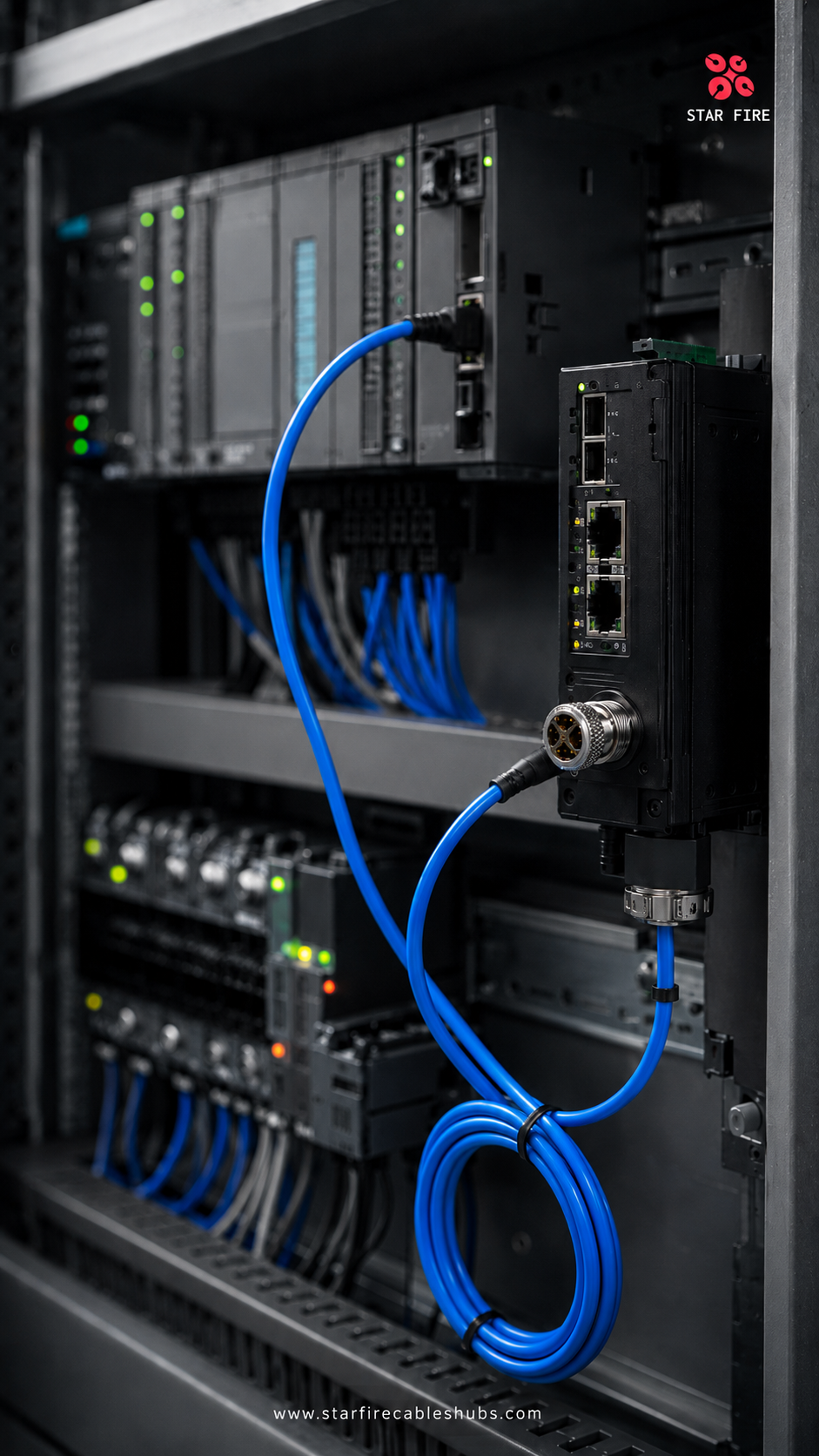
As factories, machine vision systems, control rooms, AV-over-IP networks, transportation infrastructure, and intelligent edge devices move toward higher data rates, the connector becomes part of the transmission channel. A rugged housing alone cannot compensate for insufficient bandwidth, poor pair geometry, inadequate shielding, or the wrong Ethernet interface.
That is why the difference between M12 D-Code and M12 X-Code matters.
Both are rugged circular Ethernet interfaces designed for demanding environments. But they were developed for different network requirements. The right question is not simply, “Which one is better?” The better question is: “What does the complete network actually need?”
THE CORE DIFFERENCE
M12 D-Code is the established choice for 100 Mbps industrial Ethernet. It typically uses four contacts, or two differential pairs, and is widely used with protocols such as PROFINET, EtherNet/IP, and EtherCAT where Fast Ethernet is sufficient.
M12 X-Code uses eight contacts, or four differential pairs. Its internal cross-shaped separation structure helps isolate the four signal pairs and control crosstalk. In a properly designed Cat 6A channel, X-Code supports Ethernet data rates up to 10 Gbps.
In simplified terms:
- D-Code: 4 contacts, two pairs, typically 100BASE-TX, up to 100 Mbps.
- X-Code: 8 contacts, four pairs, Cat 6A / Class EA capability, up to 10GBASE-T.
- D-Code is standardized within the M12 family under IEC 61076-2-101.
- X-Code high-speed Ethernet interfaces are standardized under IEC 61076-2-109.
But speed alone does not explain the engineering difference.
PAIR ARCHITECTURE CHANGES THE CHANNEL
100BASE-TX requires two twisted pairs. This matches D-Code architecture well and makes D-Code an efficient solution for PLCs, remote I/O, sensors, drives, industrial controllers, and many machine networks that do not generate high-bandwidth traffic.
Gigabit and 10 Gigabit Ethernet require all four pairs. X-Code was designed around that requirement.
The X-shaped separator in the mating interface is not cosmetic. It creates physical separation between the four pair groups and contributes to better control of near-end crosstalk, far-end crosstalk, and pair-to-pair interference at higher frequencies.
At 100 Mbps, a network can tolerate channel characteristics that would become unacceptable at 1 or 10 Gbps. As frequency increases, impedance consistency, return loss, insertion loss, shielding continuity, pair balance, connector termination, and cable construction become much more important.
This is the point many buyers miss: choosing X-Code is not simply choosing eight pins. It is choosing a higher-performance transmission architecture.
WHEN D-CODE IS STILL THE RIGHT CHOICE
There is a tendency in technology procurement to assume that the highest specification is automatically the safest specification. That is not always good engineering.
D-Code remains an excellent choice when:
- The device interface is 10/100 Mbps.
- The application is primarily PLC, sensor, I/O, actuator, or machine-control traffic.
- Network bandwidth is predictable and relatively low.
- Existing installed equipment already uses D-Code.
- Cable size, connector cost, service simplicity, and installed-base compatibility matter more than future 10 Gigabit capacity.
For many industrial automation systems, 100 Mbps is more than adequate. A deterministic control network carrying small cyclic packets does not become more reliable simply because the physical connector supports 10 Gbps.
Using X-Code everywhere can also introduce unnecessary cost, larger cable constructions, more complex termination requirements, and tighter signal-integrity expectations without delivering a measurable operational benefit.
Good engineering is not maximum specification. It is the correct specification with sufficient margin.
WHEN X-CODE BECOMES THE BETTER ENGINEERING DECISION
X-Code becomes much more compelling when the network is carrying large volumes of data or when equipment is expected to migrate toward Gigabit and 10 Gigabit Ethernet.
Typical examples include:
Machine Vision and Industrial Cameras
High-resolution cameras can generate far more network traffic than conventional sensors. Multiple cameras, higher frame rates, lossless image transfer, AI inspection, and centralized processing can quickly exceed Fast Ethernet capacity.
In these systems, the cable and connector are no longer passive accessories. They are part of the imaging data path.
Industrial Ethernet Backbones
A machine may contain dozens of 100 Mbps edge devices, while its uplink or aggregation layer carries the combined traffic. D-Code may remain perfectly suitable at the edge, while X-Code is a better choice for Gigabit or 10 Gigabit uplinks.
This mixed architecture is often more rational than replacing every connection with the highest-speed interface.
Pro AV and AV-over-IP
The boundary between traditional industrial networking and professional AV is becoming less distinct.
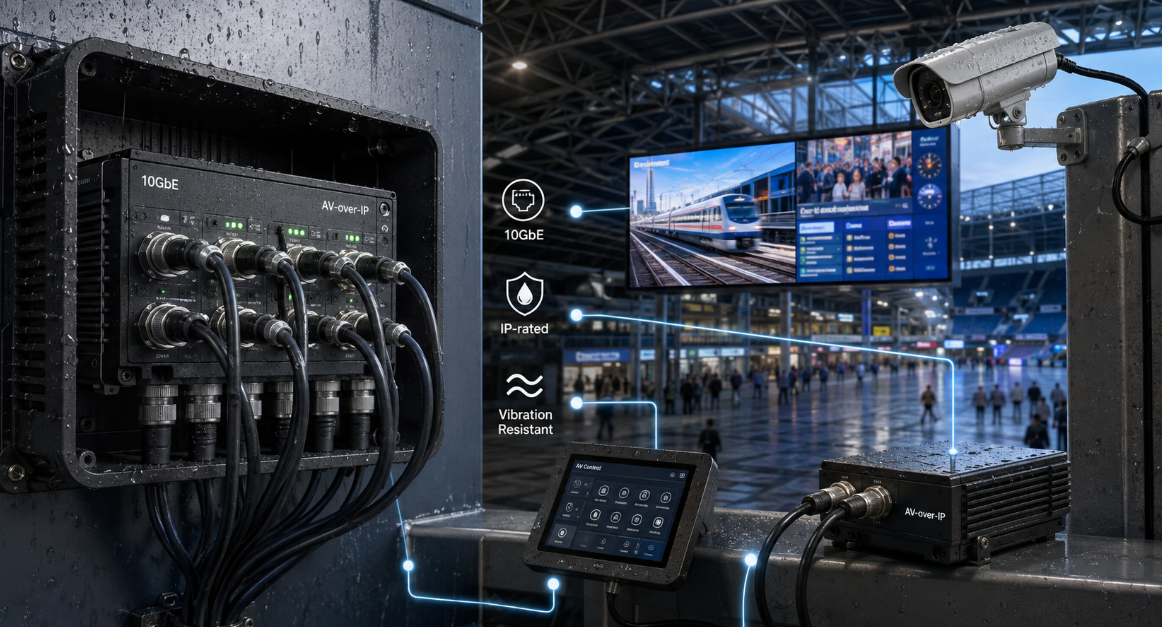
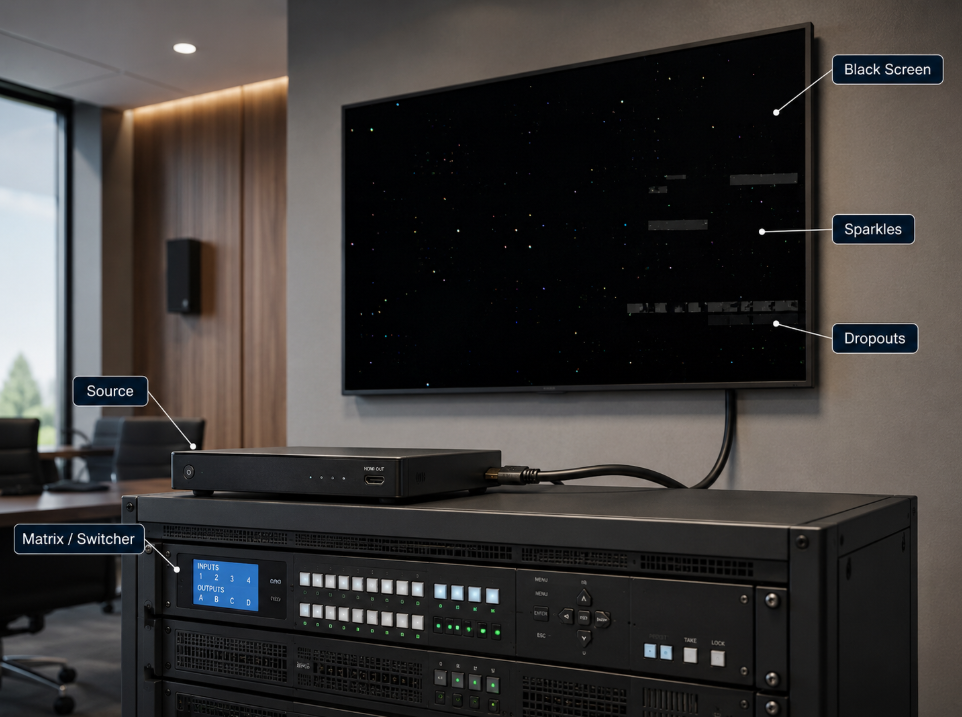
Control rooms, command centers, transportation systems, digital signage networks, broadcast environments, smart manufacturing facilities, medical imaging systems, and large visualization platforms increasingly combine video, control, USB, sensor data, cameras, and Ethernet on the same infrastructure.
Many AV-over-IP architectures operate at 1 GbE, 2.5 GbE, or 10 GbE depending on codec, image quality, latency, channel count, and compression strategy. Where rugged M12 connectivity is required in these environments, X-Code offers significantly more bandwidth headroom than D-Code.
For Pro AV system designers, this is particularly important when moving network connectivity outside the protected rack and closer to cameras, displays, industrial PCs, robotic systems, outdoor equipment, or moving machinery.
EMC PERFORMANCE CANNOT BE SEPARATED FROM BANDWIDTH
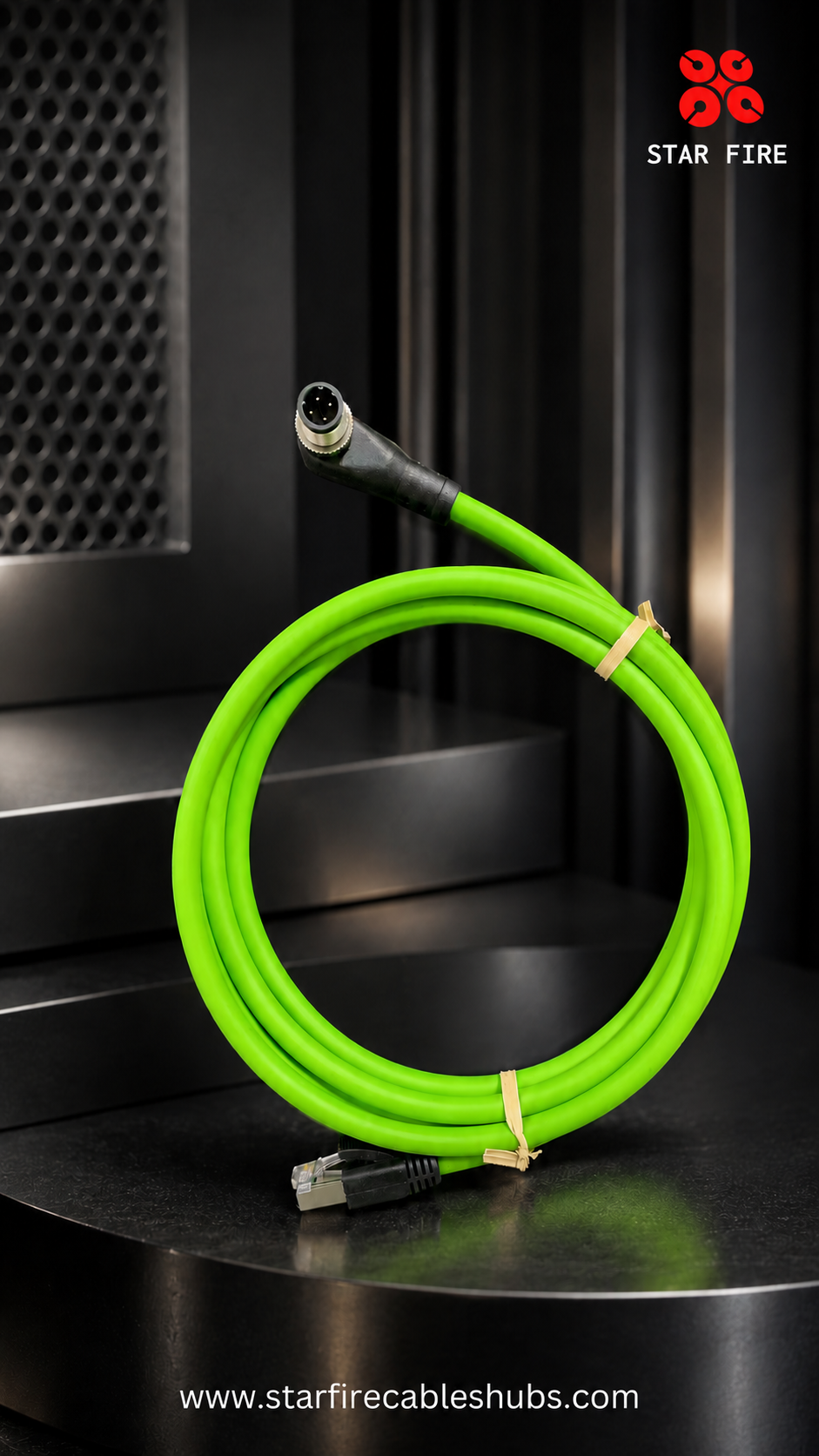
Industrial environments contain motors, VFDs, servo drives, welding equipment, switching power supplies, contactors, and high-current cables. These can create significant electromagnetic interference.
Higher-speed Ethernet does not simply require more bandwidth; it requires better control of the entire signal channel.
X-Code's pair separation and shielding architecture helps support the electrical performance required for Cat 6A transmission. But the connector alone cannot guarantee a Cat 6A or 10 Gigabit link.
The complete assembly must be considered:
- Cable category and conductor construction
- Pair twist and pair balance
- Overall and individual shielding design
- 360-degree shield termination
- Connector geometry
- Termination process
- Cable length
- Bend radius
- Flexing or torsion requirements
- Grounding strategy
- Environmental sealing
An X-Code connector installed on a poorly designed cable is not automatically a 10 Gigabit solution.
This distinction matters for procurement. Buyers should qualify the cable assembly as a transmission system, not purchase components based only on the connector label.
DO NOT IGNORE THE MECHANICAL ENVIRONMENT
Bandwidth is only half of industrial cable reliability.
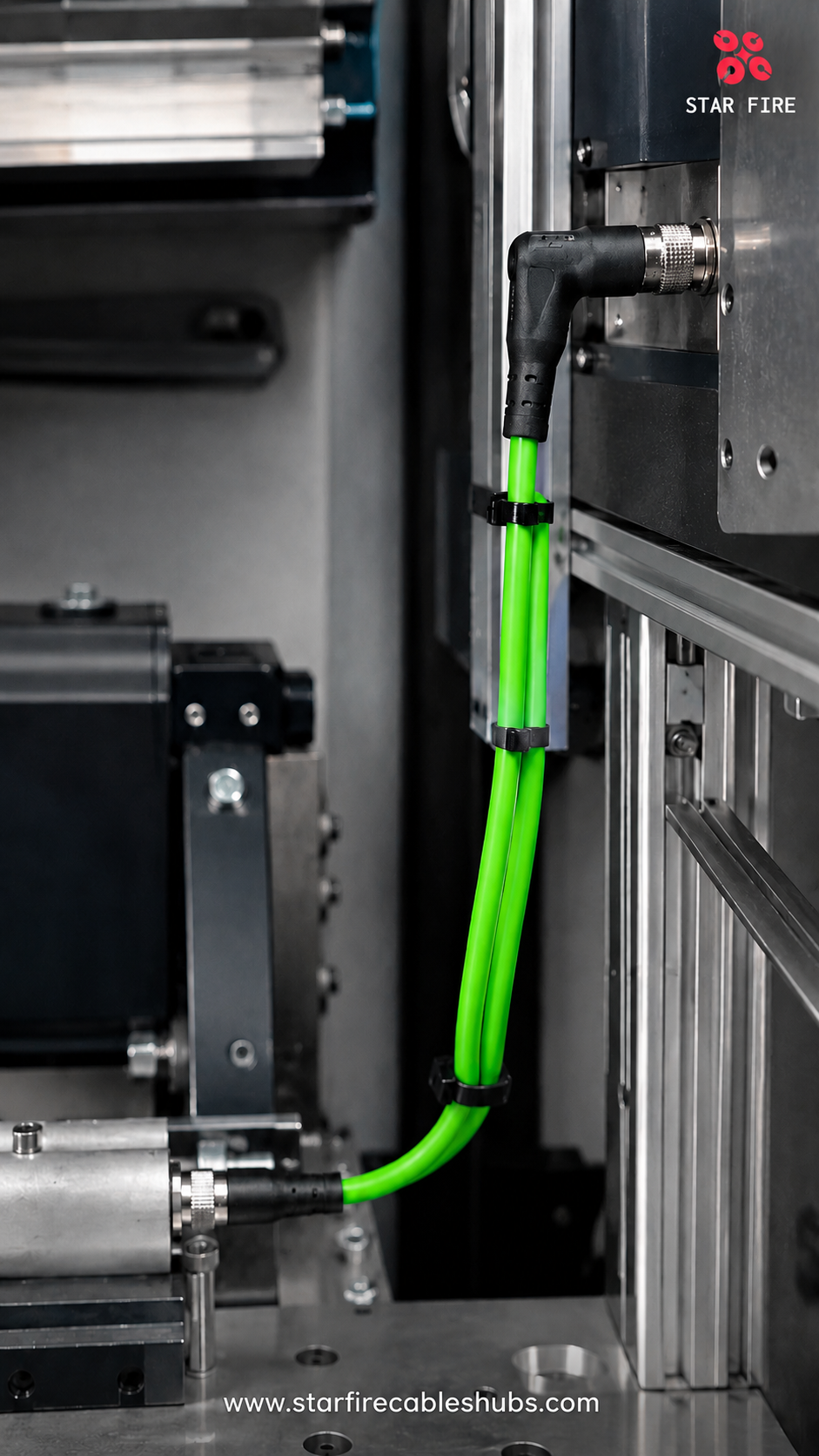
A stationary Cat 6A cable in a protected cabinet has very different requirements from a cable on a robot arm, drag chain, gantry, industrial camera, or mobile machine.
Before selecting D-Code or X-Code, engineers should also define:
- Fixed or continuous-flex installation
- Required flex-cycle life
- Torsional movement
- Minimum dynamic bend radius
- Oil and coolant exposure
- PUR or TPE jacket requirements
- UV and outdoor exposure
- Operating temperature
- IP67 or higher sealing requirements
- Vibration and shock conditions
A 10 Gbps connector does not make a cable high-flex. Likewise, a cable rated for millions of flex cycles is not automatically capable of maintaining 10 Gigabit signal integrity throughout those cycles.
For demanding machine vision and robotics applications, mechanical life and electrical performance should be validated together.
A BETTER SELECTION FRAMEWORK
Instead of asking “D-Code or X-Code?”, I recommend asking five questions.
First: What is the device's actual Ethernet interface today?
If the device is limited to 100 Mbps, D-Code may be all that is required.
Second: What will the network carry in three to five years?
If higher-resolution imaging, edge AI, AV-over-IP, centralized data acquisition, or Gigabit uplinks are part of the roadmap, X-Code may avoid an expensive infrastructure replacement later.
Third: Is this an edge connection or an aggregation connection?
A 100 Mbps sensor does not need a 10 Gigabit connector. A backbone carrying traffic from 20 sensors may.
Fourth: How harsh is the EMC and mechanical environment?
Connector coding should be evaluated together with shielding, cable construction, flex life, grounding, temperature, and ingress protection.
Fifth: Has the complete assembly been validated at the required data rate?
Do not accept “X-coded” as a substitute for transmission testing.
THE BIGGER LESSON: DESIGN THE CHANNEL, NOT THE CONNECTOR
The debate between M12 D-Code and X-Code reflects a larger change in industrial connectivity.
Industrial networks are becoming data networks. Machine vision, edge computing, digital twins, AI inspection, AV-over-IP, intelligent transportation, smart factories, and real-time monitoring are increasing the amount of information moving through environments that were once dominated by low-bandwidth control signals.
That means connectivity decisions must increasingly combine three disciplines: mechanical reliability, environmental protection, and high-speed signal integrity.
D-Code is not obsolete because X-Code is faster. X-Code is not automatically superior because it supports 10 Gigabit Ethernet.
The correct interface is the one that supports the application's data rate, environmental conditions, installed architecture, maintenance strategy, and future bandwidth requirements without unnecessary complexity.
At STAR FIRE TECH, this is how we approach M8/M12 industrial cable development: not as a connector-selection exercise, but as a complete connectivity problem involving cable construction, shielding, flex requirements, environmental resistance, signal performance, and application-specific customization.
For industrial automation manufacturers, machine vision companies, Pro AV integrators, industrial camera developers, control-room solution providers, and network equipment companies, that system-level approach is becoming increasingly important.
The connector may be only a few centimeters long. But if it is the weakest part of the channel, the entire network inherits its limitation.