Table Of Content
Table Of Content
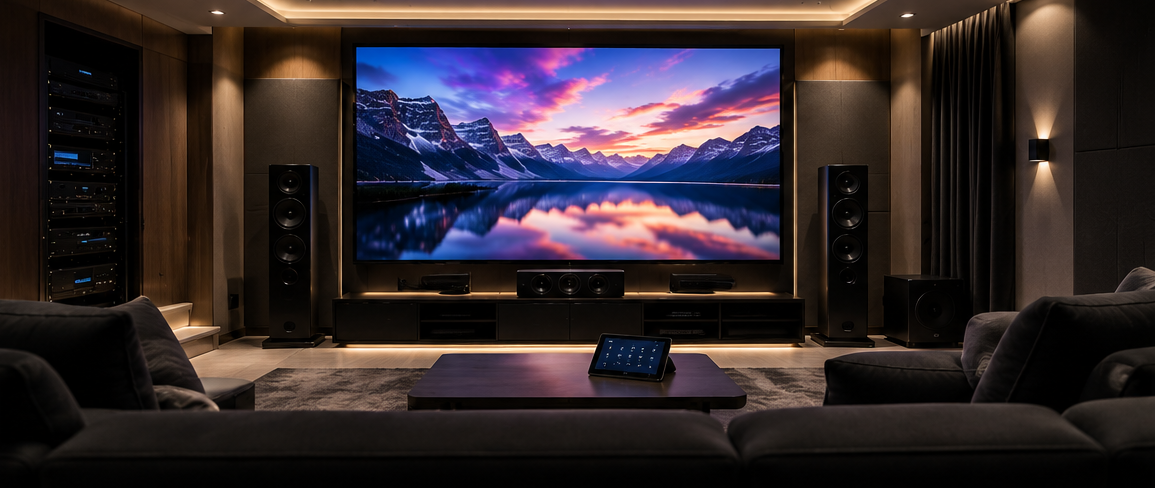
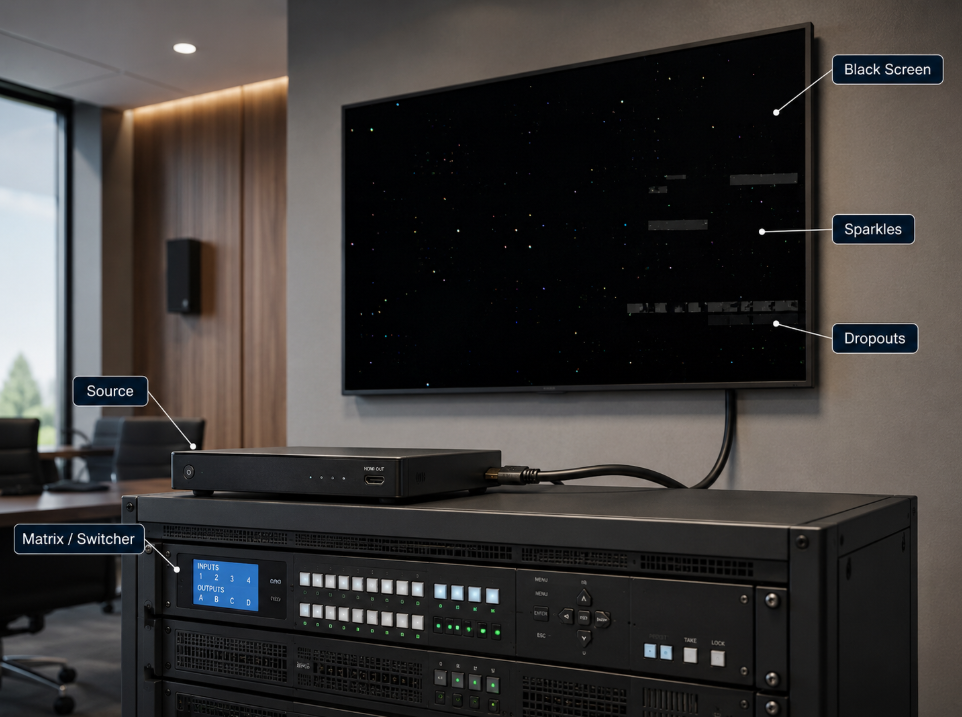
Two HDMI cables can both be marketed for 48Gbps operation, connect the same source and display, and still behave very differently in a professional AV system. One may run 4K120 or 8K60 reliably for months. The other may show intermittent black screens, sparkles, audio dropouts, failed link training, or instability after installation.
That difference is not a contradiction. A bandwidth rating describes a target capability; it does not tell you how much engineering margin the cable has under real-world conditions.
A terminology point is worth making first. In the HDMI ecosystem, the official cable designation for systems operating up to 48Gbps is Ultra High Speed HDMI Cable. The certification program requires compliant cable models and lengths to pass testing at an HDMI Forum Authorized Testing Center, including EMI requirements. In day-to-day Pro AV discussions, however, many people still use the shorthand “HDMI 2.1 cable” or “48Gbps HDMI cable.”
The more useful engineering question is therefore not simply, “Does the label say 48Gbps?” It is: “How much signal margin remains when this cable is installed in the actual system?”
48Gbps Is a System Requirement, Not a Quality Score
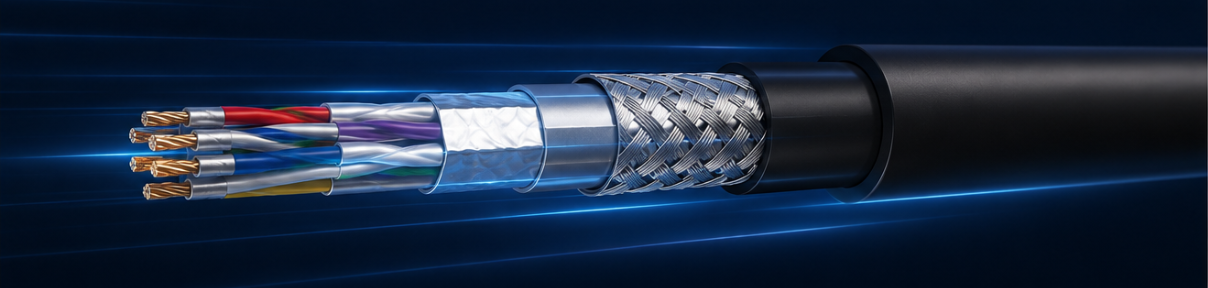
At high data rates, HDMI performance becomes increasingly dependent on the quality of the complete transmission path. Conductor geometry, impedance consistency, connector transitions, shielding, insertion loss, return loss, crosstalk, jitter, active electronics and assembly quality all influence the margin available to the receiver.
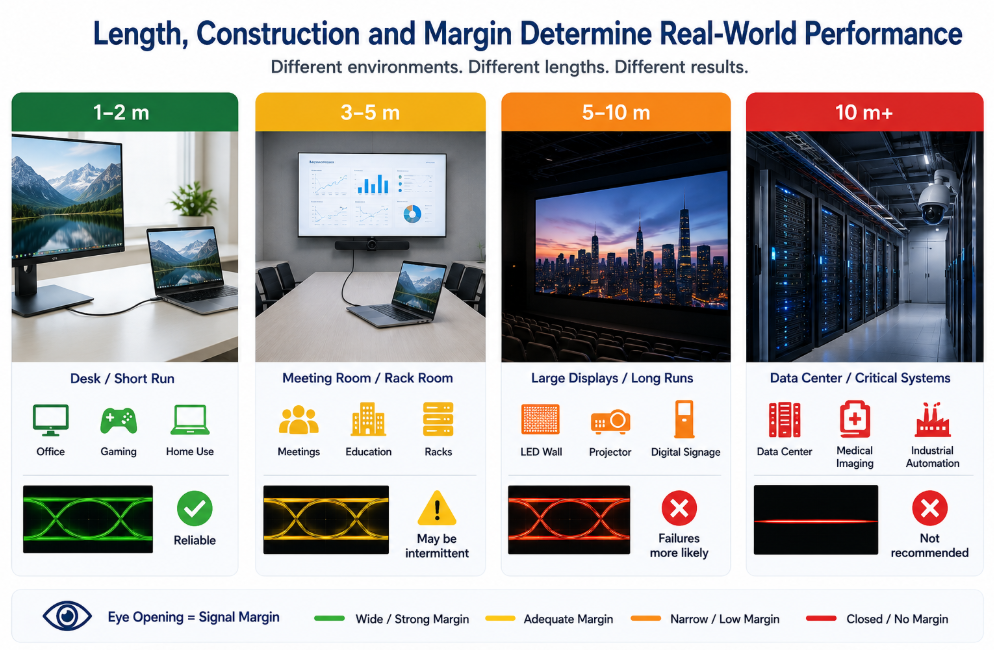
Two cables can meet the same nominal application requirement while having different amounts of margin above the pass/fail threshold. In a laboratory, both may work. In a rack, conduit, medical imaging suite, broadcast room or digital-signage installation, the cable with less margin may fail first when temperature, bending, connector wear or electromagnetic noise changes the channel.
This is why experienced Pro AV engineers do not evaluate a high-bandwidth HDMI link only by whether an image appears.
Impedance Consistency Matters More as Data Rate Rises
HDMI is a high-speed differential interface. Small variations in conductor spacing, insulation geometry, twisting, shielding or termination can create impedance discontinuities. Those discontinuities generate reflections, reduce eye opening and consume signal margin.
At lower bandwidths, the receiver may tolerate these imperfections. At 4K120, 8K60 or other high-bandwidth modes, the same cable may be much closer to the electrical limit.
Connector design also matters. The transition from cable to PCB, contact geometry, solder quality and shell construction can all influence high-frequency behavior. A cable is therefore not just “wire plus two plugs.” It is a controlled high-speed channel.
Construction Quality Changes Loss, Crosstalk, and EMI Behavior
Copper purity alone does not determine performance. Gauge, pair balance, shielding architecture, drain construction, jacket pressure, manufacturing consistency and termination quality all matter.
For passive copper HDMI cables, longer distance increases attenuation and makes construction control progressively more important. For active copper or HDMI AOC, the cable adds equalization or electro-optical conversion, so internal component quality, power design and firmware behavior become part of the link.
In professional environments, EMI is another practical differentiator. LED walls, motors, variable-frequency drives, wireless systems, power supplies and dense equipment racks can create conditions that are much harsher than a desktop test bench. HDMI's official Ultra High Speed Cable certification includes EMI requirements for exactly this reason.
FRL Link Training Can Expose Marginal Cables
High-bandwidth HDMI modes introduced with the 48Gbps generation can use Fixed Rate Link, or FRL. The source and sink establish a link using supported lane rates and training behavior before stable video transport begins.
A marginal cable may appear normal at 1080p or a lower-rate 4K format but become unstable when the system requests a higher FRL rate. Symptoms can include a delayed picture, repeated resynchronization, momentary black screens, or a system falling back to a lower format.
This is also why changing one device can suddenly “break” a cable that previously seemed fine. A new graphics card, matrix switcher, display or firmware version may exercise a different operating point or expose less channel margin.
Length Is Not a Minor Detail
HDMI does not define one universal maximum cable length. Performance depends on cable type and construction. More importantly, every length should be treated as its own engineering problem.
A 1-meter cable and a 5-meter cable from the same product family do not have identical electrical characteristics. That is why the official Ultra High Speed HDMI Cable certification process requires each length of each model line to be tested and certified individually.
For Pro AV buyers, this is an important procurement lesson: a successful short sample does not automatically validate a longer production length.
Mechanical Design Can Change Electrical Performance
The cable that passes on a bench still has to survive installation.
Tight bend radii, repeated flexing, crushed jackets, excessive pulling force and poorly supported connectors can disturb pair geometry or stress active components. Heavy connectors can also place mechanical load on recessed display ports or rack equipment.
For HDMI AOC, bend management is even more important because the optical fibers and active heads must be protected. Directionality must also be respected: Source and Display ends are not interchangeable on many active assemblies.
A professional cable should therefore be evaluated as both an electrical and mechanical system.
Certification Reduces Risk, but Engineering Margin Still Matters
Certification is extremely valuable because it verifies that a specific cable model and length has passed defined compliance testing. It also gives integrators a better way to distinguish verified products from unsubstantiated marketing claims.
But certification should not be misunderstood as saying every certified cable is mechanically identical, uses the same materials, or will have exactly the same margin in every installation.
For mission-critical Pro AV, medical imaging, control rooms and broadcast systems, it is still good engineering practice to validate the complete signal chain at the intended resolution, refresh rate, bit depth, chroma format, HDR state and HDCP condition.
What Should Pro AV Buyers Actually Compare?
When two cables both claim 48Gbps capability, look beyond the headline. Ask:
- Is the exact model and length officially certified as an Ultra High Speed HDMI Cable?
- Is the application passive copper, active copper or Hybrid AOC?
- What is the intended resolution, refresh rate, bit depth and chroma format?
- Has the cable been tested under bending, temperature and repeated plug/unplug conditions?
- How is EMI controlled?
- For AOC, what active components and optical architecture are used?
- Is the production process controlled consistently from lot to lot?
- Can the supplier provide engineering support when a source/display combination behaves differently in the field?
These questions move procurement from “buying a bandwidth number” to managing system reliability.
The Pro AV Perspective: Margin Is the Real Product
After years of working with professional connectivity, one principle becomes increasingly clear: the visible specification is only the starting point. What the customer is really buying is margin.
Margin is what allows the link to survive a longer run, a hotter rack, a tighter bend, a slightly weaker transmitter, a more sensitive receiver, an added matrix switcher, or years of connector wear.
That is especially important as Pro AV moves toward higher resolutions, higher refresh rates, HDR, AV over IP, medical visualization and other applications where the cost of an intermittent signal is far greater than the cost of the cable itself.
At STAR FIRE TECH, our work across professional AV, optical fiber communication and industrial connectivity has reinforced this approach. Whether the application uses premium copper HDMI or long-distance Hybrid AOC, the engineering target should not be “it works once.” It should be stable signal integrity with enough margin for the real installation.
The best HDMI cable is not the one with the biggest bandwidth number printed on the package. It is the one that keeps the system stable when the installation stops behaving like a laboratory.